

Subscribe To The Newsletter Now

Subscribe To The HoopTactics Newsletter

Recently @ HoopTactics


Inside HoopTactics

Basketball Tips & Strategies – April

Coaching Tips: Setting Goals is a Key to Success

After a long season, coaches need to take some time off to recuperate and re‐charge their batteries. However, before doing so, while it is fresh in your mind, review, analyze and evaluate the past season. Examine exactly what was accomplished, what was successful, and what needs to be improved in the coming year. Then use this information to set goals and objectives for the coming season. Caution: setting goals, like potential energy, is useless until action is taken to implement and achieve them.

In addition, basketball coaches, just like any other member of the teaching profession, need to evaluate their own personal performance. Personal evaluations are something that is generally disliked. However, they are vital to the improvement of any coach and basketball program, especially the self‐evaluations. For printable Program Evaluation forms – Click Here

“Flight Time” – The Key to Successful Rebounding

Flight Time is the time it takes for the ball to leave a shooter’s hand until it gets to a position where it can be rebounded. This normally takes 2 to 3 seconds. What players do, or do not do, during this Flight Time period will determine their success or failure in rebounding. Flight Time is when the great players excel. Instead of watching the flight of the ball, much like a great outfielder, they anticipate a missed shot and immediately move to the area where the ball is most likely to rebound and establish inside position. Learn more – Premium Members Click Here

Player Tips: Off Season

From October to April, teams are made. From April to October, individual players are made. This is the time of the year that you must develop and improve your basketball skills and techniques along with your physical attributes. However, to be successful, you must first take the time to do a self‐evaluation. Compile a list of the things you did well this past season, and the things you must or could improve. Things that you can do to make yourself a more solid, stronger, aggressive and intelligent player when you take the court this coming season. Ask your coaches for their input and specific recommendations for off season improvement. Then use this self‐evaluation to plan your off season workouts and skill development.

Basketball is like a bank. What you put into it, is exactly what you will get out of it. Prepare for the best. Bad habits can be practiced as well as good. Work individually on precise footwork, keeping your hands up, and the things you need to improve, not just your strengths. Do it yourself. You do not need to depend on coaches, parents or personal trainers. Individual improvement is not all fun and games. Much of off season skill development is repetitive, monotonous and tedious. However, remember: “If it’s going to be. . . It’s up to me.” – George Raveling.

Organize and play a lot of three on three half court competition. Since three on three provides for much more shooting, passing, rebounding, screening, and defensive repetitions, it is by far, the most efficient use of your time in practicing and improving your fundamental skills. In addition, after a long, hard season, it also saves additional wear and tear of your legs. Playing full court only reinforces current abilities.

Basketball Tips & Strategies – March

Quick Tip: Winning Close Games

Box Out! The vast majority of games that are decided by last shots are won on put backs ‐‐ NOT the shots.

Coaching Tips: Defending Baseline Out of Bounds Situations

Defending Baseline Out of Bounds

Coaches spend considerable amounts of practice time working on offensive baseline out of bounds plays, but spend little or no time on ways to defend them. As a result, too many easy baskets are given up during the course of the game on out of bounds plays simply because teams are not prepared to stop them.

If you analyze “Out of Bound” situations, they are unique in that it is the only time during the game of basketball where the defense actually has an advantage. Because of this numerical player advantage (5 on 4), it can be difficult for the offensive team to inbound the ball, and, as a result, numerous NCAA and NBA championships have been lost because teams were not able to make successful inbound passes in the final seconds of game. This is why many coaches like to avoid taking time outs at the end of the game.

Most coaches take it for granted that their basic half court defense applies to baseline out of bounds situations. However, this is not the case. Defending the ball when it is located out of bounds behind the defense is entirely different matter than defending the ball when it is out in front of the defense. In addition, in regular half court set offenses, defenders are mostly guarding shooters moving off screens away from the basket. On baseline out of bounds, the shooters are going directly to the basket. As a result, there is no room for error. If the defense makes an error on an out of bounds play it results in an easy basket.

Some teams will automatically zone on out of bound situations. However, zones are faced with the same problem of having to make adjustments to defend the ball being taken out on the baseline behind the basket rather than out front. In addition, zones are very susceptible to screen and roll action along with overloads, which happens to be the main staple of out of bounds plays. Learn More

Coaching Tips: Managing Timeouts Wisely

To get maximum benefit, whenever a timeout is called, players should run to the bench, especially in the case of a 20 or 30 second timeout. Note: if a player is so tired they cannot run to the bench, they should be replaced immediately. Full timeouts should be divided into two parts with the first 30 seconds being players’ time for water, towels, etc. For the last 30 seconds of a timeout all attention goes entirely to coach. Be sure to get eye contact and every player is listening before speaking. Also, make sure only one coach is speaking at time. Too many voices during a time out can be very distracting and detrimental. During timeouts, it is common place to observe four different coaches talking to different players at the same.

Since players remember very little of what is said during a timeout, keep adjustments and changes simple. One to three things at the most. In addition, do not expect them to successfully execute anything new that you have not worked on in practice. Substitutes must also be alert and pay attention to the changes and adjustments being made.

On every timeout, be sure an assistant coach double check with the official scorer on the exact number of personal fouls on each player and time outs remaining. Official scorers are known to make mistakes in crediting personal fouls to the wrong player. However, if caught early it can be corrected. However, if a player foul discrepancy is discovered late in the game, there is nothing much that can be done to correct it.

Coming out of time out, make sure every player must knows the number of time outs remaining and team foul situation. This is extremely important at the end of a close game. Games and national titles have been lost by players taking a timeout after a team has used their last timeout and not taking advantage of having fouls to give.

Basketball Tips & Strategies – February

Quick Tip: Intentional Missed Free Throw

Chances are good during the season that an end of game situation will be encountered that requires the intentionally missing of a free throw; therefore, teams must be prepared for it. Intentional missing a free throw must be taught and practiced. Players must know and recognize their assignments are on a “intentionally” missed free throw situation. Shooters must not only practice the intentional miss, they also need to be aware of the rule that the ball must hit the rim.

Coaching Tips: Protecting a Valuable Lead

Scoreboard

When ahead late in the game the clock becomes your ally; however, you must use it wisely. Keep it running and do not stop it (unless in very serious trouble). Coaches may elect to spread the court on offense to take time off the clock and cut down on the number of opponent’s offensive possessions. However, if you do so, be sure to continue to make basket cuts and attack the basket. Holding the ball for the sake of trying to run time off the clock will allow the defense to get more aggressive and disruptive. You must attack the basket. Learn more about highly successful and proven spread court offenses – Click Here

End of Game: Fouling & Clock Management

Fouling plays a critical part in the out come of the game, especially when it comes playoff time. Fouls were added to the basketball rule book to penalize; however, intelligent players and teams can use fouls to their advantage. However, when it comes to fouling to gain a competitive edge do not assume that players know how and who to foul at the end of the game. If you just tell a player to go foul, they are most likely to grab or hammer an opponent, and pick up an intentional foul.

  • Players need to be know how, when and who to foul.
  • Players need to be taught the technique of going for the quick steal or trap, and when unsuccessful, to foul immediately.
  • Players must practice this art of fouling and clock management

Learn more about fouling and clock management – Click Here 

Player Tips: Avoiding Foul Trouble

Fouling plays a critical part in the out come of the game, especially when it comes playoff time. Fouls were added to the basketball rule book to penalize; however, intelligent players and teams use fouls to their advantage. When it comes to fouling to gain a competitive edge there is no margin for error. The difference between fouls being your ally or your enemy rests on a single foul. If you analyze fouling, you will quickly see that every time you step onto the court you can count on receiving three basic fouls:

Foul #1 ‐ You will receive at least one bad call during the game.

Foul #2 ‐ At least one charge/block judgment call will go against you.

Foul #3 ‐ You will use at least one foul for strategy reasons.

Therefore, if you commit just one careless or lazy foul you are in foul trouble (Foul #4). You may commit a careless foul early in the game and think it is only your first foul. However, since the other three basic fouls are definitely coming it immediately puts you in foul trouble. Once you are in foul trouble you be come a defensive liability especially in the low post area. In the low post area, you will be forced to play behind your opponent with your hands up like a “prisoner” and only hope that your opponent does not score. If your opponent is smart they will take “no prisoners” and attack you at every opportunity. To learn more about avoiding fouls – Premium Members Click Here

Basketball Tips & Strategies – December

Looking for a Gift for the basketball enthusiast on your list?

How about giving them a HoopTactics’ Premium Membership? A perfect gift that will last for entire year and then some. Click Here

Premium Membership  What’s New

Offensive Strategies: Hawk Set Offense

Defensive Strategies: Seven Effective Ways to Attack On-Ball Screens, Low Post Disruptions

Player Development: Loose Ball Recovery

Coaching Tips: Vital Importance of 6th Player Role

Quick Tip: Teaching – The Key to Satisfaction and Success

Unfortunately, along with this increased importance being placed on winning, there has been a significant slippage in coaches’ teaching skills and abilities.  However, winning is short term. The real success in coaching comes with teaching and assisting players to become the best they are capable of becoming “on” and “off” the court.

Coaching Tips: Sixth Person Role

The importance of the sixth person(s) role in basketball cannot be over emphasized. It is one thing all excellent teams have in common. Establishing and utilizing the sixth person role in many ways is a much more important coach’s decision than determining the starters. To be successful, the sixth person(s) must possess better skills and leadership than some of the starters. In addition, the sixth person usually can play multiple positions. Without exception, when they enter the game, their role is to energize and make the team stronger. As a result, if the game is tied, it will provide the necessary boost to give the team the lead. If a team is already ahead, it will increase the lead, and if the team should be behind, it will afford them a chance to catch up.

In most cases the sixth person role is filled by a single player. However, it can be multiple players and on rare occasions even five players. Determining and getting a player to accept the sixth person role can be a challenge since player’s and parents’ ego’s can be involved. However, by communicating the vital importance of this unselfish team role, they should be more than likely to understand and accept the role as a real honor rather than a demotion.

Featured Play: Hawk Set Offense

Hawk Set Offense

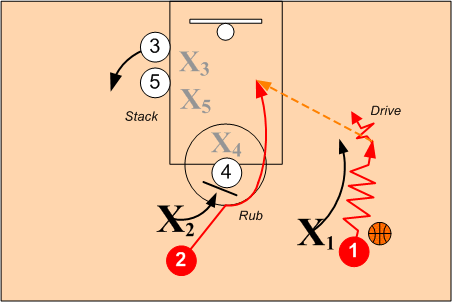
The Hawk Offense is a relative of the “UCLA” offense and a derivative of the shuffle offense. Introduced into the NBA by Hubie Brown when he was coaching in Atlanta, thus its name, it has proven to be a very successful offense on all levels of the game. Although the Hawk Offense is primarily designed to take advantage of a size mismatch at the off guard position, it also includes wing isolations and strong post ups options. Learn More – Premium Members Click Here

Defensive Tips: Attacking On-Ball Screens

Seven effective ways to attack On-Ball screens include: Prevention, Show & Recover, Switching, Trapping, Trapping Early, Jamming and Shadow (zone). Fortunately, players will not be expected to execute all the different ways to disrupt On Ball screens during a game. In fact, normally only one or two of the options will be deployed during a single game based on the opponent’s ballhandler and screener specific strengths and weaknesses. However, these options are subject to change during the course of a game. Therefore, to be successful in attacking and disrupting On-Ball screens, they must be constantly analyzed during the game as to why and how they are being set. Once analyzed, the defense can take the initiative, and readily attack it. Learn More – Premium Members Click Here

Player Tips: Loose Ball Recovery

Loose Ball Recovery

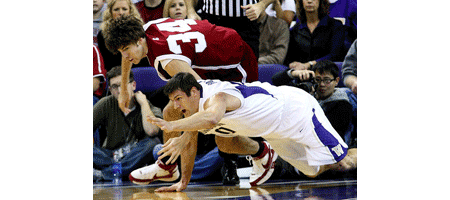
Coaches love to see players go to the floor for loose balls. However, like taking an offensive charge, players must be taught how properly dive for loose balls without sacrificing their bodies or risk of injury. Diving for the ball should be graceful and the body should land softly like a gymnast. Loose ball dives can be tricky. For this reason players should have a working knowledge of the correct techniques and plenty of practice repetitions before diving for a loose ball during a game.

In diving for loose balls, players should first lower their center of gravity close to the floor by bending their knees. Then push forward extending arms and legs straight out parallel to the floor and landing on their hip flexors. Players should never fall on the knees. Falling on a knee is a good way to end up with a torn ACL or a worse injury. Whenever possible, seek the assistance of a volleyball coach when teaching players to dive for loose balls. Once players learn how to properly dive for loose balls, the more apt they are to go after loose balls during a game without hesitation. To learn more – Premium Members Click Here

“Hoop-y” Holidays