Subscribe To The Newsletter Now

Subscribe To The HoopTactics Newsletter

Recently @ HoopTactics


Inside HoopTactics

Basketball Strategies – August 2011


HoopTactics: Bigger, Smarter, Better

The world’s most in-depth look into proven basketball strategies is now even better. You’ll find many more strategies than ever before, improved presentations, and easier navigation. Whether you are looking for new ideas or just looking to refresh your memory, you will not find a better basketball resource. Guaranteed.

Coaching Tips: The Real Satisfaction of Coaching

In recent years, winning has become the primary focus in sports. Coaches and programs are being evaluated by the number of games won rather than their program model and teaching abilities. Constant full court games and tournaments, especially on the lower levels, have replaced teaching and skill development. However, winning is short term. The real success and satisfaction in coaching comes with teaching and assisting ALL of your players to become the best they are capable of becoming “ON” and “OFF” the court. Have fun and enjoy this great game!
Coaching Prerequisites – Free Area – Click Here  Premium Members – Click Here

Defensive Strategies: Transition Defense

Do you incorporate defensive transition in your practices or do you just give it lip service and just remind them not to run back on defense with their backs to the ball after they have been burnt by an over the top pass and easy lay up? When teams walk the ball up the court, they are much easier to defend because the defense is able to get its players back into positions near the basket where they can execute pressure denials and traps. However, when teams continuously push the ball up the court and flow into early offense, it can prevent or hinder the best of pre-planned defensive disruption scenarios by forcing the defense to “react” rather than “act or attack.”

Off season and pick-up games create bad defensive transition habits. In these unorganized games, players have a tendency to hang back on offense (“Cherry Pick”) rather than hustle back on defense. As a result, during the season, coaches have their work cut out in establishing good defensive transition habits. Good transition defense really starts with good offense. When players take good care of the ball and take good shots along with strong offensive rebounding and defensive balance, it makes it difficult for the opponent to push the ball. However, do not do not leave defensive transition up to chance. Learn more about transition defense:
Free Area – Click Here  Premium Members – Click Here

Player Tips: Ten Sure Ways to Improve Your Shooting


Shooter

Players have a tendency to work hard on their shooting form and offensive moves. However, there is more to shooting than proper mechanics. HoopTactics shows you 10 sure ways to ehance your shooting abilities:

Free Area – Click Here  Premium Members – Click Here

 FREE Printable Court Diagrams


College/HS, NBA, International court formats. Choose from 36 different styles: Full court (12), half courts (18) and combinations (6 ). Click Here


Basketball Strategies – June 2011

HoopTactics Newsletter

Off the Court Season Preparation
Player Safety: Sudden Cardio Deaths
“Anyone can save a life” Automated Response System
Printable Court Diagrams: USA, NBA & FIBA (New) Formats

 Coaching Strategies: Medical Emergency Preparation

Are you prepared for a player emergency? Is your First Aid and CPR training up to date? If not, now during the off season, is a great time to become current. Training and certification does not take much time and the benefits are priceless. CPR (cardiopulmonary resuscitation) training is just not a simple matter of meeting a coaching certification requirement. It is a matter of obtaining the knowledge and capability to save the life of one of your players. Coaches should not step on the floor without it.

Player safety is an awesome responsibility and liability that is inherited with basketball coaching. Therefore, all coaches, including assistants and volunteers on every level of the game must be first aid trained and prepared in the event of a player emergency. Washington State University women’s head basketball coach, June Daugherty, who not only had one of her players survive a cardiac arrest (stoppage of the heart), but also survived a cardiac arrest herself, has reminded HoopTactics just how important it is for not only coaches, but also all players as well, to be trained in CPR (cardiopulmonary resuscitation). It was a teammate that administered CPR that saved the life of her former player!

Sudden Cardio Death

Sudden Cardio Death is the number one cause of death among athletes. Last season a Michigan High School player received national media attention when he died after making a game winning shot. This did not only sent shock waves throughout the basketball world, but brought out the concerns of the hidden health dangers faced by young athletes and the importance of coaches being prepared for on the court life threatening emergencies.

In that same week, four other basketball related sudden cardio deaths occurred. In the United States over a 100 sudden cardio deaths occur annually among middle school, high school and college athletes with basketball having the highest risk. That is one every three days. The risk of sudden cardiac death among NCAA Division I male players is 1 in 3,000. The most common cause of sudden cardio related deaths among young athletes is hypertrophic cardiomyopathy a thickening of the heart muscle. This abnormal growth which goes undetected in most cases, can cause cardiac arrest during exertion particularly in young African-American players where the risk is 3X greater than Caucasian players. The risk of sudden cardio death is also 3X greater in males than females.

Sudden Cardio Death Survival

The good news is, if CPR is started and defibrillation applied within the first few minutes of sudden cardio death, the chances of survival are great. Automatic External Defibrillator (AED’s) are now required by law in public malls, airports, and casinos. However, 30 states still do not require them in schools. Fortunately, administrators, foundations and communities are realizing the real need for AED’s and providing a growing number of schools with AED’s. Make sure your school or venue has one available. Proper use of an Automatic External Defibrillator (AED) is relatively simple matter and only takes a few minutes to learn. AED’s are practically “dummy” proof. They will only automatically fire (shock) if it is warranted. Note: Coaches’ accessibility after school hours can be a problem that needs to be address.

Screening & Prevention

Since athletic training and competition increases the risk of sudden cardiac death in players with underlying heart disease, the American Heart Association, highly recommends that student/athletes be screened with a careful history, including family history and through physical examination including EKG’s and Echocardiograms. However, testing and screening will not detect all causes of sudden cardio death. Currently, 80% occur with no warning or previous symptoms including family history. Therefore, all coaches must be prepared. This means not only being CPR trained, but also having a plan of action in place.

Minnesota’s “Anyone can save a life” Response Model

Note: This emergency response model is applicable to all basketball programs on all levels, youth through professional, not just high schools. If you are conducting a basketball program on any level, it is your responsibility to have an automated response system in place in the event of an emergency.

Minnesota State High School League found that 60% percent of their schools had no plan in place for after school hours emergencies. This resulted in organizing an unique program that focused on putting an automatic external defibrillator (AED) in every high school in the state, and to develop an organized plan to respond to sudden cardiac emergencies. The program named “Anyone Can Save a Life,” empowers coaches to organize their teams into action in the event of an emergency. It requires coaches to spend 10 minutes at the beginning of each team’s season asking questions of his/her team as to how many have been trained in CPR and would they be willing to assist in the event of an emergency if needed? From this dialog, players are then assigned emergency roles. This creates an automatic response system which allows the coach to remain with the victim without having to give direction.

Automated Response System:

1. At least two players are assigned to call 911.
2. At least two players are assigned to run to the athletic trainer’s office.
3. Two players are assigned to know where the nearest AED device is and to go retrieve it.
4. Other players are assigned to go to a pre-determined location to meet the medics or an ambulance.

After those assignments have been made, the coach fills out a worksheet, which is kept on record in the school’s athletic office. Each team is required to review the assignments periodically during the season. While this may seem like just one more thing to add to a coach’s workload, most coaches understand the importance of having a plan and a course of action in place. The chances of a positive and successful outcome in the event of an emergency, far outweighs the added responsibility of a coach of having one more thing to do.

CAUTION: When undertaking First Aid and CPR training, do not vision yourself of saving a complete stranger’s life and receiving a medal. The life you are going to save is going to be someone close and dear to you (a parent, spouse, child, best friend, one of  your players, etc.)!

Online Resources:

Save a Life: View Learn Hands-Only CPR Demo Video (1:10 minutes) Click Here

Learn/Review CPR Online – Free public service supported by the University of Washington School of Medicine – Click Here

American Red Cross First Aid-CPR-AED Classes Click Here

For more information on Basketball Player Injuries and Safety:  Free Area – Click Here  Premium Members – Click Here


Basketball Court DiagramsFree printable court diagrams (USA, NBA and FIBA formats). Click Here

Basketball Stratagies – May 2011


HoopTactics Newsletter

Improving  Player Motor Skill Learning
Playing Smart
Brain Boosting Benefits of Cardio Exercise
Importance of Practicing at  Game Speed

 Player Development: Improving Player Motor Skill Learning

Are you aware that HoopTactics.com is an excellent way to supplement and reinforce your on the court instruction? Motor skill learning is vastly improved when mental learning takes place between practice sessions. This is where the Player Development section of HoopTactics.com can become a real tutor and help.

Players on all levels will greatly improve their game, and gain a competitive advantage by using HoopTactics to go way beyond just the hows, and learn the whens & whys of various basketball skills and techniques. HoopTactics will make for a more solid, aggressive and intelligent player, and in the process, increase their self-confidence and playing success every time you take the court. If players want to compete on the highest levels of the game, HoopTactics is definitely for them.

 Special Student/Athlete memberships are available for only $19.95. Have your serious minded players signup for Student/Athlete membership now. Click Here

Player Development: Playing Smart

Note: This might be a little too technical in some cases. However, it is the premise that is important.

Was your team in better shape than any team you played last season? Did you win a couple of games each year just on physical conditioning?

There may be much more to being in shape than just gaining a physical advantage.  Breaking a sweat on a regular basis can get your players into amazing shape, but new research has shown it can make them smarter too. Physical workouts will not only increase their muscular, respiratory and cardiovascular capabilities, it will also improve their smarts and productivity. Even a 30 minute workout pumps extra blood to the brain, delivering vital oxygen and nutrients it requires to perform at maximum efficiency. Cardiovascular workouts provide the brain with chemicals that enhance functions such as memory, problem solving and decision making. All which are critical to a successful basketball performance.

Working Out the Brain at the Same Time as Your Heart

According to clinical psychologist and memory researcher, Thomas Crook, PH. D, “cardiovascular health is more important than any other single factor in preserving and improving learning and memory. During exercise, all that extra blood bathes your brain cells with oxygen and glucose which they need to function. The more oxygen the brain gets, the better it performs.”

Brain Boosting Benefits of Cardio Exercise

Muscles also send hormones to your brain. These hormones mix with a chemical, called brain-derived neurotrophoic factor or BDNF, which plays a role in brain cell growth, mood regulation and learning. John, Rately, associate clinical professor of psychiatry at Harvard Medical School, says, “BDNF is like fertilizer for the brain. Without it, our brains can’t take in new information or make new cells.” He goes on to state that exercise has another vital role in signaling the release of several key hormones that not only affects learning and attention, but also influences attention, perception and motivation. By elevating these hormones in the brain, it helps keeps us in focus, feeling better and releases tension.”

Importance of Practicing at Game Speed

Intensity of the workout does make a difference. A study in Neurobiolgy of Learning and Memory has found that people learned vocabulary words 20% faster after intense exercise than after low-intense exercising. Those who under take a more demanding exercise, experienced higher levels of BDNF, dopamine and epinephrine in their brains afterwards. Therefore, the more you challenge your body physically, the more the brain benefits. By being in great physical shape, it will not only allow your players to play harder and faster for longer periods of time, but will also enable them to think quicker and make better decisions.

Premium members learn more about motor skill learning. Click Here

Offensive Strategies: Early Transition
Numbered Break

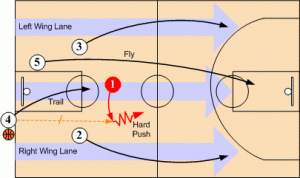
The key to a successful early push is a team’s ability to make the transition to offense and bust out faster than the opponent can make a defensive transition and get back. If executed to perfection early push usually ends up with an easy shot off an out numbered situation. However, gaining an out numbered player advantage is not the only benefit from an early push. Easy baskets and/or defensive fouls are also a result of the defensive players not having enough time to set up, and often end up out of position unable to make a play. Easy baskets and defensive fouls off player mismatches are another benefit to the early push, since the defensive players do not have ample amount of time to assume their desired matchups.

Learn more. Free Area Users Click Here. Premium members Click Here

Free Basketball Court Diagrams

Free printable court diagrams (USA, NBA and FIBA formats). Click Here 
Basketball Strategies – March 2011

HoopTactics Newsletter

Taking Full Advantage of the Final Four Tournaments
End of Game Situation – To Foul or Not To Foul?
Out of Bounds Plays – Automatics

NCAA Final Four Tournaments: Learn Rather Than Watch

While enjoying the final four basketball tournament become more than just an interested spectator. Since teams are fairly evenly matched, the NCAA tournaments offer a great opportunity to observe and learn about end of game strategies. What works and what doesn’t. To do this you cannot watch the ball. Instead, focus on what is taking place away from the ball both offensively and defensively. Take notes on actions and plays from which you can benefit, do not rely on memory. Be sure to analyze and evaluate carefully since what is successful on the NCAA level may not be appropriate for you level or player personnel.

Coaching Scenario: +3 points with less than 5 seconds remaining and opponent has ball possession.

In this situation, should you foul and send your opponent to the free throw line risking a successful putback off an intentionally missed free throw or should you risk the opponent making a three point field goal?

The percentages are heavy in favor of fouling. However, do not foul a shooter. The vast majority of teams do not practice missing free throws and putbacks off the miss. If fact, not all players know the rules that the ball must hit the rim or that the shooter cannot cross the free throw line until the ball strikes the rim even on the college or professional levels.  However, be aware that this fouling strategy can backfire if you allow an offensive rebound and putback shot off the ensuing intentional missed free throw.

All defenders must be determined to box out and if they cannot secure possession, they must tip the ball away from the opponents keeping it in play. Fortunately, since teams do not practiced missing a free throw, most shooters will short arm the shot and try to bang it hard of the front edge of the rim. However, this usually results in the ball bouncing straight down or on a low trajectory in favor of the defensive rebounders. To be successful, an intentional miss should be missed to the right or left side of the rim.

Offensive Situations: Automatic Reads Are The First Option On All Out of Bound Plays.

Some coaches just like to get ball inbounds and then set up a play, while other coaches find it a great opportunity to attack; and, since most teams are poorly prepared to defend out of bounds situations, they deploy several inbounds plays during a game. However, no matter what philosophy is utilized, automatic reads are the first option on any out of bound play.

1. Players should cut to basket for lay-up any time their defender plays with their back towards them watching the basketball.

2. When the inbounder is left unguarded, they should execute a quick “give & go” with the inbounder making a quick inbounds pass and cutting to the basket for a return pass.

3. If a defender faces up and plays with their back to the inbounds passer, players should have the “Green” light to execute a lob pass over the defender for shot.

4. If the inbounds passer’s defender plays with their back to the ball, the inbound passer can simply pass the ball off the defender’s back, step in bounds, pick it up and score.

Note: On automatics, players should communicate using eye contact and body language.

Proven out of bounds plays & guidelines. Learn more – Click Here 
HoopTactics Premium Members – Click Here