

Subscribe To The Newsletter Now

Subscribe To The HoopTactics Newsletter

Recently @ HoopTactics


Inside HoopTactics

Basketball Strategies – February 2011

HoopTactics Newsletter

Losing Close Games & Championships
Nightmares to Avoid
Premium Members Learn More

Losing Close Games & Championships

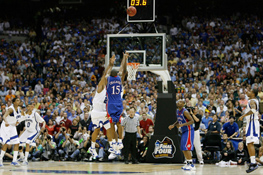
To win a major championship, you probably will have to win a least two games at the buzzer!

15 Nightmares to Avoid That Will Upset Your Championship Dreams and Haunt You the Rest of Your Life.

Failing to prepare is preparing to fail.” — Coach John Wooden

Not protecting a hard earned lead

 When ahead late in the game the game clock becomes your ally. However, you must use it wisely. Keep it running and do not stop it (unless in very serious trouble). Coaches may elect to spread the court on offense to take time off the clock and cut down on the number of opponent’s offensive possessions. However, in doing so, be sure to continue to make basket cuts and attack the basket. Holding the ball for the sake of trying to run time off the clock will allow the defense to get more aggressive and disruptive. You must attack the basket. If the opponent tries to trap or double team, assume a 2-1-2 alignment and move the ball.

Watching the ball and not boxing out on a last shot

On last shot situations, more games are won on putbacks than on made shots. Therefore, on last shot situations, it is imperative that all defenders aggressively box out and prevent any offensive rebound instead of watching the flight of the ball to see if it is going to be made or not.

Giving up an offensive rebound on a missed free throw

Defensively, teams should work hard to never give up an offensive rebound off a missed free throw situation during a game. Many of championships are lost because of a failure to box out on free throws. Players should be well drilled in boxing out on all free throw situations. Players must also communicate to make sure that the shooter is boxed out. Pinch or double team against a really good offensive rebounder. Be determined to rebound the ball.

Allowing precious time to run off the clock before fouling

Hopefully, you are well prepared and in control of the game so that you will not need to resort to clock management. However, if you ever fall behind late in the game don’t give up! By using time outs and fouls, the last few minutes of a game can be an eternity. At this point in the game, the clock is your worst enemy, not the opponents, so every second counts. Therefore, do not let precious time run off the clock before fouling. If you need to foul, foul right away.

Not substituting for key players in must foul situations

When fouling to the stop the clock at the end of the game, during a timeout or free throw or defensive out of bounds situation, substitute players into the game that can afford to foul instead of losing their best players because of disqualification. Also, key players in foul trouble are reluctant to foul, allowing precious time to run off the game clock.  Once a foul has been committed, stopping the clock, players in foul trouble can be reinserted back into the game.

Not teaching and practicing how to foul
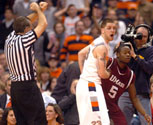
Most coaches assume players know how to foul. However, in reality, when a coach tell the players to foul, they will simply go out and just push or grab an opponent resulting in an intentional foul. Since the opponent gets to shoot free throws and retains ball possession, this is disastrous.

CAUTION: There is no room in the game of basketball for hard fouls (even in the NBA) especially on lay ups when shooters are most vulnerable to injury. Play hard but play fair. Basketball carries more than enough injury risk without a player intentionally or unintentionally injuring another player when fouling.

Fouling a shooter

Eliminate the three point play. Giving up a three point play by fouling a player in the act of shooting is a RBP (Really Big Play). Instead of fouling a shooter and giving up a three point play, it is better to just concede the shot and let them score. All you have to do is to score on the next possession to “erase” or cancel it. However, if you foul the shooter and give up a three point play, you will then have to not only score on your next possession, but also come up with a defensive stop and score a second time to erase or cancel it.

Not saving timeouts

Save your timeouts. You will need at least two at the end of a closely fought game. Force the opponent to use their time outs especially early in the game. Early in the game, use substitutes to make changes and adjustments rather than taking a valuable time out. Play through adversity. Do not ever call a timeout in reaction or frustration to bad call or play. It will only waste one of your valuable time outs! Having time outs at the end of the game will definitely increase your chances of winning.

Not knowing the time out situation

Coming out of time outs, make sure every player must knows the number of time outs remaining along with the team foul situation. This is extremely important at the end of a close game. Games and national titles have been lost by players taking a timeout after a team has used their last timeout.

Not knowing and taking advantage of the team foul situation

All too often games are lost on last second shots because a players are unaware that they had a foul(s) to give. After timeouts all players should be aware of the team foul situation and if they have any fouls to give. Keeping an opponent out of the bonus free throw situation is a real advantage.

Not avoiding the opponent’s intentional foul

Do not allow the opponent to foul in order to stop the clock. Move the ball and run as much precious time off the clock as possible  before the opponent can foul. Also, be sure to have your best free throw shooters in the game.

Not prepared for intentionally missing a free throw

Chances are good that an end of game situation will be encountered that requires intentionally missing of a free throw. Therefore, teams must be prepared for it. Intentionally missing a free throw must be taught and practiced. Players must recognize and know what their assignments are on an “intentionally” missed free throw situation. Shooters must not only practice the intentional miss, they also need to be aware of the rule that the ball must hit the rim on the attempt.

Not prepared for last shot situations

End of game situations really become paramount when a single shot can make the difference of winning and losing along with determining a team’s playoff hopes and fate. Therefore, to be successful, teams must be prepare for last shot situations. A last shot situation is not just a simple matter of drawing up a play. There are numerous last shot situations to address dependent on court location and time on the clock. Be sure to get the ball into the hands of your best player, and let them hit the open shot or pass to an open teammate. Keep the play simple and execute. The more complex the action, the greater chance that a breakdown will occur.

CAUTION: Don’t ever expect players to execute anything they have not practiced. The chances of drawing up a last shot play during a timeout and having it be successful is very minimal.
 

Taking the last shot too soon

Taking the last shot too soon, even if it is made, provides the opponent with an opportunity to tie or win the game. When holding for the last shot in a game, players should be in position with 10 seconds and initate the play with 8 seconds remaining. This will allow enough time to take the shot and go to the offensive boards for a second effort. If the opponent should rebound, they will not have enough time to advanced the ball down the court for a shot.

Failure to inbound the ball

Many championships have been lost because teams were not able to inbound ball at end of game. It is not easy to inbound the ball under pressure. In making an inbounds pass, the passer is facing a five against four defensive advantage and only has five (5) seconds in which to locate a receiver and make a successful inbounds pass. In addition, to this numerical disadvantage, by rule the inbounder cannot move, except after a made shot. This provides the defense with the opportunity to jam or smother the passer very effectively with an active defender on ball. Also, on baseline out of bound situations, the backboard comes into play and becomes a real obstacle which the inbounds passer has to contend. Good inbounds passers are vital, and a team will not win a championship without one.

HoopTactics Premium Members learn much more:

Basketball Strategies – January 2011

HoopTactics Newsletter

HoopTactics  New Version 5.0
Supplementing on Court Training with HoopTactics
The Versitile 1-3-1 Zone Defense
Defensive Recovery After a Tunover

New Version 5.0

Bigger, Cleaner, & Clearer

HoopTactics just got better. The new version 5.0 comprehensive upgrade is now available for viewing. In addition, to all the new additions and enhancements, version 5.0 is staying abreast with technology and is ideal for the new iPads and touch screen tablets! Being able to use your finger to scroll and navigate around the website is definitely luxurious. Enjoy!

Coaching Strategies: Player Homework Assignments

In addition to the HoopTactics website replacing textbooks as the primary reference on the college level for basketball coaching and theory classes, HoopTactics is an ideal supplement for player training and  learning. With on the court practice time being at a premium, with HoopTactics, players can go online to reinforce what is being taught on the court. As a result players, on all levels, will greatly improve and enhance their learning experience and game. 

HoopTactics’ Player Development goes well beyond just the how’s, covering in detail the when’s & why’s of various basketball skills and techniques. HoopTactics will definitely help make more solid, intelligent and aggressive players along with increasing their self-confidence and playing success. A special student premium membership rate of only $19.95 is available for players. For this HoopTactics’ Special Student/Athlete Premium Membership – Click Here

Defensive Stategies: 1-3-1 Zone

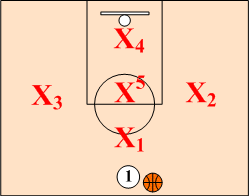
1-3-1 Zone is probably the most versatile of all the zone defenses since it is very favorable and conducive to matching up and trapping. In fact, its basic form is probably the least use. The 1-3-1 zone can be easily extended as a half and full court press or used as secondary defense for special situations.

1-3-1 Zone DefenseWhile most zones matchup to the ball, in the 1-3-1 zone, defenders play off and overplay the passing lanes. In playing the passing lanes, it spreads the offense and forces the offense to throw over the defense or extended cross court passes which are vulnerable to interceptions and deflections. Like on zone defenses, the 1-3-1 zone requires active defenders with arms stretched out and all five players moving as a single unit on all passes. Premium Members Learn Much More – Click Here

Player Development: Defensive Recovery After a Turnover

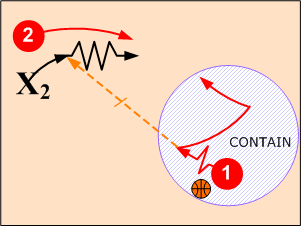
Defensive transition or recovery after a turnover is a frequent and, often times, overlooked situation by coaches in their defensive preparation. Any time the ball is turned over, the offensive players need to know that they must make a quick transition to defense and make every effort to make a defensive stop.

ContainmentUpon turning the ball over, ideally, the passer should retreat first and then pick up the player with the ball. They must contain rather than attacking the dribble to in order to “buy time” for their teammates to recover and get back on defense. However, in reality, the passer’s momentum is towards the receiver and the natural reaction is to immediately attack the ballhandler. This usually results in either the ball handler getting past the defender or with the defender picking up a reaching foul. Therefore, it is imperative that players are taught to contain any time an interception should occur rather than attacking the bal lhandler.

Hustling back and making a defensive stop after a turnover is a “Really Big Play (RBP)” in basketball. A turnover, no matter how bad, can be cancelled out or “Erased” by increasing the defensive intensity and making a defensive stop. Therefore, defenders must be determined to make defensive stops after turnovers. This usually just requires hustle and effort on their part.

Premium Members Learn More – Cick Here

Basketball Strategies – December 2010

Holly

Looking for a Gift for the basketball enthusiast on your list?

How about giving them a HoopTactics Premium Membership? A perfect gift that will last for entire year and then some. Click Here

P.S. A copy of Advanced Basketball Defense would also be great to receive! Advanced Basketball Defense – Click Here

HoopTactics Newsletter

Sound Advice for Solving Offensive Problems
The Vital Sixth Person Role
Developing a Defensive Stopper
Use of Pre-Season Games to Build Depth

Coaching Tip: Coach players not the system.

It’s not what you run, but how you run it that counts. Basketball is not a game of offenses and defenses, but a game of effort and execution. If you are experiencing problems during games, go back and work on basic fundamentals and execution. Do not change or add new plays.

Player Development: Importance of sixth person Role.

The importance of the sixth person(s) role in basketball cannot be over emphasized. It is one thing all excellent teams have in common. Establishing and utilizing the sixth person role in many ways is a much more important coach’s decision than determining the starters. To be successful, the sixth person(s) must possess better skills and leadership than some of the starters. In addition, the sixth person usually can play multiple positions. Without exception, when they enter the game, their role is to energize and make the team stronger.

Determining and getting a player to accept the sixth person role can be a challenge since player’s and parent’s egos can be involved. However, by communicating the vital importance of this unselfish team role, they should be more than likely to understand and accept the role as a real honor rather than a demotion.

Coaching Strategies: Developing a Defensive Stopper.

A vital but often overlook position on a team is a defensive “Stopper.” Having an outstanding defensive player is essential to any championship hopes. Like shooters, stoppers aren’t born and just don’t happen. They must be development and nourished. Successful defensive Stoppers are a result of having solid on and off ball defensive fundamentals along with a strong attitude and relentless determination. They are highly challenged and motivated when it comes to stopping and frustrating the opponent’s leading scorer. They thrive on the responsibility and opportunity of denying a good shooter a last second shot opportunity.

However, this attitude and self‐confidence must be created, fostered and supported by the coaching staff throughout the season. Since a Defensive Stopper’s role is primarily that of a defensive specialist, any offensive output is a bonus. Their job is to stop not score.

Coaching Strategies: Use Pre-season Games to Build Depth.

During Pre-season practice games, it is wise to rest your top players as much as possible. This will save their “Legs” for the critical end of the season and play-offs as well as reducing the risk of injury resulting from playing when physically tired. However, just as important, by giving reserves valuable playing time and experience, it will develop a team’s depth. In the event that a top-lined player is lost during a game or for the season, a player with quality game experience will be able to step-in and take their spot.

On the colligate level, where RPI ratings are important for post season play and ratings, resting top players is very difficult. However, the basketball seaon is like a marathon, and you need players with “Fresh Legs” at the end. Forget the stats and rest your top players whenever possible. Go for the “Gold.” Many of Championship hopes are lost because of tired legs.
HoopTactics Premium Members learn more – Click Here to find out more about Premium Membership

Hoop-y Holidays

Christmas Lights

Basketball Strategies – November 2010

HoopTactics Newsletter

Team Atmosphere & Commitment
Pre-season Player Performance Evaluation
Eliminating “Game Slippage”
Feature Play: Printable Early Flow Sets

Coaching Strategies – Team Atmosphere

The most important aspect of basketball coaching is to create and foster a total team atmosphere and commitment. Insure your players that they’re going to play in a team atmosphere. Inform them that you’re not going to tolerate anyone on the team that keeps the other players from learning, you from coaching or any other misbehavior. You need to guarantee players equal opportunity, but not equal playing time. You must establish significant roles and assignments for every player on the squad. 

Insist on a team effort at all times. No one steps on the floor without a full‐hustle attitude. Great teams are a result of the best players being the hardest workers.

Coaching Strategies – Pre-Season Player Performance Analysis

CybersportsUSA LogoAt the beginning of the season, coaches are primarily interested in using the statistical reports for individual player analysis and evaluation. How well individual players are shooting, rebounding, making steals, etc. This is why it is important to get a head start and use your statistical program, such as Cybersports for basketball,  during preseason practices and scrimmages. Do NOT wait for actual games to statistically analyze your player performances.

Coaching Strategies – Preventing “Game Slippage”

“Game Slippage” actually starts with practice. Most coaches do an excellent job of teaching through break down drills. However, when it comes to scrimmaging, most are very poorly conducted and analyzed. Keeping statistics during practice scrimmages not only will provide useful data on individual player performances but, more importantly, it will enhance the caliber of play. For example: If a player turns the ball over 10 times, in the next scrimmage they will take better care of the ball or if a player goes 1 for 10 from three point range, they will have definitely have better shot selection. Basketball is a game of habits. By improving the quality of scrimmages through the use of statistics, it will definitely better prepare teams for actual games.

Featured Play: Early Offense Continuous “Flow” Sets

Most early offenses depend on quick, wide lane releases, inbound pass, and pass advance to reach the offensive operating areas before all of the defenders can retreat into the front court area. If  initial early push is denied by good defensive transition or poor offensive run outs, or slow inbound or outlet passes, then the offensive team should flow directly into their set offense without bringing the ball back out which would allow the defense to get set.

View/Print 57 proven early flow actions that have been amassed over the years. These sets can be ran to either side of the court depending on player strengths and weaknesses. However, keep in mind it is their execution and spacing that makes them successful.

Free Area – Click Here
HoopTactics Premium Members – Click Here