

Subscribe To The Newsletter Now

Subscribe To The HoopTactics Newsletter

Recently @ HoopTactics


Inside HoopTactics

Basketball Strategies – October 2010

HoopTactics Newsletter

Pre-season Practice Planning
Pre-season Conditioning
Feature Play: Early Offense

Coaching Strategies – Pre-Season Build Your Defense First

You can add offense at any time. However, pre-season training is the only time during the season that provides ample time to build a fundamentally sound defense. Once the season starts, it is very difficult or impossible to install a solid defense.

In installing your defense first, it also provides offensive benefits since you want to practice against good defense. Practicing against poor or “dummy” defense will not adequately prepare players for games. To be successful, players need to practice against good, hard nose defense. Your offense will most likely struggle at first. However, players will soon learn to adjust to creating good leads, making crisp, accurate passes, etc.

Coaching Tip: When working offensively, have the defense switch to offense only after making 5 or 6 defensive stops (combination of defensive rebounds and turnovers). Requiring 5 or 6 defensive stops, will encourage and motivate the defense to play harder. As a result it will definitely help the offense better prepare for actual games.

SOS Pressure Defense: Free Area – Click Here  HoopTactics Premium Members – Click Here
To learn more about creating leads: HoopTactics Premium Members – Click Here
Advanced Basketball Defense – Click Here

Coaching Strategies: Physical Conditioning

Superior conditioning does not just happen nor is it acquired quickly. It is the result of a well planned and executed program of exercise, rest, and diet with rest and diet being just as important as exercise. Condition with the ball. As the late coach John Wooden said, “You are not coaching cross country.” Use your fast break drills and early offense for conditioning. This will accomplish two things: It will build your transition game and, at the same time, condition the players. You definitely want to be able to handle the ball at high speeds when tired. Learn more  about Physical Training & Conditioning.

HoopTactics Premium Members – Click Here

Featured Play: Early Offense

Early offense is composed of three phases: The initial early push, a continuous flow into an early set, and concluding with a continuity pattern as the shot clock winds down.
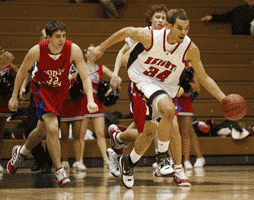
Early Push When the offense is able to PUSH the ball into the offensive operating area within 3 to 5 seconds, it prevents or hinders any pre-planned defensive disruption scenarios. Most often the defenders are spread out creating space where good 1-on-1 creativity has a chance to produce a high percentage field goal attempt. In addition, getting the ball  down the court before the defense can establish proper player match ups creates severe mismatches. Early push depends on wide lane releases, quick outlet or inbound passes, and pass advance to reach the offensive operating areas before all of the defenders can retreat.

When the early push does not create a good shot or advantage, it is important to move right into the offensive FLOW without allowing the defense to set up and become organized. Early flow actions are actually half court offenses executed without having to back the ball out to initiate a set play. If a coach chooses to call off or slow down early pushes, because of fatigue or personnel reasons, then the early flow actions become the teams half court set offenses.

The third and final phase of the early offense involves flowing into a CONTINUITY style of play. Flowing directly into a continuity without hesitation continues to prevent the defense to get organized. Continuity will also eliminates any panic or rushed shots as the shot clock winds down while allowing for the ball to get into the best player’s hands. Continuity, also, maintains court balance with good offensive rebounding position and 2nd efforts to taking place. Learn more about the need for an early offense:

Free Area – Click Here
Hoop Tactics Premium Members – Click Here

Basketball Strategies – September 2010

HoopTactics Newsletter

Successful Pre-season Planning
Effective Play Diagraming
One-on-One Defensive Fundamentals

Coaching Strategies – Pre-Season Organization

Pre-season is the time of the year that coaches love. It is the time of the season for teaching and preparation. The things coaches enjoy doing the most.

“Coaches want to practice, practice, practice,
Players want to play, play, play,
Parents & Boosters want to win, win, win

And officials want to quit, quit, quit.”

Tom Newell, Coaches Who Care

Pre-season preparation and organization entails planting the seeds for a highly successful season. This involves careful  thought and planning. Pre-seaon practices should be designed with the objective of preparing a team physically, technically, and mentally for game competition. It is imperative to start building correct habits and techniques from the start. Physical habits do not change in a game. Learn more about  Coaching Prerequisites & Practice Guidelines:

Free Area – Click Here
HoopTactics Premium Members – Click Here

Effective Use of Play Diagraming

Basketball play diagrams are the universal language of basketball coaches throughout the world. In fact, you can find basketball graffiti (play diagrams) on clipboards, whiteboards, napkins, gym floors, pieces of scratch paper, or just about anything coaches can write on.

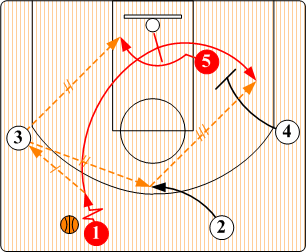
Base Cross OffensePlay diagrams can be a very effecty visual learning  tool, even during a game such as a timeout  However, do NOT assume that all of your players know how to read and interpret basketball play diagrams. 

To some players, play diagrams may look like hieroglyphics or may be difficult to comprehend. Therefore, make sure that all of your players know how to interpret and understand your play diagrams. By using a system of a few basic symbols will make it easy for even a novice to understand even the most complex play action.

Learn More About Play Diagramming – Click Here

Free Printable (USA, NBA & FIBA) Court Diagrams. Choose from 33 different styles: Full court (12), half courts (15) and combinations (6 ).  – Click Here

 One-on-One Defense: Building Attitude as Well as Aptitude

Mastering man-to-man pressure does require “over and above” time, energy and all out commitment to tough, hard-nosed effort. However, the rewards are real and immediate and a worthy sacrifice for all the sweat and effort invested. The need for drill and practice is not new.  There is no minimizing the fact that drills are methodical, repetitive and often demanding. Skillful execution of skills and second nature response to any given game situation cannot be achieved in any other way.

However, if drills and learning are approached with enthusiasm and intensity and are reinforced by consistent, positive encouragement and feedback, tedium gives way to tenacity! Pride in becoming a defensive “Stopper” and holding the individual opponent below their average scoring level can become as important a individual scoring stats. Such a defensive climate is no accident, but is the result of conscious and concentrated effort to communicate the importance of defensive dimension of the game. If you thrive on such a challenge, then pressure defense will actually be fun not work!  

Learn more about defending the player with the ball one-on-one.

SOS Defense: One-on-One “On Ball” Pressure – Click Here

Player Development: Pressuring the Player with the ball
Free Area – Click Here 
Premium Members – Click Here


Basketball Strategies – August 2010

HoopTactics Newsletter

Evolution of the Game
Master Practice Planning
12 Basic Offensive Alignments
Player Training & Conditioning

Evolution of the Game – Chronological Look at the Major Refinements

Dr. Naismith, with all of his imaginative planning, could not have dreamed his “Peach Basket” game would develop into the world’s greatest indoor sport. Although the original 13 rules have been expanded to over 100, the spirit and principles of the original rules are still in effect in today. Major rule changes over the years addressed the number of players, the court boundaries, dribbling, and the elimination of the center jump after made baskets. In the mid 1930’s inter-sectional competition led to a standardization of rules throughout the country. More – Click Here

Master Practice Plan- The Blue Print for a Successful Season

The practice of planning in advance not only assures one of a well organized and efficient practice, but also makes it possible to get more accomplished. Reasons for taking the time to develop a master plan:

  • Guarantees the maximum use of the time available.
  • Assures coverage of all phases of the game.
  • Eliminates over emphasis of any one phase.
  • Maintains better player interest.
  • Creates an environment more conducive to learning.
  • Provides foundation for efficient daily practices.

Creating a Master Plan – Click Here  Premium Members – Click Here

Offensive Strategies: Twelve (12) Basic Offensive Alignments

There are 12 commonly used offensive alignments. These different alignments are designed to take advantage of the strengths of a team’s specific player personnel. A good offensive strategist not only knows the advantages and disadvantages of each alignment, but more importantly when to employ them. This may vary from game to game or even year to year. View Alignments – Click Here

Player Development: Traning & Physical Conditioning

Superior conditioning does not just happen nor is it acquired quickly. It is the result of a well planned and executed program of exercise, rest, and diet. Training is exacting and the responsibility is heavy. What is done off the court is as important as what is done on it. To be successful, each player as well, as the team collectively, must possessed the desire and determination to develop superior physical condition. View Conditioning Guidelines: Premium Members – Click Here

Basketball Strategies – July 2010

HoopTactics Newsletter

Clemson University’s Basketball Class Pilot Program
Player Development: Creating Solid Leads
Feature Play: Spread Motion Offense

Clemson University’s Adopts HoopTactics

Clemson University’s Basketball Coaching Class replaces textbooks with the HoopTactics website. “HoopTactics was a HUGE addition to our class” according to instructor Ed Fry, a 29 year “vet” of high school and college coaching. With the cost and limitations of textbooks now days, it surely makes sense to use an online reference. This does not only save students money, but most importantly, greatly enhances the students’ learning experience. Coach Fry integrated with the HoopTactics website using written assignments and student discussion board posts.

View sample written assignment 
View sample discussion board post

Teaching a basketball coaching class or hosting a coaches clinic? Contact HoopTactics for more particulars in teaming up with HoopTactics. Click Here.

Player Development: Creating Good Leads

Learning how to get open without the ball is a vital, but often most overlooked, component of a success offensive attack. All the basketball plays and individual moves in the world are useless when a receiver receives the ball out of position. Therefore, with today’s pressure defenses, it is important for receivers to possess the abilities and skills to get open while maintaining proper court spacing. Learn more: Five proven techniques that every player should master – Premium Members Click Here

Featured Play: Spread Offense

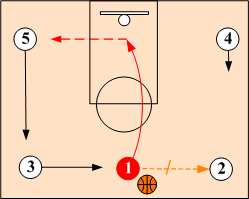
Spread Offense

The SPREAD Offense is 3-2 no post, motion offense. Since all five players are involved in the continuity, all players should be skilled passing and handling the basketball. Although, only a couple of basic cuts take place, the key to its success is the players being able to read and counter the defensive over plays. Learn More – Click Here