

Subscribe To The Newsletter Now

Subscribe To The HoopTactics Newsletter

Recently @ HoopTactics


Inside HoopTactics

Basketball Tips & Strategies – June 2010

HoopTactics Newsletter

Coach John Wooden, Featured Play: UCLA Set Offense, Individual “On” Ball Defense

Premium Membership What’s New

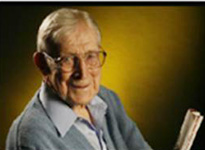
John WoodenIn Memory of John Wooden

 “Success is peace of mind that is a direct result of self-satisfaction in knowing you made the effort to become the best that you are capable of becoming.”

Basketball Legend, John Wooden, was one of the greatest coaches in the history of the game. Although, his fame extended well  beyond the sports world, it was his success and achievements on the court for which he is best renowned. He is enshrined in the Basketball Hall of Fame, both as a player and a coach.

He was a three time all-state high school player winning a state championship in 1927 and a three time all-American for Perdue University winning Perdue’s only national championship in 1932. His coaching accolades include an unprecedented 10 NCAA National Basketball Championships and 88 consecutive victories. However, what is most encouraging about John Wooden’s coaching career is that he worked his way up through the ranks being a high school teacher and coach for 11 years, and a small college coach at Indiana Teachers College (now Indiana State University), prior to being hired by UCLA.

Wooden’s dynasty at UCLA was built on sound teaching and high standards. He demanded precise execution of fundamentals and teamwork based on his “Pyramid of Success.” In 2003 John Wooden received the US Medal of Freedom. The highest honor awarded to a US civilian.   John Wooden’s example, leadership and contributions to the game will definitely live on forever.

Featured Play: “UCLA” High Post Rub Offense
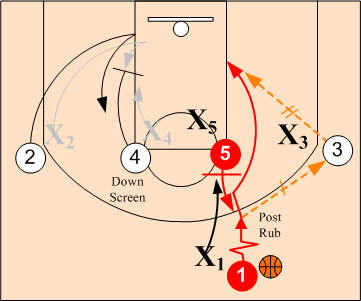
UCLA Set Offense

This potent high post attack was instrumental to the success of many of UCLA’s NCAA championship teams under coach John Wooden, and is commonly used on all levels of basketball, including the NBA. The UCLA Offense is a viable option for teams that do not have a bona fide low post player. It is primarily designed to take full advantage of a post player with good passing and shooting skills, but it also takes advantage of the post up abilities of a point guard and power forward. Like any successful offense, the UCLA offense is based on very sound principles and excellent court spacing.  Learn more about UCLA Offense High Post Rub Offense – Click Here

Off Season Player Development: Individual “On” Ball Defense

Individual “On Ball” defense is comprised of three basic fundamentals: Pressuring the player with the ball, containing a dribbler and attacking the picked up dribble. Summer basketball competition is an excellent opportunity for players to refine and improve individual defensive skills. However, with the main emphasis in these games placed on “showcasing” current abilities and strengths rather than utilizing the opportunity to improve their playing skills for future play, defensive efforts are usually lax.

Players need to take full responsibility in making off season skill improvement a primary goal. They do not need a coach or personal trainer. “A game within in a game” – Every time they take to the court, whether for a game, a practice or just a pickup game, they should make it a goal to work on improving a single or related defensive skill. They will still shoot, pass, dribble, and rebound. But, most importantly, they will be working hard to improve a specific defensive skill such as defending against dribble penetration. HoopTactics Premium Members: Learn all about defending the player with the ball – Click Here

Basketball Tips & Ideas – May 2010

HoopTactics Newsletter

Time Management, SOS Pressure Defense,  Featured Play: Horns Set Offense

Premium Membership What’s New

Coaching Strategies: Time Management

Coaching can be a very time (24/7/365) consuming endeavor. There will never be enough hours in the day. Therefore, making the most of the time that you have is vital. In almost all cases, the real problem is not a lack of time, but actually a poor usage of time. In addition to a well thoughtout program master, time management and efficiency is a key ingredient to any success. With proper time management you can get more things done, in less time, and with less stress. Learn about managing your time wisely – Click Here

SOS Pressure Defense: Key to playing and teaching hard-nosed  defense

The SOS Pressure Defensive system is based on the concept of total disruption. Total disruption is achieved by having the defense initiate the action and attacking the offense, forcing the offensive players to react and move away from their normal offensive actions. SOS pressure “D” can disrupt the most potent offenses with techniques and tactics that dictate the flow of the game. These defensive tactics set the tempo by striking first rather than reacting to an opponent’s game plan. Defensive Guru, Bob Kloppenburg, shares the basics of pressure “D” at its devastating best!

To learn more about SOS Defense – Click Here

Featured Play: “Horns” Offense

Horns Set Offense

There is an ever increasing number of teams using the Horns or “V” offense. This offensive set is primarily designed to utilize basic mid screen and roll action; however, it also creates open outside shot opportunities for good spot up, outside shooters.

By deploying a second high post screener, it allows the ball handler the option of driving off a screen in either direction. Since screens are available on both sides, unlike it’s cousin the Mid Screen, the Horns offense cannot be disrupted by simply influencing the ball handler away from the screen. Having both screeners high, also, clears out any baseline defensive help on the point’s drive. View graphically illustrated details –  Premium Members Click Here

Basketball Tips & Strategies – April 2010

HoopTactics What’s New

Coaching Strategies: Teach the Rules of the Game

There is no better time to observe the importance of knowing the rules of the game than the NCAA tournament where many of championship hopes have been shattered and lost simply by players not knowing the rules. “When talent becomes equal, then little things become paramount” – John Wooden. Do not ever assume players know even the simplest of rules. In tournament play there is no margin for error. Purchase and read the rule book. Have an official talk to your players each season about new rules and points of emphasis. Don’t become one of hose coaches who live the rest of their lives haunted because of a simple rule infraction in a crucial game. Learn more about the history and the evolution of basketball rules – Click Here

Inbounding the Ball Violations

When teaching out of bounds plays be sure to cover the rules. Most players know the 5 second rule. However, moving from the inbounds spot or stepping inbounds along with careless passes during a game can be fatal. These inbound violations are mainly a result of bad habits of not taking the ball out of bounds after a made basket in full court pick up games and scrimmages. Inbounding along the opponent’s baseline after a timeout can also be confusing. After timeouts, make sure that the player inbounding the ball knows if they can run the baseline or NOT. Learn more about Inbounding the Ball Under Pressure  – Premium Members Click Here

Intentional Missed Free Throw

Although it occurs rarely, intentionally missing a free throw should be an integral part of end of game preparations. This includes teaching the rules that the shooter cannot step across the free throw line until the ball hits the rim and that the ball must hit the rim. Proper execution of a missed free throw just may win you a game or even a championship, especially since the defense is usually ill-prepared to defend against an intentional miss.

Importance of Comforting & Consoling Players

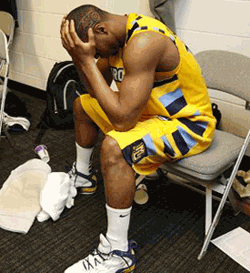
locker room lossIf a rule violation happens to occur late in the game contributing to the lost, it is the coach’s fault, not the player. If not addressed, an end of game failure can become a devastating, life long, emotion injury. Be sure to immediately comfort, console, and restore the player’s confidence making sure that they realize that it was a good learning experience for things to come, not the end of the world. Basketball is a game, and it’s the effort that really counts, not the results. As long as they give their best effort, they will never lose a game – only run out of time.

Featured Play: “Box & One” Offense

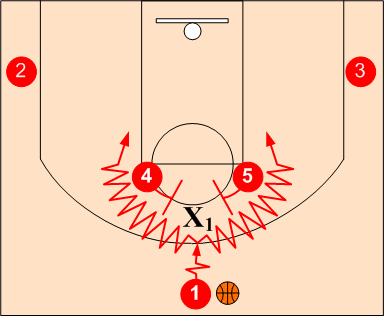
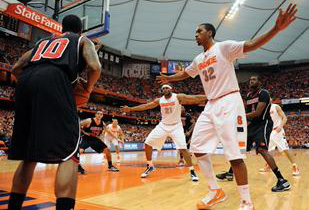
Combination defenses can be very devastating to any team not prepared to attack them. The Box & One is the most common combination defense and is primarily used to stop or neutralize an outstanding offensive player. However, like all defenses, the Box & One has its strengths and weakness. One of the biggest problems in attacking a Box & One defense is that most coaches just do not take the time to sufficiently prepare their team. To be effective and successful, offenses against combination defenses need to be practiced and refined.

Since a Box & one offense(s) is a secondary offense, it is important to keep it simple and easy for players to learn. It may just require practicing a current offense against a Box & One defense. It is also helpful, if the offense being used is similar to an already used offense. Since the Box & defense is primarily deployed to deny and limit the “touches” of an outstanding, any offensive attack must be designed to counter this overplay and free up the scorer.  To explore attacking Box & One Defenses -Premium Members Click Here

Basketball Tips & Strategies – March 2010

HoopTactics What’s New

Winning Close Games: Trailing at the end of a game

Basketball Scoreboard

Fouling plays a critical part in the outcome of the game, especially when it comes playoff time. Fouls were added to the basketball rule book to penalize; however, intelligent players and teams can use fouls to their advantage. When trailing by more than two offensive possessions late in the end, the clock is your worst enemy not your opponent. Every second counts, so if you have to foul, foul immediately. Do not let any precious time run off. Legendary, Hall of Fame coach, Dean Smith, was a mastermind of this end of game strategy.

However, when it comes to fouling to gain a competitive edge do not assume that players know how to foul. Have you practiced fouling? in reality, when a coach tells their players to foul, they are most likely to just push or grab an opponent resulting in an intentional foul. Since the opponent gets to shoot free throws and retains ball possession, this is disastrous. Players need to know how to foul, when to foul, and who to foul.

Full Court PressThese end of game fouling techniques must practiced. When taking a quick foul, players should first attack the passing lane and go for the ball. A steal, five second count or picking up an offensive charge is much better than a foul. If unsuccessful, players should foul by trying to knock the ball out of their opponent’s hands. Every once in awhile, they just might be successful in knocking the ball loose. In addition, officials will, occasionally, be out of position and not call the foul. When trapping, execute one hard trap and then foul. Learn more see Clock Management & Fouling – Premium Members Click Here

Wise Substitutions

When faced with a must foul situation, do not forget to substitute!!! During a timeout or when shooting a free throw, be sure to make defensive substitutions and put players into the game that can afford to foul instead of putting your best players into foul trouble or even losing them to disqualification. Once the foul has been committed and the clock stopped, players in foul trouble or key players can be reinserted back into the game. How many times in the recent NCAA Tournament games have you see key players, needlessly, foul out in must foul situations?

No hard fouls

There is no room in the game of basketball for hard fouls (even on the professional level) especially on lay ups when shooters are most vulnerable to injury. Play hard, but play fair. Basketball carries more than enough injury risk without a player intentionally or unintentionally injuring another player when fouling. In addition, there is never any satisfaction or sense of accomplishment in winning when the victory is achieved by injuring an opponent or breaking the rules of the game.

Playing Smart: Eliminating the “and one” fouls

Giving up a three point play by fouling a player in the act of shooting a lay-up is usually a result of a retaliatory reaction to a previous bad play or call. So, instead of fouling a shooter and giving up a three point play, it is much better and smarter to just concede the lay-up and let them score.

All you have to do is to score on the next possession to “erase” or cancel it. If you foul the shooter and give up a three point play, you will not only have to score on your next possession, but also come up with a defensive stop and then score a second time to erase or cancel it.

Featured Play: “ICE” Spread Offense

Ice Offense

The ICE offense is an all out basket attack. Using the term “ICE” makes the opponent think that you are going to hold the ball, but in reality ICE attacks the basket on every cut. In addition to protecting a lead at the end of game, ICE can be used very effectively to counter severe defensive pressure. When an opponent is applying so much defensive pressure that it is difficult to run offense, ICE can save the day with it’s constant back and basket cuts against defensive over play. ICE Spread Offense – Premium Members Click Here