

Subscribe To The Newsletter Now

Subscribe To The HoopTactics Newsletter

Recently @ HoopTactics


Inside HoopTactics

Basketball Tips & Strategies – February 2010

HoopTactics What’s New

Quick Tip: End of Game Preparation

The winning of “BIG” games and championships is not a matter of chance. It is a result of being prepared down to the smallest detail. Be sure to use the scoreboard clock to include both offensive and defensive end of game situations in your practices. Do not ever expect your players to execute anything during a game that you have not covered in practice.

Coaching Tips: Last Shot Situations

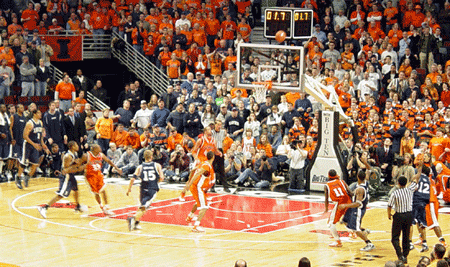
End of game situations really become paramount during the end of the season when a single shot can make the difference of winning and losing and also determine a team’s playoff hopes and fate. Therefore, to be successful, teams must prepare for last shot situations. A last shot situation is not just a simple matter of drawing up a play. There are numerous last shot situations to address dependent on court location and time on the clock. End of Game Strategies – Click Here
Last Shot

Last Shot Preparation

When the outcome of the game comes down to a single shot, teams must maintain their poise and confidence. This confidence comes from being prepared. Keep the play simple and execute. The more complex the action, the greater chance that a breakdown will occur. Practice various last shot scenarios using the game clock. This not only develops proper play timing, spacing and execution, but it also builds players confidence that they can score with just seconds remaining.
Last Shot Play

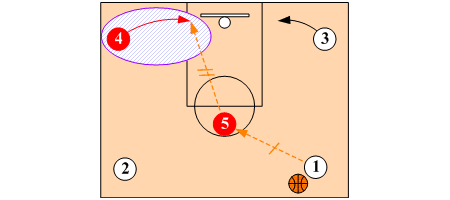
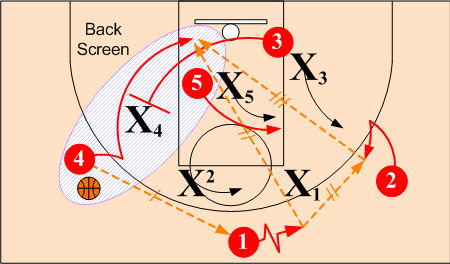
Be sure to get the ball into the hands of your best player, and let them hit the open shot or teammate. Never allow your best player to take the ball out of bounds. Players must read the defense and immediately take advantage of any defensive overplay. The type of defense being deploy will ultimately determine the last shot option. Normally, they will play soft if ahead and must pressure when behind. Last Shot Guide – Premium Members Click Here

Fundamental Skills & Techniques Required

Last second shot plays may require long passes or skip passes. Therefore, players should practice and master the skill of making a skip pass (a crisp, accurate pass from sideline to sideline) along with a baseball or semi-hook pass from the backcourt endline to the opposite free throw line (“Elbow”).

Players should occasionally practice half court shots. This usually requires developing a two handed shot. With practice some players can become fairly accurate.  Players love the challenge of trying to make half court shots.

Non-shooters should be well drilled to go to the offensive boards instead of watching the flight of the ball. Most last second games are won on putbacks not the shot. Players should practice tipping the basketball and re-directing a pass (less than second). The ability to tip the ball with both the right and left hand also plays an important role in offensive rebounding.

Note: Physical conditioning also plays a vital role late in a game. The team that is in better shape will definitely have the advantage in very tense games where players are physically tired, mentally beat, and emotionally drained. In most cases, you can expect to win at least two games during the season by being in better shape that your opponents.

Defensive Tips: Defending Against the Last Shot

Attack rather than react. Switch all screens, and attack the passing lanes. Be deceptive. Show man, but play zone on inbounds pass, or show zone and play man on inbounds pass. Be disruptive. Double team to disrupt any set play. Use a combination defense, especially against a star player. Be aware of the team foul situation, and if you have a foul(s) to give. Contest all shots, but do not foul.

Rebound!!!  The vast majority of games that are decided by last shots are won on put backs  or rebound shots — NOT the shots. Assume all shots are going to be missed and box out. Do NOT watch the flight of the ball to see if it is going to be successful. In the event that actual ball possession is not possible on a rebound, just tip the ball away from the opponents. Learn much more about Last Shot Strategies – Premium Members Click Here

Basketball Tips & Strategies – January 2010

Hoopy New Year From HoopTactics!

Note: Tex Winter is Recovering from Stroke

You may or may not be aware that Tex Winter, Triangle Post Offense, is recovering from a serious stroke. He has now progressed to a point where he can read. For those of you who like to take the time to write him a short note his address is: Tex Winter c/o Springridge Assisted Living, 32100 SW French Prairie Road, Wilsonville, Oregon 97070. Your well wishes, appreciation, and support would be deeply appreciated and helpful.

HoopTactics What’s New

Offensive Strategies: Power Set Offense
Defensive Strategies: Cases for the Defense added to all the Set Offenses
Coaching Strategies: Injury Prevention and Player Safety

Featured Play: “Cat” Spread Offense

The CAT spread offense is a simple, but very successful offense to deploy whenever the defense traps or double teams. It can also be extended and used very effectively as a weapon in attacking full and half court zone presses. The Cat Offense entails setting up in a 2-1-2 spread alignment and moving the ball with sharp accurate passing. Although, the majority of attack is comprised of just moving the ball, there are a couple of basic rules that should be applied.
To learn more – Click Here

7 Effective Ways to Disrupt a Strong Post Up Game
The importance of individual post defense cannot be over emphasized. However, sound individual post defense can be augment with post traps at times to insure total disrupt of the inside post up game. Fronting, SOS Base Go Trap, SOS Go Top, SOS Wing Go, Holding, 2-3 Zone, and Diamond & One combination defense, all provide strategic weapons to combat a strong post up game. To learn more – Premium members Click Here

Player Safety and Injuries

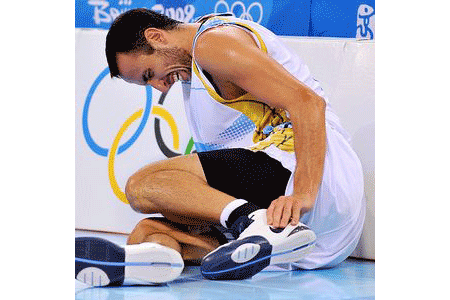
Player Injury
Unfortunately basketball injuries do occur. Each year, more than 1.6 million basketball-related injuries are treated in hospitals, doctors’ offices, clinics, ambulatory surgery centers and hospital emergency rooms. Therefore, coaches must be first aid trained and certified. Also, they must make it their job to be aware of any pre-existing health problems their players may possess.

Be extremely cautious when it comes to head, neck and back injuries. Concussions – a must read for all coaches on every level. Click Here to View

CAUTION:  Do not ever put a player at risk. Most players will insist on playing injured. However, no matter how big the game, never play an injured player without a doctor’s permission or until they are fully recovered. To learn more – Premium Members Click Here

Basketball Tips & Strategies – December 2009

Looking for a Gift for the basketball enthusiast on your list?

How about giving them a HoopTactics’ Premium Membership? A perfect gift that will last for entire year and then some. Click Here

Premium Membership  What’s New

Offensive Strategies: Hawk Set Offense

Defensive Strategies: Seven Effective Ways to Attack On-Ball Screens, Low Post Disruptions

Player Development: Loose Ball Recovery

Coaching Tips: Vital Importance of 6th Player Role

Quick Tip: Teaching – The Key to Satisfaction and Success

Unfortunately, along with this increased importance being placed on winning, there has been a significant slippage in coaches’ teaching skills and abilities.  However, winning is short term. The real success in coaching comes with teaching and assisting players to become the best they are capable of becoming “on” and “off” the court.

Coaching Tips: Sixth Person Role

The importance of the sixth person(s) role in basketball cannot be over emphasized. It is one thing all excellent teams have in common. Establishing and utilizing the sixth person role in many ways is a much more important coach’s decision than determining the starters. To be successful, the sixth person(s) must possess better skills and leadership than some of the starters. In addition, the sixth person usually can play multiple positions. Without exception, when they enter the game, their role is to energize and make the team stronger. As a result, if the game is tied, it will provide the necessary boost to give the team the lead. If a team is already ahead, it will increase the lead, and if the team should be behind, it will afford them a chance to catch up.

In most cases the sixth person role is filled by a single player. However, it can be multiple players and on rare occasions even five players. Determining and getting a player to accept the sixth person role can be a challenge since player’s and parents’ ego’s can be involved. However, by communicating the vital importance of this unselfish team role, they should be more than likely to understand and accept the role as a real honor rather than a demotion.

Featured Play: Hawk Set Offense

Hawk Set Offense

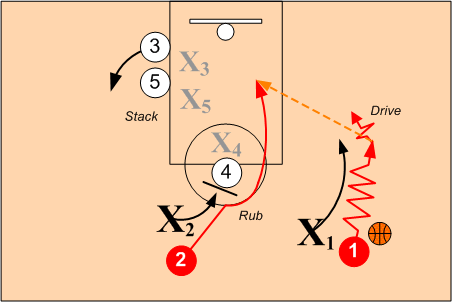
The Hawk Offense is a relative of the “UCLA” offense and a derivative of the shuffle offense. Introduced into the NBA by Hubie Brown when he was coaching in Atlanta, thus its name, it has proven to be a very successful offense on all levels of the game. Although the Hawk Offense is primarily designed to take advantage of a size mismatch at the off guard position, it also includes wing isolations and strong post ups options. Learn More – Premium Members Click Here

Defensive Tips: Attacking On-Ball Screens

Seven effective ways to attack On-Ball screens include: Prevention, Show & Recover, Switching, Trapping, Trapping Early, Jamming and Shadow (zone). Fortunately, players will not be expected to execute all the different ways to disrupt On Ball screens during a game. In fact, normally only one or two of the options will be deployed during a single game based on the opponent’s ballhandler and screener specific strengths and weaknesses. However, these options are subject to change during the course of a game. Therefore, to be successful in attacking and disrupting On-Ball screens, they must be constantly analyzed during the game as to why and how they are being set. Once analyzed, the defense can take the initiative, and readily attack it. Learn More – Premium Members Click Here

Player Tips: Loose Ball Recovery

Loose Ball Recovery

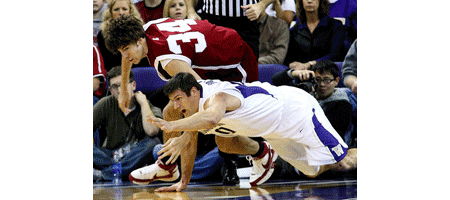
Coaches love to see players go to the floor for loose balls. However, like taking an offensive charge, players must be taught how properly dive for loose balls without sacrificing their bodies or risk of injury. Diving for the ball should be graceful and the body should land softly like a gymnast. Loose ball dives can be tricky. For this reason players should have a working knowledge of the correct techniques and plenty of practice repetitions before diving for a loose ball during a game.

In diving for loose balls, players should first lower their center of gravity close to the floor by bending their knees. Then push forward extending arms and legs straight out parallel to the floor and landing on their hip flexors. Players should never fall on the knees. Falling on a knee is a good way to end up with a torn ACL or a worse injury. Whenever possible, seek the assistance of a volleyball coach when teaching players to dive for loose balls. Once players learn how to properly dive for loose balls, the more apt they are to go after loose balls during a game without hesitation. To learn more – Premium Members Click Here

“Hoop-y” Holidays

Basketball Tips & Strategies – November 2009

HoopTactics What’s New

Player Development: Improving  Free Throw Accuracy, Free Throw Marksman Club, Defending Against Dribble Penetration

Defensive Strategies: Techniques for Disrupting “Off Ball” ScreensDefensive Rebounding Principles and Techniques

Quick Tip: Individual Defensive Skills and Techniques

Like their offensive counterparts, defensive fundamentals must be broken down and practiced constantly on all levels of basketball. Players need to know and practice how to guard the player with the ball, how to guard a player without the ball, how to guard a cutter, how to guard a player in post area, and how to box out and rebound on shots.

Featured Play: Clock Zone Offense

Clock Zone Offense

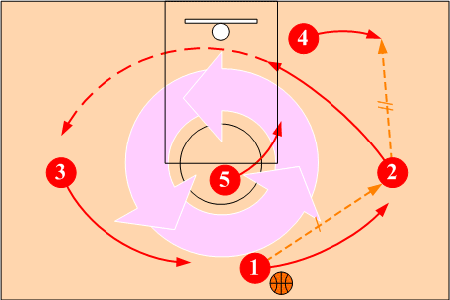
The “Clock” is a very simple but powerful zone offense. It is easy to teach, learn and execute. It incorporates a basic 1-3-1 free lance passing attack with a few basic rotation rules. It gets its name from the outside players clockwise and counter clockwise rotations. The Clock Offense is ideal for those looking for a very effective, but simple zone offense. Learn More – Click Here

Coaching Tips: Importance of Player Development

Individual player development, on and off the court, is the greatest satisfaction of coaching. Basketball is unique in that it is a game within a game. However, we coaches often have a tendency to spend more time on introducing and refining plays or defenses rather than developing and improving individual player skills and techniques that will ultimately determine their success or failure.

Remember, basketball is not a game of offenses and defenses, but a game of effort and execution. Coach your players, not the system. Be sure to develop all of your players to the best of their capabilities. Coaching great players is easy. Where great coaches excel is in getting the most out of every player on the squad regardless of physical abilities and skills.

GUIDANCE

“Regard your soldiers as your children, and they may follow you wherever you may lead.

Look upon them as your beloved sons, and they will stand by you even unto death.

If, however, you are indulgent, but unable to make your authority felt; kind hearted but unable to

enforce your commands; and incapable, moreover, of quelling disorder,

Then, your soldiers must be able to liken to spoiled children. They are useless for all tactical purposes.”

Sun Tzu Wu, Art of War 450 BC

Defending Against Out-Numbered Situations

Transition defense starts with being able to defend the out numbered situation. Players should be well schooled in how to defending out-numbered situations. Successfully defending an outnumbered break is a really big play (RBP). It often times makes the difference in winning or losing a close game.

Do not make the mistake of taking for granted that players are already knowledgeable and skilled in how to defend against the out number situations. Players need to be taught the correct way to “Wolf” (catch a dribbler from behind), how to defend 2 & 3 against one situations as well as 3 & 4 against two situations. To learn More – Premium Members Click Here

Defensive Rebounding a Total Team Effort

The importance of rebounding defensively cannot be over emphasized. A rebound on defense is equivalent to a made shot on offense. A team can play tremendous defense and force a bad or rushed shot, but this defensive effort will be wasted if the offense is allowed to rebound the missed shot. For any defensive effort to be successful it must end in a turnover or defensive rebound (defensive stop).

Defensive rebounding is a coordinated team effort, and every player must realize that it is just as important to box out and prevent their opponent from getting the rebound as it is to obtain the rebound. Therefore, defensive rebounding is one of those situations in basketball where it’s not the number of times you do, but it’s the time you do not that counts. This means that the defenders block every offensive player’s path to the basket and ball on every shot during a game. This is especially true for the shooter since they know where the ball is going as soon as it leaves their hand. Learn More – Premium Members Click Here