

Subscribe To The Newsletter Now

Subscribe To The HoopTactics Newsletter

Recently @ HoopTactics


Inside HoopTactics

Hoopy Birthday to HoopTactics Founder Coach Ernie Woods!

 Ernie Woods coaching at Hawthorne High School in California
Ernie Woods coaching at Hawthorne High School in California

Goal Setting

The Art of Teaching Basketball

What you will discover or recall

Goal Setting

Seven Steps

Post Season Review

Successful Goal Setting

Goal Setting

Success is not by chance or luck. Successful people have learned the value of setting specific goals and focusing their efforts toward achieving them. “Goals are the bridges that allow you to cross from DREAMS to REALITY.” A program and coach “without goals is like a ship without a rudder.” Goals are what give direction to physical and mental training and improvement. They are the basis of self-motivation and the foundation of all achievements. However, goals must be personal. Something that you as a coach, personally, want and have a strong desire to pursue and achieve. It is because of this intense, personal desire to reach goals that will push you through adversity to success.

Accomplishing goals and making dreams come true is incredibly satisfying. However, it is the journey, not the destination, that is the most important and rewarding part of dreams. You must never stop improving and making it a goal to get better each and every day in some small way. Daily improvements eventually add up to huge gains. You should always keep moving forward setting new goals and dreaming new dreams. You may never reach their ultimate, long term dream. However, this is irrelevant. The important thing is that you will become like your dreams.

Ambitions

CAUTION

High expectations can only lead to big disappointments. While, on the other hand, high ambitions never get disappointed and are the basis to all success. You must stay ambitious, making every day the best it can be. One day at a time. The best and most productive place to be is in the present. Too much time thinking about the past causes regret. Too much thinking about the future causes worry.

Learn More: Click Here

Worthwhile Goals Take Time

Goals Achieved with Little Effort are Seldom Worthwhile or Lasting. Hall of Fame Coach John Wooden is a perfect example to never give up!

In July of 2009 Sporting News unveiled a list of sports’ 50 greatest coaches of all time, as selected by a panel of 118 Hall of Fame, championship coaches and other experts. John Wooden, who at UCLA won a record 10 Division I men’s basketball championships in 12 years, was a runaway winner. Coach Wooden received 57 first-place votes from the panel, which included seven World Series-winning managers, four Super Bowl champion coaches and the winningest coaches in the NBA, NHL and college basketball. This was a great honor, but it is sometimes forgotten that John Wooden won his first National Championship in his 29th year of coaching. 

To Learn More About Coach Wooden’s Journey: Click Here

Seven Steps to Successful Goal Setting

To accomplish your goals you first need to know how to set them. You can’t simply say, “I want to” and expect it to happen. Goal setting is a process that starts with careful consideration of what you want to achieve, and ends with a lot of hard work to actually do it.  Goal setting not only allows you to take control of your game, it also provides you a benchmark for determining whether you are actually succeeding.

#1: Set Goals that Motivate You

Motivation is the key factor to achieving goals. When you set goals for yourself, it is important that they motivate you. This means making sure that they are important to you, and that there is value in achieving them. If you have little interest in the outcome or if they are irrelevant, the chances of you putting in the work to make them happen are slim to none.

#2: Set Relevant Goals

Goal achievement requires commitment, so to maximize the likelihood of success, you need to feel a sense of urgency and have an “I must do this” attitude. In keeping goals meaningful, you will develop the necessary focus you need to get ahead and do what you want. Without this type of focus, you will end up with inconsistent and fragment goals that will only “dribble away” or squander your time and efforts.

#3: Set Attainable Goals

Make sure that it’s possible to achieve the goals you set. If you set a goal that you have no hope of achieving, you will only demoralize yourself and erode your confidence. However, resist the urge to set goals that are too easy. Accomplishing a goal that you did not’t have to work hard for can be anticlimactic. However, by setting realistic and challenging goals, you hit the balance you need. These are the types of goals that require you to “raise the bar” and they bring the greatest personal satisfaction.

#4: Set Specific and Measurable Goals

Your goals must be clear and well defined. Vague or generalized goals are unhelpful because they don’t provide sufficient direction. Your goals need to show you the way. Make it as easy as you can to get where you want to go by defining precisely where you want to end up.

Be sure to set goals that you have control over. Goals such as making all-league, all-state, or all-American you have no control over. Include precise totals, percentages, quantities, etc. in your goal setting so you can measure your degree of success. If your goal is set without a way to measure your success, you will miss out on the celebration that comes with knowing you have actually achieved your goal.

#5: Set Time-Limited Goals

Your goals must have deadlines or time frames. Again, this means that you know when you can celebrate success. When you are working on a deadline, your sense of urgency increases and achievement will come that much quicker. Group your goals into immediate, short term and long term. Immediate goals: Specific goals aimed at a specific event or competition occurring today or within a week. Short term or intermediate goals: May be specific or less defined that require several steps to achieve. Time frame is usually within six months or a season. Long term goals are your “Dream” or career goals that you wish to achieve. Usually takes years or a lifetime to accomplish.

#6: Set Goals in Writing

Goals are the foundation of your motivation, achievements, and success. Therefore, goal setting is much more than simply saying or thinking what you want to happen. Unless you clearly define exactly what you want and understand why you want it the first place, your odds of success are considerably reduced. The physical act of writing down a goal makes it real and tangible. You have no excuse for forgetting about it. As you write, use the word “will” instead of “would like to” or “might”. Create a goal “To Do” list. Post your goals in visible places to remind yourself every day of what it is you intend to do and accomplish.

#7: Create a Plan of Action and Stick With it.

This step is often missed in the process of goal setting. You get so focused on the outcome that you forget to plan all of the steps that are needed along the way. By writing out the individual steps, and then crossing each one off as you complete it, you’ll realize that you are making progress towards your ultimate goal. This is especially important if your goal is big, demanding, or long-term.

Remember, goal setting is a constant, ongoing activity not just a means to an end. Build in reminders to keep yourself on track, and make regular time-slots available to review your goals. As time goes by, your intermediate and long term goals will evolve into short term or immediate goals. Some goals will be achieved, while others will be modified or replaced. The important thing is that you will always have direction.

For Printable Version: Click Here

Post Season Review Key to Future Success

Not Improving

After a long season, coaches need to take some time off to recuperate and re‐charge their batteries. However, before doing so, while it is fresh in your mind, review, analyze and evaluate the past season. Total program reviews are a must to setting goals and laying a solid foundation for the next season’s play. Examine exactly what was accomplished, what was successful, what was unsuccessful, what needs to be improved in the coming year, what was outside of your control and how can it be prevented in the future? To improve you must ask and answer hard questions. Then use this information to set goals and objectives for the coming season. 

Post Season Evaluation Guidelines: Click Here

.

Five Stars

______________________

Coming Next:

TBA

_____________________

Art of Teaching Basketball Series
#1Coaching, Life Skills, Keys to SuccessTap Here to View
#2Legal LiabilitiesTap Here to View
#3Major Medical EmergenciesTap Here to View
#4Motivation & LearningTap Here to View
#5Player Learning StylesTap Here to View
#6Motor Skill LearningTap Here to View
#7Game of HabitsTap Here to View
#8Changing Bad HabitsTap Here to View
#9Goal Setting & Season ReviewTap Here to View

______________________

Changing Habits

The Art of Teaching Basketball

What You Will Discover or Recall:

Changing Bad Habits

Three Stages

Coaches Role

The Metamorphosis of Changing a Bad Habit

Brain fights to hold on to established habits

As a coach, you may not reap the immediate rewards of the hours put into player development. Since players develop at different rates and ages, be sure to develop all of your players to the best of their capabilities.

Correcting bad habits is by no means an easy task, and not all efforts will be successful, since it comes down to the individual player’s motivation and willpower. In correcting bad habits, players will progress through the following three stages:

Stage 1

A coach notices the hand of a player, with a pretty good shot, is moving out to one side on their follow through. The coach explains, demonstrates the correct position and tells the player to visualize the follow through. At first the corrected follow through will feel awkward and unnatural to the player. The shot becomes unsuccessful with the player missing almost all of their shots.

Habits Stage 1

Stage 2

With repeated practice and determination, the body starts to respond to the brain. The follow through begins to assume the correct position more readily and the shot becomes more fluid. The shot starts to gradually climb back to the previous level of accuracy. However, the shooter still has to think about the correct follow through movement.

Habits Stage 2

Stage 3:

Great player never get bored with practice repetitions

With still more hours of practice, the shooter thinks less and less about the shooting mechanics. Their form adjusts to the new position. Neuromuscular systems are working together in unison. Shooting has significantly improved and the corrected follow through motion “feels” right.

Habits Stage 3

Critical Coaches’ Role

To be successful, coaches must guide, support, and encourage players through all three stages of correcting bad habits. In some cases, this will entail continuing to support them long after they leave your program.
However, all of the time and effort spent on player development is well worth it.

In the correction of a bad habits, coaches must also persist. Making corrections requires extra hours, days and even years of the part of coaches. They just cannot point out bad habits and assume players have the ability and fortitude to make the changes on their own.

Coaching Tip Habits

Bad habits, such as missing layups during a game, start in practice. If coaches tolerate missed layups, and dunks, during practice, don’t expect players to be perfect during games.

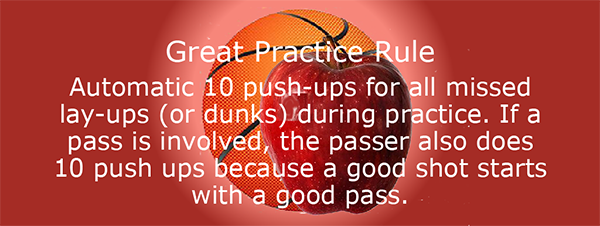
Great Practice Rule: Automatic 10 push-ups for all missed lay-ups (or dunks) during practice. If a pass is involved, the passer also does 10 push ups because a good shot starts with a good pass.

.

Five Stars

_____________________

The Art of Teaching Basketball

Coming Next:

Season Review & Goal Setting

_____________________

Art of Teaching Basketball Series
#1Coaching, Life Skills, Keys to SuccessTap Here to View
#2Legal LiabilitiesTap Here to View
#3Major Medical EmergenciesTap Here to View
#4Player Motivation & LearningTap Here to View
#5Player Learning StylesTap Here to View
#6Motor Skill LearningTap Here to View
#7Game of HabitsTap Here to View
#8Changing Bad HabitsTap Here to View
#9Goal Setting & Season ReviewTap Here to View

_____________________

Basketball: A Game of Habits

The Art of Teaching Basketball

What You Will Discover or Recall:

Game of Habits

Vital Importance of Keeping Hands Up

Preventing Bad Habits

“I am your constant companion. I am your greatest asset or heaviest burden. I will push you up to success or down to disappointment .

I am at your command. The things you do may as well be turned over to me. For I can do them quickly, correctly and profitably.

Those who are great, I have made them great. Those who are failures I have made failures.

I am not a machine, though I work with the precision of a Machine and the intelligence of a person. You can run me for profit, or you can run me for ruin. It makes no difference to me.

I am at your servant. Take me, educate me, lead me. Just be firm with me, and I will place the world at your feet.

Be easy with me and I will destroy you.”

Who am I?

Down Arrow

(Your Habits)

Aristotle habit quote

Habits are not instincts. They are conditioned reflexes created by repetitive acts over a period of time. They are embedded in the brain. Since the brain cannot decipher good habits from bad habits, bad habits cannot simply be erased. They must be changed and replaced which is no easy task. It can take years. You cannot achieve success just by thinking about what is correct. A player can listen and read about every aspect of successful shooting. However, the only way for that player to develop good shooting habits is by repeated shooting. “Perfect practice makes perfect.” Since our habits are the result of repetition over time, following the coach’s instructions, when a player makes their first shot it is probably luck. After repeated practice, if a player makes the thousandth shot and follows it up with the thousandth and one shot, it is a result of a good habit.

Luck vs Skill : Click Here to View

.

“Habits do not change during a game.”

This is true with team habits as well as individuals. Team habits are fostered and reinforced daily in practice. If a lack of effort, execution and discipline are tolerated or ignored in practice, they become bad habits. Therefore, the importance of paying attention to the smallest details cannot be over emphasized. If missed lay-ups, careless passing and bad shot selection is allowed in practice, it will definitely carry over into games. Coaches must persist and insist on proper execution and effort at all times.

In helping all your players in developing and refining their individual skills, it will not only provide them with the necessary training and habits that will afford them, along with the team, the best opportunity to be successful, but more importantly, have a great experience in this great game. Coaching great players is easy. Where great coaches excel is in getting the most out of every player on the squad regardless of physical abilities and skills. Individual player development, on and off the court, is by far the greatest satisfaction of coaching.

The Vital Importance of Keeping Your Hands Up

Importance of players' hands up at all times.

Often overlooked but a vital part of basketball is that the game is played with your hands up. You shoot, pass, dribble, receive, rebound, and play defense with the hands up. In fact, the only times a player’s hands are down is on a mistake such as a loose ball or when receiving a very low pass. Therefore, it is imperative that players, on every level of the game, create a habit of having their hands up at all times.

Both Hands Are Up When Shooting

All types of shots, including layups, are shot with the hands up. Since underhand lay ups are very susceptible to being blocked, it is highly recommended that players develop the habit of shooting layups overhand. Even with the two hand underhand free throw, the shooter finishes with both hands up. Note: the off hand plays a very important role in shooting the ball accurately.

Both Hands Are Up When Passing

Two hand chest pass, finish with thumbs down and palms out position follow through position. When executing a one-handed push pass the off arm is used to protect the ball from the defense. In throwing a baseball pass the off hand guides and protects the pass in the same matter as in shooting the ball. Except for an underhand flip pass, which most of the time is a dangerous and careless pass, all passes are executed with both hands up.

Both Hands Are Up When Receiving the Ball.

In passing the basketball, players should always pass to receivers that have both hands up and call for the ball. Therefore, to eliminate unforced turnovers, it is a good rule for players not to pass to any player with their hands down no matter how open. On the NBA level, players learn quickly to keep the hands up on offense; otherwise, their noses will be bloodied with sharp, crisp passes from great passers.

Both Hands Are Up When Dribbling

Both hands up dribbling

By rule the dribbling hand must remain on the top of the ball. In fact, it is a violation (carrying or palming the ball) and automatic turnover any time the ball is dribbled with the hand on the side or under the ball. The off hand is held in an elbow high position to protect the ball from the defender.

.

Both Hands Are Up On Defense

Both hands up on defense

When guarding the player with the ball, it is important to have both hands up in order to take away the shot and pass options and forcing the ballhandler out of a triple threat position. When guarding a player without the ball, having hands up allows for deflections and interceptions. It also discourages passers in throwing the ball to the defender’s opponent. When playing zone defense having both hands up is mandatory.

Both Hands Are Up Rebounding

Both hands are up rebounding

Both offensive and defensive rebounding positioning requires having both hands up ready to react to the ball. Rebounders must assume every shot is going to be missed. If they watch the flight of the ball with their hands down, they become easy targets to be boxed out.

Teaching Your Players to Listen

Improving hand quickness and playing skills in becoming a better player, starts by creating a habit of holding both hands up at all times when they are on the court. During practices, players should hold their hands up any time a coach is talking. This accomplishes two things:

  1. First and foremost, it is a good way to remind you to pay attention and listen. As a player, before you can learn any basketball skills, you must learn to listen and see.
  2. Secondly, in holding your hands up throughout practice, it helps to condition and strengthen all the muscles that are required to keep your hands up.

Once players learn to keep their hands up, it will eliminate many of the unforced turnovers along with increasing their scoring and passing abilities. By having your hands up, it also creates a positive attitude of wanting and calling for the ball which in turn develops and increases their confidence.

Preventing Bad Habits

  • The importance of “Early Time,” the time prior to practice starting, cannot be over emphasized. It is the foundation of a successful workout. Early Time does not only prepare players physically, but more importantly, it puts them in the right frame of mind. With a proper use of early time players will be able to better concentrate, understand, and learn.
  • Be sure to include the “When” and “Why” when teaching the “How” in skill development,
  • Bad habits, such as missing layups during a game, start in practice. If coaches tolerate missed layups, and dunks, during practice, don’t expect players to be perfect during games.
  • On offense, when in possession of the ball (triple threat) or dribbling make sure that the players see the floor by focusing their eyes on the rim.
  • On offensive and defensive transition, players must maintain vision on the ball and never run with their backs to the ball.
  • On offense and defense, players must assume that all shots will be missed and establish rebounding position.
  • On defense, players should always sprint back. You are never too late on defense.

.

Five Stars

_____________________

Coming Next:

Correcting Bad Habits

_____________________

Art of Teaching Basketball Series
#1Coaching, Life Skills, Keys to SuccessTap Here to View
#2Legal LiabilitiesTap Here to View
#3Major Medical EmergenciesTap Here to View
#4Motivation & LearningTap Here to View
#5Different Learning StylesTap Here to View
#6Motor Skill LearningTap Here to View
#7Game of HabitsTap Here to View
#8Changing Bad HabitsTap Here to View
#9Goal Setting & Season Review8/25/2020

_____________________