

Subscribe To The Newsletter Now

Subscribe To The HoopTactics Newsletter

Recently @ HoopTactics


Inside HoopTactics

Basketball Tips & Strategies – July

HoopTactics Newsletter

Coach John Wooden, Featured Play: UCLA Set Offense, Individual “On” Ball Defense

Premium Membership What’s New

John WoodenIn Memory of John Wooden

 “Success is peace of mind that is a direct result of self-satisfaction in knowing you made the effort to become the best that you are capable of becoming.”

Basketball Legend, John Wooden, was one of the greatest coaches in the history of the game. Although, his fame extended well  beyond the sports world, it was his success and achievements on the court for which he is best renowned. He is enshrined in the Basketball Hall of Fame, both as a player and a coach.

He was a three time all-state high school player winning a state championship in 1927 and a three time all-American for Perdue University winning Perdue’s only national championship in 1932. His coaching accolades include an unprecedented 10 NCAA National Basketball Championships and 88 consecutive victories. However, what is most encouraging about John Wooden’s coaching career is that he worked his way up through the ranks being a high school teacher and coach for 11 years, and a small college coach at Indiana Teachers College (now Indiana State University), prior to being hired by UCLA.

Wooden’s dynasty at UCLA was built on sound teaching and high standards. He demanded precise execution of fundamentals and teamwork based on his “Pyramid of Success.” In 2003 John Wooden received the US Medal of Freedom. The highest honor awarded to a US civilian.   John Wooden’s example, leadership and contributions to the game will definitely live on forever.


Featured Play: “UCLA” High Post Rub Offense
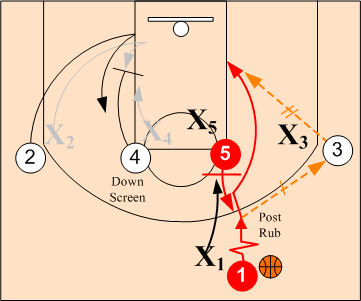
UCLA Set Offense

This potent high post attack was instrumental to the success of many of UCLA’s NCAA championship teams under coach John Wooden, and is commonly used on all levels of basketball, including the NBA. The UCLA Offense is a viable option for teams that do not have a bona fide low post player. It is primarily designed to take full advantage of a post player with good passing and shooting skills, but it also takes advantage of the post up abilities of a point guard and power forward. Like any successful offense, the UCLA offense is based on very sound principles and excellent court spacing.  Learn more about UCLA Offense High Post Rub Offense – Click Here

Off Season Player Development: Individual “On” Ball Defense

Individual “On Ball” defense is comprised of three basic fundamentals: Pressuring the player with the ball, containing a dribbler and attacking the picked up dribble. Summer basketball competition is an excellent opportunity for players to refine and improve individual defensive skills. However, with the main emphasis in these games placed on “showcasing” current abilities and strengths rather than utilizing the opportunity to improve their playing skills for future play, defensive efforts are usually lax.

Players need to take full responsibility in making off season skill improvement a primary goal. They do not need a coach or personal trainer. “A game within in a game” – Every time they take to the court, whether for a game, a practice or just a pickup game, they should make it a goal to work on improving a single or related defensive skill. They will still shoot, pass, dribble, and rebound. But, most importantly, they will be working hard to improve a specific defensive skill such as defending against dribble penetration. HoopTactics Premium Members: Learn all about defending the player with the ball – Click Here

Basketball Tips & Strategies – June

Quick Tip: Real Competitors

Real competitors are those special players that come to play every time they step on the court. They are a team’s hardest workers constantly, improving. They are not the type that scream at their teammates or officials or kick trash cans after the game. They are the type that are determined and just plain enjoy playing. Competitors are those players that players love to play with not against, spectators love to watch, and coaches love to coach.

Coaching Tips: Coach Players Not the System

It’s not what you run, but how you run it that counts. Basketball is not a game of offenses and defenses, but a game of effort and execution. Develop ALL of your players to the best of their capabilities. Coaching great players is easy. Where great coaches excel is in getting the most out of every player on the squad regardless of physical abilities and skills. Establish significant roles and responsibilities for every player on the squad. If you can’t, then release them. If you experience problems during games, go back and work on basic fundamentals and execution. Do not change or add new plays.

Player Tips: Developing a Strong Inside Game

Power Lay-Up

Posting up is a big part of the game of basketball. It is truly an advantage to have a dominant force inside. However, post ups are not limited to just big men, ALL players, regardless of size, should be proficient in posting up strong and executing basic post moves To exploit mismatches is much better to take the defender inside than to go one‐on‐one from the outside. The reason being, posting up eliminates any defenders from sagging off and helping out against dribble penetration. How are your post moves? Do you have a strong power lay up? Can you shoot the baby hook from both sides? Do you know how to read and seal off the defense? Do you have a deadly “Turn‐a‐round Jumper”? Can you counter a post double team? You should work just as hard on mastering post moves as you do your outside moves. Learn more about developing a strong inside game – Click Here

Food for Thought – May

HoopTactics Newsletter

Off Season Player Skill Development
Player Responsibility for Improving Skills
Value & Benefits of Playing 3-on-3

Player Improvement: Off Season Training

From October to April, teams are made. From April to October, individual players are made. This is the time of the year that players must develop and improve their individual basketball skills and techniques along with their physical attributes. However, to be successful, they must first take the time to do a self‐evaluation. Players should compile a list of the things they did well this past season, and the things they must or could improve. Things that they can do to make themselves more solid, stronger, aggressive and intelligent when they take the court this coming season. They should also seek input and specific recommendations for off season improvement from their coaches . Then use this self‐evaluation to plan and execute their off season workouts and skill development.

Player Improvement: Do It Yourself Program

Players should not depend entirely on coaches, parents or personal trainers to be successful. They must be self-motivated and rely on themselves. Baba Watson’s recent winner of the Masters’ Golf Tournament is a prime example of self motivation and development. He won the most prestigious professional tournament in golf without ever taking a golf lesson. He has learned and perfected the game of golf on his own initiative. Basketball is like a savings account at a bank. What you put into it, is exactly what you will get out of it. Players must prepare for the best. They should work individually on the things they need to improve, not just their strengths. Individual improvement is not all fun and games. Much of off season skill development is repetitive, monotonous and tedious. Bad habits can be practiced as well as good.

Success on the court  is not by chance or luck. Successful people have learned the value of setting specific goals and focusing their efforts toward achieving them. “Goals are the bridges that allow you to cross from DREAMS to REALITY.” A player “without goals is like a ship without a rudder.” Goals are what give direction to physical and mental training and improvement. They are the basis of self-motivation and the foundation of all achievements. However, goals must be personal. Something that players, personally, want and have a strong desire to pursue and achieve. It is because of this intense, personal desire to reach goals that will push them through adversity to success. Accomplishing goals and making dreams come true is incredibly satisfying. However, it is the journey, not the destination, that is the most important and rewarding part of dreams. Players must never stop improving and making it a goal to get better each and every day in some small way. Daily improvements eventually add up to huge gains. They should always keep moving forward setting new goals and dreaming new dreams. Players may never reach their ultimate, long term dream. However, this is irrelevant. The important thing is that they will become like their dreams.

However, remember: “If it’s going to be. . . It’s up to me.” – George Raveling.


Player Improvement: Playing Three-on-Three

Players should organize and play a lot of three-on-three half court competition during the off season. Since 3-on-3 provides for much more shooting, passing, rebounding, screening, and defensive repetitions, it is by far, the most efficient and effective use of their time in practicing and improving their fundamental skills. In a full court game of approximate a hour and a half, How many shots does a player take? How many rebounds do they grab? How many passes do they make? How many screens do they set and use? How many times do they guard a player with the ball? How many times do they defend against dribble penetration? How many times do they guard a player without the ball? Compare these figures with the totals that they would receive in playing the same 1 1/2 hours of three on three half court and you will instantly see the importance and value of 3-on-3 in improving and developing individual basketball skills to their fullest. In addition, after a long, hard season, 3-on-3 also saves additional wear and tear of players legs.  It also will help eliminate burn-out.

Caution: Playing full court only reinforces current abilities.

HoopTactics.com Player Development Section

HoopTactics Premium Player Development Presentations will definitely enhance players’ chances for success by greatly improving their playing skills, game preparation, and playing intelligence. Player Development Presentations consist of Player Prerequisites, Practicing Smart, Playing Smart, Offensive Skill Development and Defensive Skill Development. A special Student/Athlete Semi-Annual Premium Membership is available for only $19.95. (Must be enrolled in a school or college). To learn more Click Here >>>


HoopTactics Online Store


Basketball Staff Sweat Shirt


Basketball Staff and HoopTactics gear. Visit the HoopTactics online store to see what is available that will meet your basketball needs. Free shipping on orders over $60.

Click Here to visit HoopTactics’ Online Store


Now Available on Ipad - Click Here

Kindle Advanced Basketball Defense


Basketball Tips & Strategies – April

Coaching Tips: Setting Goals is a Key to Success

After a long season, coaches need to take some time off to recuperate and re‐charge their batteries. However, before doing so, while it is fresh in your mind, review, analyze and evaluate the past season. Examine exactly what was accomplished, what was successful, and what needs to be improved in the coming year. Then use this information to set goals and objectives for the coming season. Caution: setting goals, like potential energy, is useless until action is taken to implement and achieve them.

In addition, basketball coaches, just like any other member of the teaching profession, need to evaluate their own personal performance. Personal evaluations are something that is generally disliked. However, they are vital to the improvement of any coach and basketball program, especially the self‐evaluations. For printable Program Evaluation forms – Click Here

“Flight Time” – The Key to Successful Rebounding

Flight Time is the time it takes for the ball to leave a shooter’s hand until it gets to a position where it can be rebounded. This normally takes 2 to 3 seconds. What players do, or do not do, during this Flight Time period will determine their success or failure in rebounding. Flight Time is when the great players excel. Instead of watching the flight of the ball, much like a great outfielder, they anticipate a missed shot and immediately move to the area where the ball is most likely to rebound and establish inside position. Learn more – Premium Members Click Here

Player Tips: Off Season

From October to April, teams are made. From April to October, individual players are made. This is the time of the year that you must develop and improve your basketball skills and techniques along with your physical attributes. However, to be successful, you must first take the time to do a self‐evaluation. Compile a list of the things you did well this past season, and the things you must or could improve. Things that you can do to make yourself a more solid, stronger, aggressive and intelligent player when you take the court this coming season. Ask your coaches for their input and specific recommendations for off season improvement. Then use this self‐evaluation to plan your off season workouts and skill development.

Basketball is like a bank. What you put into it, is exactly what you will get out of it. Prepare for the best. Bad habits can be practiced as well as good. Work individually on precise footwork, keeping your hands up, and the things you need to improve, not just your strengths. Do it yourself. You do not need to depend on coaches, parents or personal trainers. Individual improvement is not all fun and games. Much of off season skill development is repetitive, monotonous and tedious. However, remember: “If it’s going to be. . . It’s up to me.” – George Raveling.

Organize and play a lot of three on three half court competition. Since three on three provides for much more shooting, passing, rebounding, screening, and defensive repetitions, it is by far, the most efficient use of your time in practicing and improving your fundamental skills. In addition, after a long, hard season, it also saves additional wear and tear of your legs. Playing full court only reinforces current abilities.