

Subscribe To The Newsletter Now

Subscribe To The HoopTactics Newsletter

Recently @ HoopTactics


Inside HoopTactics

Food for Thought – March 2015


Last Shot Guidelines
Last Shot Timing
Defending Last Shots
Comforting & Consoling Players

Coaching Strategies: Last Shot Guidelines

A last shot situation is not just a simple matter of drawing up a play. There are numerous last shot situations to address dependent on court location and time on the clock. When the outcome of the game comes down to a single shot, teams must maintain their poise and confidence. This confidence comes from being prepared.

  • Be sure to get the ball into the hands of your best player, and let them hit the open shot or teammate. Never allow your best player to take the ball out of bounds.
  • Players must read the defense and immediately take advantage of any defensive overplay. The type of defense being deploy will ultimately determine the last shot option. Normally, they will play soft if ahead and must pressure when behind.
  • Non-shooters should be well drilled to go to the offensive boards instead of watching the flight of the ball. Most last second games are won on putbacks not the shot.
  • Keep the play simple and execute. The more complex the action, the greater chance that a breakdown will occur.
  • Practice various last shot scenarios using the game clock. This not only develops proper play timing, spacing and execution, but it also builds players confidence that they can score with just seconds remaining.
  • Physical conditioning also plays a vital role late in a game. The team that is in better shape will definitely have the advantage in very tense games where players are physically tired, mentally beat, and emotionally drained. Note: normally, you can expect to win at least two games during the season by being in better shape that your opponents.

Last Shot Timing – Basic Rule

10 Seconds: Players need to be in position for play

8 Seconds: Initiate play

3-5 Seconds: Take the shot & go to offensive boards for second effort.

0-2 Seconds: If opponent does rebound they will not have enough time to advance ball down court for shot.

Maximum Number of Dribbles

At the end of a game or period players must know how many dribbles they can take.

3 Seconds = 1 Dribble

5 Seconds = 3 Dribbles

7 Seconds = 5 Dribbles

Required Fundamentals

Most last second shot plays require long passes. Therefore, players should practice and master the skill of making a skip pass (a crisp, accurate pass from sideline to sideline) along with a baseball or semi-hook pass from the backcourt endline to the opposite free throw line (“Elbow”). If players can not execute either of these passes, any last second shot play becomes worthless. Designated an inbounds passer. Make sure that your inbounds passer can successfully execute long passes and knows the rules.

Players should occasionally practice half court shots. This usually requires developing a two handed shot. With practice some players can become fairly accurate. Whenever possible, make the attempt from the center of the floor in line with the basket where a bank shot has the best percentage of being successful. A shoot around practice before game is a good time to practice half court shots. You can also end practices with a half court shot. Reward the first player to make one. Players love the challenge of trying to make half court shots.

Players should also practice tipping the basketball and re-directing a pass (less than second). The ability to tip the ball with both the right and left hand also plays an important role in offensive rebounding. Remember, most last shot games are won on the putback not the shot.

Printable Last Shot Guidelines Chart. Click Here >>>

Intentionally missing a free throw

NOTE: Chances are good during the season that an end of game situation will be encountered that requires the intentionally missing of a free throw; therefore, teams must be prepared for it. Intentional missing a free throw must be taught and practiced. Players must recognize and know what their assignments are on an “intentionally” missed free throw situation. Shooters must not only practice the intentional miss, they also need to be aware of the rule that the ball must hit the rim on the attempt.

Defending Against the Last Shot

Attack Rather Than React

Be aware of the team foul situation, and if you have a foul(s) to give. Be deceptive. Show man, but play zone on inbounds pass, or show zone and play man on inbounds pass.  Use a combination defense, especially against a star player.  Be disruptive. Double team to disrupt any set play.  Contest all shots, but do not foul. Switch all screens, and attack the passing lanes. Push ballhandlers to a sideline. This reduces the chance of a successful bank shot.

Rebound, Rebound & Rebound!

The vast majority of games that are decided by last shots are won on put backs — NOT the shots. Box out, especially on free throws.

You must eliminate any offensive rebound of a missed shot. This requires a team effort. Assume all shots are going to be missed. Do NOT watch the flight of the ball to see if it is going to be successful. Close out to spot up shooters on balance with both hands up. Be alert for a pump fake. Do not run at or past the shooter.

Note: Last year in the NCAA Men’s Final Four Tournament, four (4) games, along with any championship hopes, were lost by fouling shooters on last second three point shot attempts.

When you are unable to obtain actual ball possession on rebound, tip the ball away from the opponent or to a teammate.

 Importance of Comforting & Consoling Players
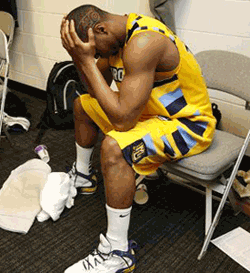
locker room lossIf not addressed, an end of game failure can become a devastating, life long, emotion injury. Be sure to immediately comfort, console, and restore the player’s confidence making sure that they realize that it was a good learning experience for things to come, not the end of the world. Basketball is a game, and it’s the effort that really counts, not the results. As long as they give their best effort, they will never lose a game – only run out of time.


Food for Thought – February 2015


Wise Substitutions
End of Game Guidelines
Double Teaming

Making Sound Substitutions

By establishing definite roles and responsibilities for each player, it takes the guess work out of substituting.

Come game time, a team should be well prepared technically, physically, and mentally. If the coach has done a great job of teaching and each player knows their role and assignments, substitutions should be just, basically, limited to keeping players rested and out of foul trouble. However, players should be well aware that it can be a real advantage to come off the bench since it gives a player the opportunity to watch and analyze their opponent actions and strengths. Offensively is the opponent a penetrator? A spot up shooter? A post up player, A screener? An offensive rebounder? etc. Defensively, how do they defend the post? are they zoning? If so, what type of zone and where are the open shots? Also, because officials have a tendency for the officials to call more fouls at the beginning of the game, by coming off the bench these early foul calls can be avoided.

Suggestions & Tips:

• Before each game inform the players as to the planned substitution order and timing. When the substitution order is known, the players will be better mentally prepared when it comes time to enter the game. Otherwise, you will have players watching the game clock, hoping to get into the game, instead of watching the game and analyzing their opponents’ actions. However, must be flexible since the best of game plans can go awry with early foul trouble or player injury.

• Any time a player(s) come out of game, make it mandatory to sit next to coach for communication purposes. Inform the player of the reason for the substitution, even if it is just for a short rest. To start the game this requires that the sixth person (first sub) sit next to coach on “Ready Alert” mentally prepared to enter the game.

• Great Substitution rule to use in order to encourage players to hard at all times along with preventing players from hitting the fatigue “wall” along with removing any fear or doubt of not getting back into the game:

If players take them selves out of game (by tugging on shirt) they get to put themselves back into the game when ready. If coach makes the substitution, then coach will make decision when to sub back into the game.

Note: when subbing back into the game, player may not necessary go back in for player who replaced them.

• On player mistake(s), try to wait until the player makes a positive play or touches the ball before making a substitution. You certainly do not want players on the court worried that if they make a mistake they will immediately pulled out of the game.
• To avoid serious player foul trouble, substitute on second personal foul in first half and on third personal foul early in the second half.

• AUTOMATIC SUBSTITUTION: On any behavior technical foul substitute immediately and have the player sit down next to coach until cooler head prevails. There is no place on the court for a player that has lost control. Players must be able to play through adversity and not let a bad call, play or opponent action cause them to loose control.

• At the beginning of the season, it is wise to rest your top players as much as possible. This will save their “Legs” for the critical end of the season and play-offs as well as reducing the risk of injury resulting from playing when physically tired. However, just as important, by giving reserves valuable playing time and experience, it will develop a team’s depth. In the event that a top-lined player is lost during a game or for the season, a player with quality game experience will be able to step-in and take their spot.

NOTE: On the colligate level, where RPI ratings are important for post season play and ratings, resting top players is very difficult. However, the basketball season is like a marathon, and you need players with “Fresh Legs” at the end. Forget the stats and rest your top players whenever possible. Go for the “Gold.” Many of Championships are lost because of tired legs.

Strategic Substitutions

• Early in the game, use substitutes to make changes and adjustments rather than taking a valuable time out.

• If you plan on using a player, be sure to get them some playing time in the first half. Certainly, do want to put a player into the game for the first time at the end of a close game.

• Make a substitute on a free throw situation to set a press or defense.

• Alternate offensive and defensive substitutions at end of game on free throws and time outs.

• When fouling to the stop the clock at the end of the game, make defensive substitutions whenever possible and put players into the game that can afford to foul instead of losing their best players because of disqualification. Once a foul has been committed, stopping the clock, players in foul trouble can be reinserted back into the game. Close game may go several overtimes.

• Make sure to have your best free throw shooters in the game when the opponent is in a must foul situation.

• Get an extra ballhandler on the floor against full court pressure.

• Make a mass substitution on rare occasions. If starters are not playing hard substitute immediately and let them sit for awhile. They will definitely get the message and their attention.

• To increase defensive motivation and intensity have players play until opponent scores a set amount of points, such as 6 points. They can score all they want, but just do not let the other team score. Once the opponents score six points substitute. You can adjust the points allowed such as six points for starters and four points for reserves.

CAUTION: Basketball, unlike other sports, does not have a “Mercy” rule. Therefore, when the teams are mismatched, it is the sole responsibility of the coach to see that the opposition does not get embarrassed by running up the score!

Coaching Strategies: End of Game Guidelines

End of game situations really become paramount during the end of the season when a single shot can make the difference of winning and losing along with determining a team’s playoff hopes and fate. Therefore, to be successful, teams must be prepare for end of game situations.

When Behind Late in the Game

The clock is the enemy, not the opponents. Seconds are precious. Every effort should be made to prevent time from running off the clock. By proper use of time outs and fouls the last few minutes of a game can be an eternity so don’t ever give up.

  1. Take a charge.
  2. Create a five (5) second violation.
  3. Steal the inbounds pass.
  4. Give a foul.
  5. Rebound aggressively at both ends. Putbacks and second efforts are vital.
  6. Push the ball on offense. Be quick but do not hurry. Make successful passes.
  7. Go strong to the basket. The opposing players usually play poor defense since they do not want to foul.

When Ahead Late in the Game

The clock is your ally. Do not stop it (unless in very serious trouble). Be sure that players know how many timeouts are remaining and if they have a foul(s) to give. Being aware of the timeout and team foul situations can make the difference in winning or losing.

  1. Maintain disruptive pressure without fouling.
  2. Deny dribble penetration. Build cushion staying between your opponent and the basket.
  3. Pressure all three point shots with both hands up high.
  4. Use a half court press to defend against fast breaks and slow game tempo.
  5. Box out and rebound. Do not allow any second efforts.
  6. Take care of the ball offensively. Maintain proper spacing and use sharp accurate passes.
  7. Move the ball and do not allow the opponent to stop the clock by fouling.

Premium Members Learn More:

Go to: Coaching Strategies/Winning Close Games/ Clock Management & Fouling


Playing Intelligently: Double Teaming

Double teams and traps require teamwork. One defender must contain (block the dribbler’s path), while the other defender attacks the ball. Players must know their roles when double teaming. If both defenders attack the ball or both contain, the offensive player will be able to split the trap. In containing the dribbler, the defender should take a charge whenever possible.

Influence the dribbler into a primary (corner) trap zone or secondary (sideline) trap zone. “LOCK UP” – Do not allow the offensive player to split the trap. Pressure the player with the ball with both hands, but do not foul. Be sure to employ quick helpside rotations when trapping. Once the trap is set, off ball defenders should be in position to deny all passing lanes out of the trap. Most passers will telegraph their passes. If/when pass is made out of the trap close out on the ball quickly. Trappers must sprint release and dive to basket into helpside I positions. Quick releases and rotations are a key ingredient to successful traps.

All or None Principle

When trapping, do NOT ever go half way. If you are going to trap – trap. However, players can and should fake a trap at anytime.

Common Errors Made When Trapping

Premium Members go to: Player Development/Defensive Skills/ Double Teaming/”Common Errors Made When Trapping”


Tips & Strategies – January 2015

HoopTactics Newsletter

Managing Your Timeouts Wisely

Avoiding Foul Trouble

Coaching Strategies: Managing Your Timeouts Wisely

Since timeouts are used primarily for strategy purposes, they play an important role in every basketball game, and are extremely crucial at the end of a close game. Therefore, they should be anticipated and used wisely. To get maximum benefit, whenever a timeout is called, players should run to the bench, especially in the case of a 20 or 30 second timeout. Note: if a player is so tired they cannot run to the bench, they should be replaced immediately. Full timeouts should be divided into two parts with the first 30 seconds being players’ time for water, towels, etc. For the last 30 seconds of a timeout all attention goes entirely to coach. Substitutes must also be alert and pay attention to the changes and adjustments being made.

Be sure to get eye contact and every player is listening before speaking. Also, make sure only one coach is speaking at time. Too many voices during a time out can be very distracting and detrimental. During timeouts, it is common place to observe four different coaches talking to different players at the same. Since players remember very little of what is said during a timeout, keep adjustments and changes simple. 1 to 3 things at the most. In addition, do not expect them to successfully execute anything new that you have not worked on in practice.

Play Diagrams: If you are going to draw plays during a timeout, make sure all players know how to understand them and that they are clearly drawn. Do not take it for granted that they have been taught how to interpret and understand play diagrams.

How to Read & Interpret Play Diagrams.  Click Here >>>

Double Check Timeouts

On every timeout, be sure an assistant coach double check with the official scorer on the exact number of personal fouls on each player and time outs remaining. Official scorers are known to make mistakes. However, if caught early it can be corrected. However, if a player foul discrepancy is discovered late in the game, there is nothing much that can be done to correct it. Coming out of time out, make sure every player must knows the number of time outs remaining and team foul situation. This is extremely important at the end of a close game. Games and national titles have been lost by players taking a timeout after a team has used their last timeout.

InGame Bench Chart (Timeouts, Team Fouls & Possession Arrow). Click Here to View/Print>>>

Learn More: Timeout Strategies

Premium Members go to: Coaching Strategies/Game Time Decisions/Timeouts/”Timeout Strategies & Tips”

SIDE NOTE: Before TV time outs and stopping the clock the last minute after made field coaches figured out ingenious ways to stop the clock. These uncharged timeouts included: fake injury, fake lost contact lens, accidental spilled water on floor, and even the spilling of popcorn on the court by a manager. Fortunately, with the stoppage of the clock in the last minute and increase in the number of time outs, these drastic measures are no longer needed.


Playing Intelligently: Avoiding Foul Trouble

Fouling plays a critical part in the out come of the game, especially when it comes playoff time. Fouls were added to the basketball rule book to penalize; however, intelligent players and teams use fouls to their advantage. When it comes to fouling to gain a competitive edge there is no margin for error. The difference between fouls being your ally or your enemy rests on a single foul. If you analyze fouling, you will quickly see that every time you step onto the court you can count on receiving three basic fouls:

Foul #1 – You will receive at least one bad call during the game.

Foul #2 – At least one charge/block judgment call will go against you.

Foul #3 – You will use at least one foul for strategy reasons.

Therefore, if you commit just one careless or lazy foul you are in foul trouble (Foul #4). You may commit a careless foul early in the game and think it is only your first foul. However, since the other three basic fouls are definitely coming it immediately puts you in foul trouble. Once you are in foul trouble you be come a defensive liability especially in the low post area. In the low post area, you will be forced to play behind your opponent with your hands up like a “prisoner” and only hope that your opponent does not score. If your opponent is smart they will take “no prisoners” and attack you at every opportunity.

What constitutes a careless or lazy foul?

1. Reaching instead of moving your feet to establish good defensive position.

2. Reaching because you are tired and out of condition.

3. Fouling out of frustration after a bad call or play. Committing a technical foul. Since most leagues now count technical fouls toward disqualification, loss of control not only puts you in foul trouble but also creates an unforced turnover! (See “Playing Through Adversity” Article).

4. Fouling because you are too slow getting back on defense and are out of position.

5. Trying to block shots instead of taking a charge.

6. Going over the back of an opponent for a rebound instead of establishing good rebounding position.

7. Fouling a player in the act of shooting.

8. Playing defense by standing behind a player in the low post area.

9. Establishing defensive stance after your opponent has already received the ball.

10. Fouling a dribbler from the side.

11. Committing an offensive foul by driving into a crowd.

12. Creating a foul on your teammate by coming off a screen before the screen has been set.

Tips & Strategies – December 2014

Holly

Looking for a Gift for the basketball enthusiast on your list?

How about giving them a HoopTactics Premium Membership? A perfect gift that will last for entire year and then some. Click Here

P.S. A copy of Advanced Basketball Defense would also be great to receive! Advanced Basketball Defense – Click Here

HoopTactics Newsletter

Importance of Using Pre-Season Games to Build Team Depth
Defensive Strategy – Quarter Court Trap
Player Development: Successfully Attacking Out Numbered Situations
“Hoop-y” Holidays

Coaching Strategies: Use Pre-season Games to Build Depth.

During Pre-season practice games, it is wise to rest your top players as much as possible. This will save their “Legs” for the critical end of the season and play-offs as well as reducing the risk of injury resulting from playing when physically tired. However, just as important, by giving reserves valuable playing time and experience, it will develop a team’s depth. In the event that a top-lined player is lost during a game or for the season, a player with quality game experience will be able to step-in and take their spot.

On the colligate level, where RPI ratings are important for post season play and ratings, resting top players is very difficult. However, the basketball season is like a marathon, and you need players with “Fresh Legs” at the end. Forget the stats and rest your top players whenever possible. Go for the “Gold.” Many of Championship hopes are lost because of tired legs at the end of a long season.

Defensive Strategies: Quarter Court Trap

Quarter Court Press

When the opponent spreads the court and tries to hold the ball, the Quarter Court trap becomes a viable defensive weapon.  It can also be used as surprise tactic after an opponent time out to force a quick turnover or to force the opponent into taking a valuable timeout.  The Quarter Court trap is deployed out of a 1-3-1 alignment which readily allows for trapping or double teaming the ball in the corners. It is a fairly easy defense to teach and learn. However, when deployed at the right time, it can create havoc and panic against any opponent who is not prepared to attack constant double teams.

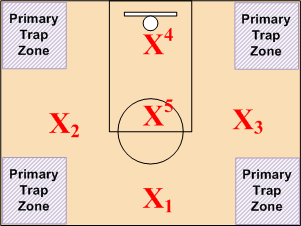
Primary Trap Zones

trap zones

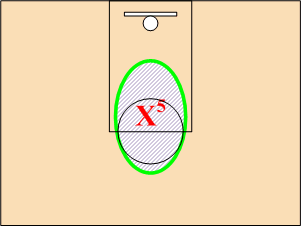
The Quarter Court trap takes full advantage of the primary trap zones.  A primary trap zone is an area on the court where two extra defenders (the out of bounds lines) come into play.

Player Roles & Responsibilities

double teams

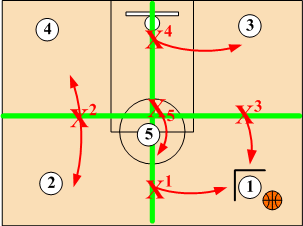
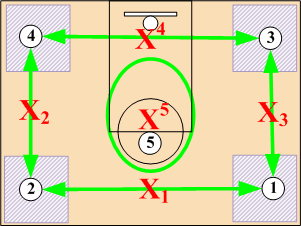
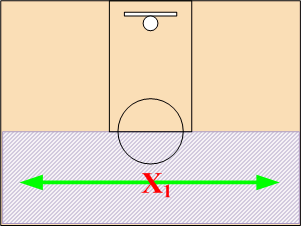
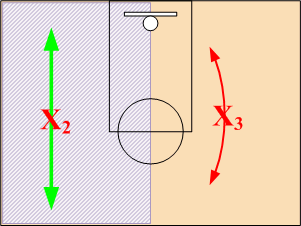
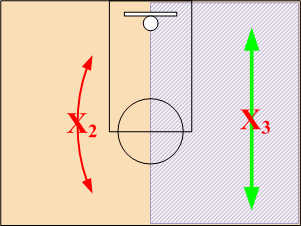
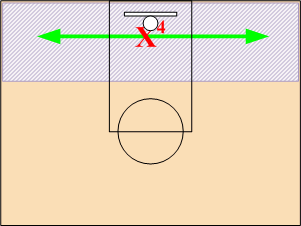
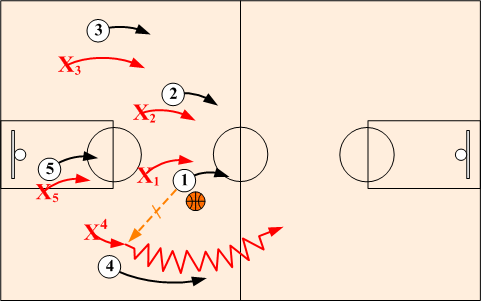
The Quart Court trap allows for constantly double teams on the ball.The Point guard X1 is responsible to traps the ball whenever it is above the free throw line. When the ball is below the free throw line, X1 becomes an interceptor anticipating a pass out of the baseline traps. Defender X4, assumes a position under the basket and is responsible for the baseline sideline to sideline. When the ball is below the free throw line they will trap. When it is above the free throw line they are an interceptor responsible for ball side corner. Defender X2 is responsible for the side area from the midcourt line to the baseline. When the ball is on their side of the court they trap. When it is on the opposite side, they assume an interceptor role. Defender X3 is responsible for the opposite side area from the midcourt line to the baseline. When the ball is on their side of the court they trap. When it is on the opposite side, they assume an interceptor role. Post defender X5 sole responsibility is to keep the ball out of the middle.

Basic Rotations

Top Right Corner

When the ball is in the top right corner, defenders X1 and X3 execute a hard double team. X4 attacks the baseline passing lane and X2 cuts off any cross court passes. Post X5 keeps the ball out of the middle.

Baseline Right Corner

If the ball is passed to the right baseline corner, X3 and X4 trap. X1 denies any passes back out, X2 cuts off the cross court passes, and X5 keeps the ball out of the middle.

Top Left Corner

When the ball is in the top left corner, X1 and X2 execute a hard double team. X4 attacks the baseline passing lane and X3 cuts off any cross court passes. Post X5 keeps the ball out of the middle.

Baseline Left Corner

If the ball is passed to the left baseline corner, defenders X2 and X4 trap. X1 denies any passes back out, X3 responsible for cross court passes, and post X5 keeps the ball out of the middle.

Middle

Should the ball get successfully into the middle, defender X5 assumes a “Nose on Chest” On-Ball position pushing O5 towards a corner or baseline pushpoint.

Premium Members Learn More: Quarter Court Trap Variations

Player Development: Successfully Attacking the Out Number Situations

Coaches, on all levels, should not make the mistake of assuming and taking for granted that players are skilled in attacking out numbered situations. In fact, there are very few coaches that actually take the time to teach or reinforce the principles and techniques required to successfully attack and score on out number situations. Failure to take advantage and capitalize on these situations will not only make the difference in winning or losing close games, it will also cancel any great defensive effort that created the out numbered situation in the first place.

Break Aways (1-on-0, 2-on-0)

Break Away

Main Objective: Lay up shot and steal

On all breakaways, it is imperative that you score. It is important that the player take as few dribbles as possible to get to the basket in order to prevent any defensive pursuit (“Wolf”) catching up with them from behind. Teammates should attempt to cut off defensive pursuit and/or get into rebounding position to follow up on any missed shot.

A five-on-zero (5-on-0) situation should never occur. The last two players, trailer and safety, should not go beyond half court assuming defensive responsibilities to prevent any counter break if the ball is turned over on the break away or ready to apply full court pressure after a successful basket.

Staying in bounds

Finishing

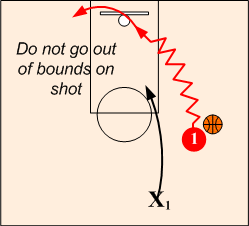
Players should be taught to go in hard to the basket and lay the ball up soft staying inbounds after shooting the lay up. Staying inbounds will force the shooter to go vertically on the shot rather than just throwing it up (vomiting) they run under the basket. When coming from a wing angle shooters should also stay above the block so that they can easily use the backboard on the shot.

Pass Ahead

Pass Ahead

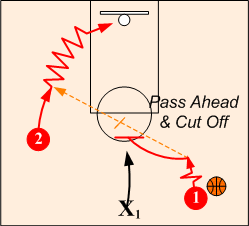
On all breakaways, whenever possible, players should pass the ball ahead. This will allow the ball to get to the basket quicker and an easier shot. The passer will also be able to cut off any defensive pursuit and be in position to rebound any missed shot.

NOTE: This situation brings out the “character” of a team. If a player dribbles selfishly to the basket instead of passing to a teammate ahead, you have real problems.

Double Back to Steal

Solo Press

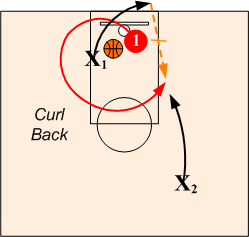
In most cases, after giving up an easy break away on a solo layup, the opponents are frustrated and disorganized, and, as a result, are very careless in bounding the ball (taking ball out with back to court, wrong player taking it out, etc). This provides an excellent opportunity for the shooter to curl around and steal the inbounds pass.

 CAUTION: Missed Layups
Basketball is a game of habits. Missed layups during a game can be traced directly back to practice. Therefore, do NOT ignore or tolerate missed layups in practice.

Automatic 10 Push ups Rule

Anytime a layup is missed in any drill, the player has automatic 10 push ups If a passer is involved on the missed layup, they too have 10 push ups Players will quickly understand the importance of making layups (finishing) and start taking missed layups very seriously.
Premium Members Learn More:

Capitalizing on 2-on-1 Situations, 3-on-2 situations, 3-on-3 Situations

Login and go to Offensive Strategies/Early Offense/Early Push/Attacking Out Number Situations


Hoop-y Holidays

Christmas Lights