

Subscribe To The Newsletter Now

Subscribe To The HoopTactics Newsletter

Recently @ HoopTactics


Inside HoopTactics

Tips & Strategies – November 2014

Fostering a Team Atmosphere

Team Atmosphere
Persistence a key to success
Insist on “Best Efforts” at all times
Real Competitors
Establishing Significant Player Roles

Basketball Team Atmosphere

“The whole (team) is greater than the sum of its parts (players).”

On every level of basketball, one of the most important aspects of coaching is creating and fostering a total team atmosphere and commitment. It is the difference between success and failure. Insure your players that they are going to play in a team atmosphere. Inform them that you are not going to tolerate anyone on the team that keeps others from learning, you from coaching or any other misbehavior. Get rid of the non-workers. Great teams are a result of the best players being the hardest workers. No one steps on the floor without full hustle attitude. Insist on a team effort at all times.

A SHORT COURSE IN HUMAN RELATIONS:

The One Most Important Word: “We”
The Least Important Word: “Me”

This team chemistry and love is an end product of great coaching and proper leadership. There is no “I” in the word “Team.” It is amazing how much can be accomplished when no one cares who gets the credit. The San Antonio Spurs, 2014 NBA Champions,  fully understood that the best potential of “me” is “we.” So much can learn about the importance of team play by watching the following this video. It vividly illustrate that “an individual can make a difference, but a team can make a miracle.” This team chemistry and love is an end product of great coaching and proper leadership.

San Antonio Spurs Tribute – The Beautiful Game (6:20)

 Persistence a Key Success

There is an old adage that is often times quoted: “Great teams play hard, play smart and play together.” However, there is one other very important ingredient that is missing from this cliché and that is “persistence.” Persistence is what enables players and teams to reach their full potential and goals. It is what separates the great ones from the mediocre ones. Most teams can play hard, play smart, and together for short periods of time. However, to be successful, they must be able to sustain this high level of effort over the course of the entire season which is no easy task.

Demand ”Best Efforts” at All Times

Habits do not change in a game. Never tolerate or ignore a player’s laid-back or apathetic attitude and efforts. All great players have one thing in common. They have great work ethics and will not be outworked by anyone. They pay attention to detail. Too much attention and recognition is paid to records and accomplishments, and not enough to the long, hard, hours, days, and years great players put into developing and refining the skills and techniques that make them so successful. In tolerating or ignoring a lack of effort and selfishness, coaches are not only cheating the team, but just as importantly, they are cheating the player and depriving them of any future opportunity to play on a higher level of the game.

Real Competitors are Vital to a Team Effort

Real competitors are those special players that come to play every time they step on the court. They are a team’s hardest workers constantly battling and competing. They are not the type that scream at their teammates or officials or kick trash cans after the game. relying on their brawn more than their brains. Real competitors dive for loose balls, take charges, fight for rebounds, etc. They just plain enjoy playing and never give up. Competitors are those players that players love to play with not against, spectators love to watch, and coaches love to coach. You cannot win without them.

Establish Significant Player Roles

Guarantee players that they will receive equal opportunities, but not equal playing time. Develop and establish significant roles and assignments for every player on the squad such as 6th Person, Defensive Stopper, Designated Inbounder, etc. Championships are never achieved without the unselfish play of the complementors on the team. Rather than scoring themselves, these role players make it possible for others to score. These supporting roles, which are vital to a total team effort, must be constantly acknowledge and reinforced by the entire coaching staff throughout the season.

6th Person Role

The importance of the sixth person(s) role in basketball cannot be over emphasized. It is one thing all excellent teams have in common. Establishing and utilizing the sixth person role, in many ways, is a much more important coach’s decision than determining the starters. To be successful, the sixth person(s) must possess better skills and leadership than some of the starters. In addition, the sixth person usually can play multiple positions. Without exception, when they enter the game, their role is to energize and make the team stronger. As a result, if the game is tied, it will provide the necessary boost to give the team the lead. If a team is already ahead, it will increase the lead, and if the team should be behind, it will afford them a chance to catch up. However, on the other hand, if the over all strength of the team is decreased with the first substitution, if the game is tied, the team will fall behind. If they are ahead at the time, it will allow the other team the opportunity to catch up, and if they are already behind at the time of substitution, they will fall further behind. In most cases the sixth person role is filled by a single player. However, it can be multiple players and on rare occasions even five players.

Determining and getting a player to accept the sixth person role can be a challenge since player’s and parents’ ego’s can be involved. However, by communicating the vital importance of this unselfish team role, they should be more than likely to understand and accept the role as a real honor rather than a demotion. The attitude and efforts of the sixth person(s) must be recognized, fostered and supported whole heartedly by the entire coaching staff throughout the season. The NBA has recognized the importance of the Sixth Man and presents an annual award for the leagues most valuable sixth person which is an excellent idea to do on any level or team.

Defensive Stopper

A vital but often overlook position is a defensive “Stopper.” Having an outstanding defensive player, one who not only can deny or disrupt a great offensive players from receiving the ball; but, in addition, are masters of one on one defense and push points is essential to any championship hopes. Like shooters, stoppers aren’t born and just don’t happen. They must be development and nourished. Successful defensive Stoppers are a result of having solid on and off ball defensive fundamentals along with a strong attitude and relentless determination. They are highly challenged and motivated when it comes to stopping and frustrating the opponent’s leading scorer. They thrive on the responsibility and opportunity of denying a good shooter a last second shot opportunity.

However, this attitude and self-confidence must be created, fostered and supported by the coaching staff throughout the season. Since a Defensive Stopper’s role is primarily that of a defensive specialist, any offensive output is a bonus. Their job is to stop not score. 

CAUTION: Do NOT go into a game without a defensive stopper!

Designated Inbounds Passer

“Good inbound passers are hard to find.”

It is not so easy to inbound ball. Most players and coaches take making an inbounds pass for granted, and rely on individual player effort to get the job done. However, in making an inbounds pass, the passer is facing a five against four defensive advantage and only has five (5) seconds in which to locate a receiver and make a successful inbounds pass. In addition, to this numerical disadvantage, by rule the inbounder cannot move, except after a made shot. This provides the defense with the opportunity to jam or smother the passer very effectively with an active defender on ball. Also, on baseline out of bound situations, the backboard comes into play and becomes a real obstacle in which that the inbounds passer has to contend.

Many of championships have been lost because teams were not able to inbound ball at end of game. Players on all levels, including the NBA and WNBA, need to know and practice the fundamental skills and concepts required in making a successful inbound pass. In additional to the physical skills involved, good inbound passers must posssess a strong commitment to team play since they are taken for granted and very rarely rewarded for the efforts. However, good inbounders are vital, and a team will not win a championship without one.

Team Leadership

Every team needs at least one leader. The coach on the floor. One that plays with intelligence and poise. They sacrifice and surrender “me” to “we.” This unselfish play makes their teammates better. Leaders play in the future constantly anticipating ahead of the current action. As a result, the game is actually played in slow motion to them. In thinking ahead, their heads are always in the game which allows them to play through adversity. They rarely get upset or loose their poise. On the other hand, players playing in the present, or worst yet, playing in the past, such as arguing about a bad call or upset about a teammates turnover, the game becomes more difficult and actually speeds up dramatically as they lag behind and attempt to catch up with the action.

Leaders also know their strengths and weakness and play within their limitations. Often times, a player’s lack of discipline and their ego’s get the best of them scoring at the expense of their teammates.. They will shoot three point shots when then effective range is inside the three point line. Relying on “hope” or luck rather than skill to make the shot. Selfish play is often times the result of outside pressures and influences such as parents, personal coaches and agents. However, no one likes to play with a “Ball Hog.”

Changing a “Me” to “We” attitude is a real challenge in coaching, and is the utmost importance to success.


Have Fun and Enjoy this great Game!

HoopTactics

Tips & Strategies – October 2014

Try-outs, Player Evaluations & Squad Selection

Basketball Tryouts

On the professional level, player evaluation is a high stake endeavor with millions of dollars involved. Physical abilities and skills are of the utmost magnitude. However, on most levels of the game, priorities and emphasis should be on solely on player skill development, not winning games. You will not need to look at the scoreboard to see who is ahead, it you take the time to teach your players how to shoot, pass, rebound and play defense.

Pre-season preparation and organization entails planting the seeds for a highly successful season. This involves careful thought and planning, starting out with a highly organized try-out and squad selection. Try-out plan should include: determining a team’s personnel needs, player evaluation method, and a final selection process. In conducting a highly organized try-out, it does not only allows for a fair and objective player evaluations; but, more importantly, it will provide coaches with a valuable understanding of the team’s overall skill level which is a great benefit and head start in planning pre-season practices.

Player evaluation is not easy. Expect a wide range of skill and experience levels. Know the difference between participants and players. Participants are those players that show up to practice and games only. Participation is usually the result of parents’ or peer’s decision. Players are those individuals who love the game and put in extra practice time. By providing a program of fun and individual skill development, coaches can turn participants into players. In emphasizing the importance of skill development, players will also become better “students” of the game and gain a greater understanding that competitions and games are won or lost for the most part during practice and preparation.


Six Steps to Conduct Successful Try-outs and Squad Selection

| Needs | Criteria | Evaluation Form | Organizing Tryout | Evaluation | Selection & Notification |

With players capable of improving daily, coaches should not cut players if at all possible. Adhere to the old adage, “When in doubt, keep.”  Also, keep and work with the “Bigs.” Don’t expect immediate dividends. They are a future investment. All of the legendary “Hall of Fame” coaches had one thing in common. They were great teachers who worked endless hours in developing their “Bigs.”

#1. Establish Team Needs

Before conducting any try-outs, you first must establish the team needs. Important team factors such as determining skill needs, position needs, team chemistry, substitution strength, along with the proper number of players to keep must be considered.

#2. Establish Player Evaluation Criteria

Once the team needs are determined and established, create established player evaluation criteria to best fit those needs. Coaches will need to assess the abilities of each player’s quickness, speed, jumping, coordination, alertness, shooting, passing, ball handling, rebounding, and defense. Along with evaluating a player’s skills, extreme importance is given to evaluating a player’s characteristics of attitude, discipline, cooperation, enthusiasm, self-control, and being coachable. Determining factors include:

  1. Determine the best players/athletes.
  2. Determine the best competitors.
  3. Determine the proper position for each player
  4. Determine the correct combination for the strongest possible starting unit
  5. Determine the first line replacements and possible realignment of positions to keep team strength

John Wooden’s, Legendary Hall of Fame Basketball Coach, criteria for a perfect player: Team player, plays both offense and defense, can rebound, offensively pretty good from the outside and good from the inside, good study and work habits and is never going to be an embarrassment in any way “on or off” the court.

#3. Create Player Evaluation Forms

Based on evaluation criteria, an Evaluation Form should be created and used for each player. Try to limit the criteria to 10 or fewer items. However, this will vary according to the number of candidates trying out, and also the level. The higher the level, the more detailed player evaluations will be required.

Important subjective characteristics

  1. Work ethic & Coachability
  2. Competiveness
  3. Positive Attitude & Appearance
  4. Reliability & Dependability
  5. Poise & Self control
  6. Loyalty & Integrity
  7. Leadership
  8. Determination & Confidence
  9. Experience & Years of Eligibility

Important Physical Characteristics

  1. Quickness and speed
  2. Size and jumping ability
  3. Shooting
  4. Inside Presence
  5. Passing Level
  6. Dribbling/Ball Handling
  7. Offensive Rebounding Ability
  8. Defensive Skills
  9. Def Rebounding Ability
  10. Conditioning

  Printable Player Evaluation Form

#4 Organizing the Try-out

Most tryouts amount to just scrimmaging and are basically a waste of time. Trying to evaluate players during an uncontrolled scrimmage is very difficult, if not impossible. The skills that are required to play organized basketball are entirely different that those required to play in unorganized scrimmages or pick up games.

Coaches’ Prerequisites:

  1. All coaches’ First Aid and CPR certifications are current.
  2. An organized plan for automatic response to medical emergencies is in place.
  3. Trainer and/or medical kit is available.

Player Prerequisities:

  1. Current physical exam and health insurance
  2. Filled out health record and emergency contact information
  3. Signed assumption of risk form (Required my most schools and associations)

Optional:

  1. Physical Measurements: Height, Weight, Reach, Arm Span, Age/Year in school
  2. Pre-Testing: Vertical Jump, Standing long jump, 40 yard dash, Sitting medicine ball toss, Agility Drills, etc.

Suggested Try Out Drills:

When conducting evaluation drills, it is best to group players into drills by position and abilities. Use simple breakdown drills that will demonstrate specific or closely related skills. Use several baskets at the same time. This will take pressure off the players and allow you to examine multiple candidates at the same time. When players are attempting an unfamiliar drill in front of peers and coaches, there is a good chance that, even, the most skilled and composed player will succumb under the pressure. You certainly do not want to miss out on a potentially great addition to your team because of a poorly organized tryout.

Wolf Drill: This one-on-one full court drill that will demonstrate players pursuit speed and ability to make lay-ups at top speed. View/Print

Free Throws: Have players shoot 50 free throws ten at a time. Record total made. This total can also be used in setting up a free throw ladder.

Five Spots Shooting Drill: This is an excellent drill to check players’ form and confidence. Players shoot at close range from five spots in front of basket. Players shoot at each spot until they make 5 shots in a row where they move to the next spot. Anytime they miss they go back to beginning. Object is to make 25 in a row. Record best efforts. View/Print

Range Finder Shooting Drill: This drill will establish a shooter’s range on five spokes radiating out from the basket. Shooting along one spoke at a time, the shooter takes a step back (away from the basket) anytime they make three shots in a row. If they miss three in a row a step closer to the basket. View/Print

Pass/Pass Passing Drill: Pair up facing each other at distance of 12 feet (width of lanes line). Making chest passes to each go down the court and make a lay-up. Start with six passes to start. After going down and back reduce the number of passes to 5, then 4, then 3. This will demonstrate players’ chest pass form along with the ability to lead receivers and handle the ball at high speeds. View/Print

Baseball Pass: Test players’ ability to make long, accurate passes. Have them make long passes subtracting the distance to the right or left to determine their adjusted accuracy distance. View/Print

Speed Dribbling: Set up a dribbling course using chairs. Players dribble to half court right handed and back to baseline left handed. Then weave through chairs to half court and back. Finish dribbling to half court left handed and back to baseline right handed. If possible, set up two courses and have players race against each other. View/Print

Speed Contest: Players sprint from baseline to opposite free throw Line. Pair up players and use a tournament or ladder format with winners moves up and losers moves down until you get a champion and all the places. In addition to determining each player’s acceleration and speed, the direct competition also eliminates timing and timing errors.

Scrimmaging:

One-on-One:  tournament or ladder format “Make it take it.” Three dribbles/no backing end. Group players into “Bigs” and “Smalls.” Use tournament format with winners moving up and losers down.

Three-on-Three (half or full court): Allows for better observations and evaluation of candidates’ skills both offensively & defensively. Try to set up teams with a pivot, point guard and an outside shooter.

Five-on-Five Full Court: If at all possible keep statistics. This will not only improve the caliber of scrimmage, it provides for statistician training. Set up round robin play, so that candidates are matched up against multiple opponents. Rate and rank all players into groups according to round robin observations and evaluations. Reorganized players into to goups according to rankings and play addition scrimmages.   Error in rating and ranking? Give players in lower ranked groups an incentive and opportunity to move up and play with a higher rank group if they play well.

Premium Members: Proven Scrimmage Drills

#5. Evaluating Players

Coach Tom Newell’s “Light Bulb” Evaluation:

30 watt player – puts forth minimum effort, has no real desire or passion for the game. no basketball outside practices

60 watt player – plays and practices hard but lacks experience, wants to get better, going to improve

90 watt player – has ability, inconsistent effort, missing in action about 25% of time because lack of preparation and focus.

Halogen – lives and dies basketball, real competitor, makes teammates better, player coaches love.

Give all candidates an equal opportunity to show skills and make squad. Use every available method for help in making accurate player evaluations such as observation, testing, statistics, player interviews and self-ratings. Look for positive attributes. Find reasons to keep rather than cut. What players can do, not what they cannot do. Be alert to spot good competitors. Also, consider team spirit and morale, and get rid of the non-workers. Great teams are a result of the best players being the hardest workers.

Coaches Evaluation Process

  1. Each Coach fills out an evaluation form for each player. This is important for player feedback and development.
  2. Conduct a coaches meeting to develop consensus evaluation. Find reasons to keep rather than cut. When in doubt keep. Let the player make decision.
  3. Hold private player meetings – review evaluation & decision. Get player’s input/self evaluation.

CAUTION

Be sure to keep a written copy of each player’s composite evaluation. This is especially true if you are coaching a school team where lawsuits are becoming common place. It is also important tool to use when meeting with players and/or parent(s) who may challenge your decision.

#6. Final Squad Selection/Cutting Players

“It’s all about the players, not the coach.”

Do not ever post a list. Inform each player personally. Coaches owe this courtesy to all the candidates. Communication is the utmost importance since getting cut from a team can be a traumatic experience that can last a life time. Candidates’ should never be treated as mere pawns, even on the professional levels. After all, they are human beings with feelings and were willing to contribute everything they could to you and the team.

Provide those players cut with a copy of the composite evaluation including a list of skills that they need to improve for future play. Also, ask them if they are interest in assuming other important team roles such as a team manager, statistician, video person, etc. Be sure to finish the player meeting on a positive note.


Remember Michael Jordon got cut in his sophomore year of high school!


COMING NEXT: Fostering a Team Attitude


Learn More: Visit HoopTactics.com


Tips & Strategies – September 2014

Best read online: hooptactics.com/Newsletter


Medical Emergency Preparation

Are you prepared for a player emergency?

Training & Certification
Sudden Cardio Death
Organizing an Automated Response System
Personal Liabilities – It’s the Law
Common Basketball Injuries
Injury Prevention & Player Safety
Heat Exhaustion & Heat Stroke

Training & Certification

Bleeding Injury

Is your First Aid and CPR training up to date?

If not, now  is a great time to become current. Training and certification does not take much time and the benefits are priceless. CPR (cardiopulmonary resuscitation) training is just not a simple matter of meeting a coaching certification requirement. It is a matter of obtaining the knowledge and capability to save the life of one of your players. Coaches should not step on the floor without it.

CAUTION: When undertaking First Aid and CPR training, do not vision yourself of saving a complete stranger’s life and receiving a medal. The life you are going to save is going to be someone close and dear to you (a parent, spouse, child, best friend, one of  your players, etc.)!

Washington State University women’s head basketball coach, June Daugherty, who not only had one of her players survive a cardiac arrest (stoppage of the heart), but also survived a cardiac arrest herself, has reminded HoopTactics just how important it is for not only coaches, but also all players as well, to be trained in CPR (cardiopulmonary resuscitation). It was a teammate that administered CPR that saved the life of her former player!

 Online Resources:

Save a Life: View Learn Hands-Only CPR Demo Video (1:10 minutes) Click Here

Learn/Review CPR Online – Free public service supported by the University of Washington School of Medicine – Click Here

American Red Cross First Aid-CPR-AED Classes –  Click Here

Sudden Cardio Death

Do you know that basketball carries the highest risk for Sudden Cardio Death?

Unconscious Player

Sudden Cardio Death is the number one cause of death among athletes. Recently, a high school player received national media attention when he died after making a game winning shot. This did not only sent shock waves throughout the basketball world, but brought out the concerns of the hidden health dangers faced by young athletes and the importance of coaches being prepared for on the court life threatening emergencies.

In that same week, four other basketball related sudden cardio deaths occurred. In the United States over a 100 sudden cardio deaths occur annually among middle school, high school and college athletes with basketball having the highest risk. That is one every three days. The risk of sudden cardiac death among NCAA Division I male players is 1 in 3,000. The most common cause of sudden cardio related deaths among young athletes is hypertrophic cardiomyopathy a thickening of the heart muscle. This abnormal growth which goes undetected in most cases, can cause cardiac arrest during exertion particularly in young African-American players where the risk is 3X greater than Caucasian players. The risk of sudden cardio death is also 3X greater in males than females.

Sudden Cardio Death Survival

The good news is, if CPR is started and defibrillation applied within the first few minutes of sudden cardio death, the chances of survival are great. Automatic External Defibrillator (AED’s) are now required by law in public malls, airports, and casinos. However, 30 states still do not require them in schools. Fortunately, administrators, foundations and communities are realizing the real need for AED’s and providing a growing number of schools with AED’s. Make sure your school or venue has one available. Proper use of an Automatic External Defibrillator (AED) is relatively simple matter and only takes a few minutes to learn. AED’s are practically “dummy” proof. They will only automatically fire (shock) if it is warranted. Note: Coaches’ accessibility after school hours can be a problem that needs to be address.

Screening & Prevention

Since athletic training and competition increases the risk of sudden cardiac death in players with underlying heart disease, the American Heart Association, highly recommends that student/athletes be screened with a careful history, including family history and through physical examination including EKG’s and Echocardiograms. However, testing and screening will not detect all causes of sudden cardio death. Currently, 80% occur with no warning or previous symptoms including family history. Therefore, all coaches must be prepared. This means not only being CPR trained, but also having a plan of action in place.

Minnesota’s “Anyone can save a life” Response Model

Note: This emergency response model is applicable to all basketball programs on all levels, youth through professional, not just high schools. If you are conducting a basketball program on any level, it is your responsibility to have an automated response system in place in the event of an emergency.

Minnesota State High School League has organized a terrific plan to respond to sudden cardiac emergencies. The program named “Anyone Can Save a Life,” empowers coaches to organize their teams into action in the event of an emergency. It requires coaches to spend 10 minutes at the beginning of each team’s season asking questions of his/her team as to how many have been trained in CPR and would they be willing to assist in the event of an emergency if needed? From this dialog, players are then assigned emergency roles. This creates an automatic response system which allows the coach to remain with the victim without having to give direction.

Automated Response System:

1. At least two players are assigned to call 911.

2. At least two players are assigned to run to the athletic trainer’s office.

3. Two players are assigned to know where the nearest AED device is and to go retrieve it.

4. Other players are assigned to go to a pre-determined locations to meet the medics or an ambulance.

After those assignments have been made, the coach fills out a worksheet, which is kept on record in the school’s athletic office. Each team is required to review the assignments periodically during the season.

View/Print Printable Medical Emergency Response Assignment Form

While this may seem like just one more thing to add to a coach’s workload, most coaches understand the importance of having a plan and a course of action in place. The chances of a positive and successful outcome in the event of an emergency, far outweighs the added responsibility of a coach of having one more thing to do.

Coaching  Liabilities & Responsibilities

Liability laws have been enacted to protect athletes and to provide for a safe and healthy environment. Failure  to Act Prudently During a Medical Emergency is major coaching responsibility. It is also the coach’s legal responsibility to be aware of any pre-existing health problems their players may possess. Court decisions have held that coaches have the duty to be aware of all players’ physical fitness, medical conditions, and skill level.

Require written proof of physical exams prior to participation along with evidence of medical insurance. In addition, be sure to create a list of players’ emergency phone numbers and keep it available at all times.

View/Print  Printable Emergency Phone Numbers Form

CAUTION: Health care providers cannot lawfully render treatment to a patient without consent. When a minor is involved, consent must be obtained from a parent or legal guardian. Having a “consent form” on file not only expedites medical care, but also provides some protection against a parent’s claim that emergency care was not authorized. Consent forms should list any allergies to medications along with specifying who to notify in the event of a medical emergency.

Common Basketball Injuries

Do you know the proper treatment for  a bloody nose?

Player Injury

Unfortunately in basketball injuries do occur. Each year, more than 1.6 million basketball-related injuries are treated in hospitals, doctors’ offices, clinics, ambulatory surgery centers and hospital emergency rooms. Therefore, all coaches, assistants, volunteers, and personal trainers, in addition to having a current first aid & CPR certification, should be alert to treat the following basketball related injuries:

Note: Make sure that a first aid kit and supplies including ice or cold packs are available for every practice and game. Also, make sure that the training or first aid room is accessable. This is especially true during non-school hours.

Head, Neck & Back injuries: Be extremely cautious when it comes to head, neck and back injuries. First aid: take all head, neck and back  injuries seriously. Remove from practice or game immediately and seek medical advice. Requires doctor’s permission before returning to play.

Concussions:  A must read for all coaches, paid or volunteer, on every level of the game!  Click Here >>>

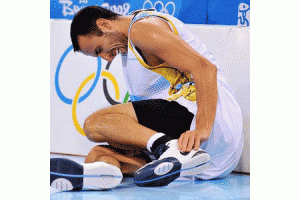
Ankle Sprains: First aid: Ice and elevation (internal bleeding). If/when no ice available tie shoe strings tighter. Do not remove shoe. Serious sprains require x-rays.

Knee Twist: First aid: Ice and elevation. Seek medical evaluation.

Bleeding: Cuts especially around the eye brows (Elbows) First aid: Using gloves apply a sterile gauze pad(s) apply direct pressure and elevation.

Bloody Nose: First aid: Have player sitting down, pinch nose (direct pressure) and lean slightly forward using a towel or sterile gauze pad.

Abrasions (floor burns): First Aid: wash with soap and water. Cover loosely.

Dislocations: Fingers, shoulder First aid: immobilize and transport. Do NOT try to relieve dislocation.

Jammed finger or thumb: First aid: apply ice. Tape injured finger to adjacent finger by rapping two thin pieces of tape between joints. Do NOT tape over a joint.

Heat Exhaustion (excessive sweating): First Aid: Cool down immediately and give water. Do not put back into game. Heat exhaustion can progress into life threatening heat stroke.

Muscle Cramps: First aid: apply direct pressure. Once relieve, massage or knead. Adnominal cramps are serious seek medical assistance immediately.

Contusions and Bruises: First Aid: apply ice to injured area (internal bleeding).

Strains & Muscle Pulls: Growing, Thighs, Hamstrings First Aid: Ice

Knocked Out Tooth: First Aid: Jam tooth back into position and transport to dentist. If tooth, cannot be held in place in mouth, put it into cold water or milk. Dental injuries are all too common among young athletes, especially those playing basketball and baseball. According to the National Youth Sports Safety Foundation, more than 3 million teeth will be knocked out in youth sporting events in the United States this year.

Youth Basketball – Minor bumps, falls, and pride injuries: First Aid: Take to water fountain and have them drink or rub some “Holy Water” on injury.

CAUTION Do not use elastic bandages except for holding on ice bags. Elastic bandages can cut off circulation and form blood clots which can be life threatening.

Injury Prevention & Player Safety

Player safety is an awesome responsibility and liability that is inherited with basketball coaching. It includes facility and equipment usage, proper skill & technique instructions, educating players, warming up & cooling down, and providing sufficient player rest during practice or games.

Facilities & Equipment Usage

Learn to be cognizant of potential dangers and hazards around the court area at all times.  Prior to any practice, game or open gym, make sure the facility is safe. Adhere to the first aid adage, “Ounce of prevention is worth a pound of cure.” Learn to be cognizant of potential dangers and hazards around the court area at all times. Double check to see that all standards are stowed out of the way, balls remained picked up, water is not on the floor, etc.

Make routine equipment inspections. Baskets and boundary lines should not be too close to walls, bleachers, water fountains, or other structures. Goals, as well as the walls  behind them, should be padded.

List and post rules & warnings for equipment usage especially in weight rooms.  Have all equipment installed and repaired by qualified personnel only. Make sure that a first aid kit and supplies including ice or cold packs are available for practices as well as games.

Provide Proper Skill & Technique Instruction

Coaches must follow the accepted practices for teaching specific basketball skills and techniques. Certain drills and other methods that are standard for basketball instruction should be followed. It is especially important that coaches focus on the more hazardous areas of basketball training, such as proper techniques for taking a charge or diving for a loose balls.

Coaches should constantly update their coaching knowledge and expertise by attending classes, seminars, clinics and through online resources such as HoopTactics. If coaching certification is required, keep it up to date.

Player  Guidelines for Injury Prevention

The American Academy of Orthopedic Surgeons offers the following 12 recommendations and ways for players to prevent basketball injuries:

  1. Always take time to warm up and stretch. Research studies have shown that cold muscles are more prone to injury.
  2. Play only your position and know where other players are on the court to reduce the chance of collisions.
  3. Avoid contact. Do not ever hold, block, push, charge, or     trip an opponent. Know the proper technique to “give” a foul at the end of a game.
  4. Use proper techniques for taking charges and diving for loose balls.
  5. Select basketball shoes that fit snugly, offer support, and are non-skid. Cotton socks can absorb perspiration and also give added support  to the foot. Be sure to lace up shoes tightly.
  6. Protective knee and elbow pads will protect you from bruises and abrasions. Use  ankle braces to reduce the incidence of ankle sprains.
  7. Use a mouth guard to protect your teeth and mouth.  If you wear glasses, use safety glasses or glass guards protect your eyes.
  8. Do not wear jewelry or chew gum during practice or games.
  9. Avoid playing tired. Take water breaks and rest as needed. Fatigue not only cuts down on performance, but also drastically increases the chances of injury.
  10. Outdoor courts should be free of rocks, holes, and other hazards. Inside courts should be clean, free of debris, and have good traction.
  11. When playing outside, environmental conditions must be considered. Players should avoid playing in extreme weather or on courts that are  not properly lighted in the evening.
  12. Be knowledgeable about first aid and be able to administer it for minor injuries, such as facial cuts, bruises, abrasions, along with minor tendinitis, strains,  or sprains.

 Proper Warm Up

Starting a strenuous physical activity, such as basketball, without proper warm-up is detrimental to athletic performance and health. The purpose of  a warm-up is to prepare for muscular activity, and is not an exhausting activity to bring on fatigue. It should be composed mainly of stretching and  light running exercises. It should be of sufficient duration and intensity to adequately prepare players for the physical demands of the game or work-out.

Cooling Down

Cooling down and/or stretching after practice can be more beneficial to injury prevention than stretching at the start of practice. Think about ending  workouts and practices by making 10 consecutive free throws. For younger players make 10 free throws.

 Sufficient Player Rest

It is imperative to provide  players with ample rest during a game or practice. This is especially true when participating in big games and tournaments. In practice, be sure to follow  strenuous drills with water breaks or light  drills such as shooting.

Playing tired not only reduces a player’s performance and effectiveness, but more importantly, increases their chance of injury. When tired, players are more apt to lose their balance along with the ability to avoid contact.

A great substitution rule to use in order to encourage players to hard at all times along with preventing players from hitting the fatigue “wall” along with removing any fear or doubt of not getting back into the game:

If players take them selves out of game (by tugging on shirt) they get to put themselves back into the game when ready. If coach makes the substitution, then coach will make decision when to sub back into the game.

Note: when subbing back into the game, player may not necessary go back in for player who replaced them.

Heat Exhaustion & Heat Stroke

Players can overheat by doing too much, too fast or enduring too long.  Be vigilant for  heavy sweating since it is a major symptom of heat exhaustion and early sign of heat stroke. Heat stroke is the third most common cause of death among athletes. Therefore, it is imperative to remove and immediately cool any player from competition  or practice suspected of having any signs of heat exhaustion or stroke. Heat stroke has a 100% survival rate when a player is cooled down within the first ten minutes. However, the mortality rate increases tremendously with time. In just 30 to 40 minutes the survival rate is less than 40%.

With heat exhaustion, once cooled down and feeling better, players will want to resume play or practice. However, do not ever allow them to return. They are finished for the day since continue participation can result in life threating heat stroke.

CAUTION: Over motivated coaches can also greatly contribute to player injuries and heat stroke by overtraining players. Do not run a “Boot Camp” by pushing players too hard and running them into the ground the first few days of practice. This will only result in sore, achy muscles that will be detrimental and hinder player performance and learning over the next few weeks. Basketball conditioning is best done over a period time using full court drills. You want your team in the best physical shape at the end of the season when it counts, not the first week of practice.


Coming Next: Try-Outs, Player Evaluation & Squad Selection


Tips & Strategies – August 2014

Caution: A Mandatory read before stepping out onto the court!!!


Personal Liabilities Inherited with Coaching

Coaching Liabilities

As a coach, doing what you love to do is awesome and rewarding. However, it can really come back and haunt you if you do not adhere to your legal responsibilities. With the alarming increase in the number of sports lawsuits in recent years, coaches on all levels of the game, paid or volunteer, must be acutely aware of the legal ramifications and responsibilities that accompany coaching. These personal liabilities cannot be ignored or avoided. Criminal charges and civic lawsuits, no matter how frivolous and unjustified, are very serious matters that can be devastating and costly, even when they are won or dismissed.

Liability laws have been enacted to protect athletes and to provide for a safe and healthy environment. Legal liability is established through negligent or intentional acts that harm a third party either through omission (not performing an act that is expected to be performed by a prudent person) or by commission (performing an intentional act that results in harm). Examples of coaches’ personal liability can include: Failure to Stay within Job Description, Faulty Equipment or Usage, Insufficient Supervision, Inadequate Instruction, Failure to Act Prudently During a Medical Emergency, Failure to Report Harassment (Bullying), Hazing or Sexual Misconduct, Failure to Supervise Volunteers, and Improper Transportation.

 12 Ways to Protect Yourself Against Legal Liabilities

By addressing the following 12 coaching obligations and responsibilities, it will not only help protect you from lawsuits and legal challenges, but it will also insure your players of a wholesome participation and safe environment.

1. Have Personal Liability Insurance

Personal liability can and does result in civil lawsuits, criminal charges, exposed personal assets, loss of careers and reputation damage. Therefore, coaches must have appropriate insurance that covers both public liability and personal accidents. Do NOT go on the court without it. The risks are too great!

Make sure that all volunteer coaches are aware of their need for liability insurance. You will also need personal liability insurance that covers basketball camps, off season (summer) coaching, open gyms and any personal training since schools  require proof of liability insurance for non-school facility usage.

 2. Stay within the Job Description following school/district policies and Federal laws.

As a coach, you are acting as an agent of your employer, as long as you stay within the course and scope of your designated and assigned duties. Acting outside of a job description will expose you to personal liability. Do not assume duties, make sure that you have a written contract and/or job description. Also, make sure that your entire coaching staff, paid and volunteer, are aware of their duties and personal liabilities.

3. Warn Participants of Risks

Players must be warned of the risks in playing basketball. Provide a written document warning parents and players of the inherent risks unique to basketball. Obtain a signed acknowledgement of the risk warning document from parent and athlete prior to participation. Be sure to alert and warn players of any changes in equipment, rules, techniques or strategy. Keep a written record of time, place, subject and method of these changes.

 4. Require Proof of Physical Exams, Medical Insurance and Treatment Consent

Require proof of physical exams prior to participation. Court decisions have held that coaches have the duty to be aware of all players’ physical fitness, medical conditions, and skill level. Also, require evidence of medical insurance.

CAUTION: Health care providers cannot lawfully render treatment to a patient without consent. When a minor is involved, consent must be obtained from a parent or legal guardian. Having a “consent form” on file not only expedites medical care, but also provides some protection against a parent’s claim that emergency care was not authorized. Consent forms should list any allergies to medications along with specifying who to notify in the event of a medical emergency. 

5. Provide Proper Supervision

Basic rule: If you cannot see them, you are not supervising them!

Provide proper supervision of players at all times. This includes waiting time prior to practice. As a coach you must also reasonably foresee potential dangers along with watching out for and prohibiting players to practice or play with injuries. Be particularly alert and cautious of players exhibiting any concussion symptoms.

Concussions – A must read for all coaches!

 6. Provide Safe Equipment & Facilities

 Prior to any practice, game or open gym, make sure the facility is safe. Adhere to the first aid adage, “Ounce of prevention is worth a pound of cure.” Learn to be cognizant of potential dangers and hazards around the court area at all times. Double check to see that all standards are stowed out of the way, balls remained picked up, water is not on the floor, etc. Make routine equipment inspections. List and post rules & warnings for equipment usage especially in weight rooms.  Have all equipment installed and repaired by qualified personnel only. Make sure that a first aid kit and supplies including ice or cold packs are available for practices as well as games.

 7. Provide Proper Instruction

 Coaches must follow the accepted practices for teaching specific basketball skills and techniques. Certain drills and other methods that are standard for basketball instruction should be followed. It is especially important that coaches focus on the more hazardous areas of basketball training, such as proper techniques for taking a charge or diving for a loose balls. Coaches must also keep a record of daily practice plans documenting all training activities by time, place, subject and method. Coaches should constantly update their coaching knowledge and expertise by attending classes, seminars, clinics and through online resources such as HoopTactics. If coaching certification is required, keep it up to date.

 8. Follow prudent and approved protocols during an emergency

Coaches are legally responsible for the safety of their players. Unfortunately basketball injuries do occur. Each year, more than 1.6 million basketball-related injuries are treated in hospitals, doctors’ offices, clinics, ambulatory surgery centers and hospital emergency rooms. Therefore, all coaches must be certified in basic first aid and in CPR. Prior to every practice or game, make sure that you have access to first aid facilities and a means by which to contact emergency services. A first aid kit and supplies including ice or cold packs should also be available at all times. Once an athlete has suffered an injury, clearance to return to play must be provided by a doctor in writing. Do not play hurt or injured players.

Organize and have in place an Emergency Medical Plan tailored to the availability of school and local community resources. All coaches and players must be specifically trained how to activate and execute the Emergency Medical Plan. Also, develop an alternative Emergency Medical Plan to be executed when traveling to another facility.

 9. Report Suspected Abuse Immediately

It is the coach’s responsibility, and required by law, to protect players against all forms of abuse. Coaches must be able to recognize indicators that may signify abuse and take appropriate action if concerned.

  • Neglect (inadequate food)
  • Emotional abuse (threats, taunts)
  • Sexual abuse (misconduct, pornography)
  • Physical abuse (trauma or bruising)

CAUTION: Failure to report sexual misconduct, harassment (bullying), and physical abuse are criminal offenses.

In addition, coaches have an ethical and legal responsibility to educate their athletes about drug & supplement use and abuse along with providing general nutritional advice. Give players advice and guidance only when appropriate, and never offer any advice beyond your level of qualification and training. Player Confidentiality: Never discuss a player with anyone except parents or school administrators or authorized legal authorities.

10. Follow Transportation Rules

Buses are the safest mode of transportation. If school vans are used make sure that they are not overloaded (maximum capacity of ten) and that drivers are properly licensed and insured. Require players to always return with the team. Never allow a player to return with anyone except a parent. Require a written release with the parent’s signature, if a player is released to their parents rather than traveling back with the team. If transportation is not provided, let parents know in writing that they will be responsible for transportation. It is highly recommended that coaches do not use their personal vehicles for transporting players to away venues. If you do use your own vehicle, make sure that you are properly insured. Never transport students alone in your car!

 11. Maintain Strict Accountability When Handling Fees and Money

Be extremely cautious when collecting fees and monies. Whenever possible, ask for payments to be made with checks, money orders or credit cards. For any cash payments issue receipts and keep possession of your receipt book for 5 years. Always have a witness when counting cash. Do not store cash. Deposit it immediately using the proper channels and obtain a receipt. Do not ever open a personal basketball bank account or deal in petty cash unless you are running your own basketball camp, tournament or personal training and have a business license.

CAUTION: You may be held responsible for funds collected by parents or boosters for team related matters. Make sure that they follow all district and athletic department accounting and reporting policies.

12. Keep Written Records

Keeping written records is a must. Being right is not enough. Coaches and their designees have to prove it. Be sure to keep a file of the following records:

  • Proof of certification and First Aid/CPR training.
  • Player Physical Exams
  • Signed Warning of Risks Document
  • Eligibility Information
  • Written Practice Plans
  • Written Emergency Action Plan
  • Copies of all Injury and Accident Forms
  • Parent/Guardian Consent forms
  • Written doctor’s return to play clearances
  • Alternate transportation permission slips
  • All Financial Collections & Transactions.

It is highly recommended that you keep files for at least five to seven years since many lawsuits do not occur until years after the fact.