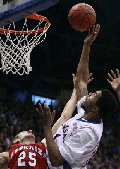


Subscribe To The Newsletter Now

Subscribe To The HoopTactics Newsletter

Recently @ HoopTactics


Inside HoopTactics

Tips & Strategies – January 2013

HoopTactics Newsletter

“RBP’s” – Really Big Plays
Defensive Recovery (“Wolf”)
Loose Ball Save or Recovery
Taking an Offensive Charge
Offensive Rebound on a Missed Free Throw
Inbounds Pass Interception

RBP’s – “Really Big Plays”

When teams are evenly matched, the outcome of the game can be determined on a single big play. “RBP’s” (Really Big Plays) are the result of just plain determination and hustle. Really Big Plays include: a successful “Wolf” (defensive recovery), taking a charge, a loose ball recovery, and an offensive rebound off a missed free throw. All of these extra effort actions will ignite and inspire teammates, and, as a result, change the momentum and outcome of the game. The nice thing about RBP’s is that they do not require any special abilities or talent on the part of the players. Anyone can make them. However, RBP’s cannot be taken for granted and must be practiced and refined.

“Wolf” – Defensive Recovery

“Wolf” is a term used to describe the action of a defensive player on a break away pursues the dribbler from behind preventing or disrupting a sure lay-up shot. Catching a dribbler from behind to block or disrupt a shot is a RBP. When wolfing and catching a dribbler from behind, players should attempt to block the shot low using the hand closest to the ballhandler. Low blocks not only disrupt the shot, but usually cause the ball to be deflected off the shooter resulting in a turnover. Blocking the ball high can result in contact and a foul being called. Also, when successful high blocks usually go directly out of bounds allowing the opponents to retain ball possession.

When wolfing, the defender should stop and NEVER go under or beyond the backboard. Nothing good ever happens to a defensive player behind the backboard. By exerting strong pressure from behind (wolf), it will force the ballhandler into taking a rushed or hurried shot increasing the chance of a missed shot. Therefore, it is imperative for the defender to assume that the shot will be missed and rebound. Securing a defensive rebound will trigger a counter break and an outnumbered situation going back the other way.

Premium Members learn more: Defending Out Numbered Situations Click Here >>>

Loose Ball Save or  Recovery
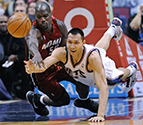
Loose Ball DiveGoing to the floor or out of bounds to recover a loose ball always sets the tone of game. Making a save or recovery that ordinarily would not be made is a RBP. When going to the floor for after a loose ball, players should use a “Volleyball” dive tipping or deflecting the ball to teammate. Always save to a teammate. When ball goes out of bounds, teammates instead of watching should create passing lanes by forming a semi-circle. NEVER save ball directly under the opponent’s basket. Throw the ball out to the sideline or near mid court. That way, if the ball is intercepted defenders are in place. When a ball intercepted directly under basket it will result in an easy basket for opponent.

In teaching players to properly go to the floor for loose balls, seek the the advice and expertise of a volleyball coach. Note: Coaches can be held legally liable if the proper techniques are not taught.

Premium Members learn more: Gaining Possession of Loose Balls & Deflections >>>

Taking an Offensive Charge
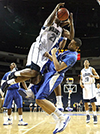
Taking an Offensive ChargeAnticipating and taking an offensive charge is a “Really Big Play” (RBP) in basketball. It not only takes away a potential basket and creates an offensive turnover but it also assesses the offensive player with an additional penalty of a personal foul. When taking a charge, it is important to try to establish good defensive position by squaring up before the ball handler can get into a shooting motion, preferably outside the three second area. Officials have a tendency to call blocks rather than offensive charges inside the 3 second area. If a blocking foul is called when the defender is outside the free throw lane, it will be a non-shooting foul (unless in the bonus).

CAUTION: When taking a charge, players should always tuck their chins in and never roll on their neck or head.

In taking a charge it is very important to eliminate injuries. Defenders must be taught and trained in the correct way to absorb the contact.  This includes tucking their chins into their neck to prevent their head from hitting the floor, and falling  backwards, lowering their center of gravity by sitting down keeping their arms tucked in close to their body. Reaching backwards with an arm to break the fall can result in a serious arm or wrist injury. Also, if the defender remains rigid and does not give on contact, injuries to one or both players are likely to occur. 

By knowing how to properly take a charge not only prevents injuries; but, more importantly, players are more likely to take charges during a game.

Offensive Rebound on Missed Free Throw

Obtaining an offensive rebound off a missed free throw is a RBP. Rather than size and strength that is required for defensive rebounding, offensive rebounding requires anticipation, determination, and hustle. Offensive rebounds on free throw situations really become paramount at the end of the game. If behind, an offensive rebound will provide a team with another chance to catch up. If ahead, they will allow a team to run off additional clock, denying the opponents any opportunity to catch up.

Offensive rebounding requires that the offensive players be active and box out the defensive players. In most situations, since players and teams watch the flight of the ball and do a poor job of boxing out, all the offensive players have to do is simply step around the defender to establish inside rebounding position. However, in cases, where defenders do block out, offensive players need to know how to use arm over and spin techniques to get inside. In addition, on free throw situations, players can use stunts and teamwork such as “Duck” or “Cross.”

Premium Members learn more: Offensive Rebounding Techniques & Second Efforts – Click Here >>>

Interception of Inbounds Pass

Defending Inbounds PassIntercepting an inbounds pass, especially late in the game, is a really big play. When an opponent takes a time out to set up a game winning out of bounds play, it can all go for naught ifan alert defensive player anticipates and steals the inbounds pass. In most cases, the steal of a sideline inbounds pass will result in an easy layup since the opponent will have no one back to defend the basket.

Defending out of bounds plays, cannot be left up to chance. Coaches spend considerable amounts of practice time working on offensive baseline out of bounds plays, but spend little or no time on ways to defend them. As a result, too many easy baskets are given up during the course of the game on out of bounds plays simply because teams are not prepared to stop them. If you analyze “Out of Bound” situations, they are unique in that it is the only time during the game of basketball where the defense actually has an advantage. Coaches should exploit this numerical player advantage to its fullest. Since the vast majority of out of bounds plays revolve around screens, the various techniques used to defend against screens can be incorporated into an effective out of bounds defensive attack.

Four Effective Ways to Combat the Baseline Out of Bounds. Premium Member’s Click Here >>>

Related HoopTactics’ Newsletter:

February 2011: 15 Nightmares to Avoid That Will Upset Your Championship Dreams and Haunt You the Rest of Your Life.



Join the HoopTactics’ Premium Team and Gain a Competitive Advantage

“Quit wasting your time searching the net for ideas and answers.”

HoopTactics is a comprehensive resource designed to greatly enhance your basketball knowledge and expertise. It is comprised of a multitude of in-depth, easy to understand, graphical presentations that take you through the inner-workings of hundreds of proven strategies in great detail. Whether you are looking for new ideas or just looking to refresh your memory, you will not find a better and faster basketball resource. Guaranteed! Learn more about Premium Membership – Click here to visit HoopTactics

HoopTactics Online Store
 

Basketball Staff Sweat Shirt


Basketball Staff and HoopTactics gear. Visit the HoopTactics online store to see what is available that will meet your basketball needs. Free shipping on orders over $60.

Click Here to visit HoopTactics’ Online Store


Advanced Basketball Defense
Advanced Basketball Defense Availale on iPad

Kindle Advanced Basketball Defense


Basketball Tips & Strategies December 2012


“Hoop-y” Holidays

 Holly

Looking for a Special Gift for the basketball enthusiast on your list?

How about giving them a HoopTactics Premium Membership? A perfect gift that will last for entire year and then some. Click Here

P.S. A copy of Advanced Basketball Defense would also be great to receive! Advanced Basketball Defense – Click Here

HoopTactics Newsletter

Attacking Out Numbered Situations
Breakaways (1-on-0,  2-on-0)
Attacking 2-on-1 Situations
Attacking 3-on-1 Situations
Attacking 3-on-2 Situations
Attacking 3-on-3 Situations
Coaching Tip: Missed Layups

 Attacking the Out Number Situations

“You Must Score to be Successful.”

Coaches, on all levels, should not make the mistake of assuming and taking for granted that players are skilled in attacking out numbered situations. In fact, there are very few coaches that actually take the time to teach or reinforce the fundamentals and principles required to successfully attack and score on out number situations. Failure to take advantage and capitalize on these situations will not only make the difference in winning or losing close games, it will also cancel any great defensive effort that created the out numbered situation in the first place.

Breakaways (1-on-0, 2-on-0)

Main Objective: Layup shot and steal

On all breakaways, it is imperative that you score. It is important that the player take as few dribbles as possible to get to the basket in order to prevent any defensive pursuit (wolf) catching up with them from behind. Teammates should attempt to cut off defensive pursuit and/or get into rebounding position to follow any missed shot. A 5-on-0 situation should never occur. The last two players, trailer and safety, should not go beyond half court and assume defensive responsibilities to prevent any counter break if/when the ball is turned over on the break away or ready to apply full court pressure after a successful basket.  

Players should be taught to go in hard to the basket and lay the ball up soft staying inbounds after shooting the lay up. Staying inbounds will force the shooter to go vertically on the shot rather than just throwing it up (vomiting) they run under the basket. When coming from a wing angle shooters should also stay above the block so that they can easily use the backboard on the shot.

In most cases, after giving up an easy break away on a solo lay up, the opponents are frustrated and disorganized, and, as a result, are very careless in bounding the ball (taking ball out with back to court, wrong player taking it out, etc). This provides an excellent opportunity for the shooter to curl around and steal the inbounds pass.

Premium Members learn more about breakaways –  Click Here >>>

Attacking 2-on-1 Situations

Main Objective: Layup and steal

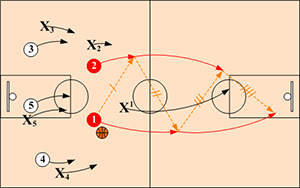
2 on 1 fast break

On any two on one situation, it is important to attack the basket and obtain a lay up. The ball should be advanced by passing between players with little or no dribbling. This will allow the ball to get down the court faster and prevent the defender from focusing on just one player. Once in the scoring area, players should be alert to read and counter the defender’s action. CAUTION: The passer, after making a pass, must always be alert to stop and avoid charging into the defender.  

Premium Members learn more about attacking 2-on-1 situations –   Click Here >>>

Attacking 3-on-1 Situations

Main Objective: To create a two-on-one situation and obtain a layup shot.

If at all possible, on a three on one situation the offensive players should immediately try to create a break away or a two on one situation by passing the ball ahead. Otherwise, the defender will just take a defensive position near the basket and force a jump shot.

Premium Members learn more about attacking 3-on-1 situations – Click Here >>>

Attacking 3-on-2 Situations

Main Objective: Open jump shot and putback (on miss).

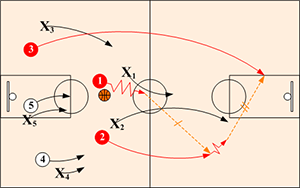
3 on 2 fast break situation


On a three on two situation, whenever possible pass the ball ahead and try to create a 2-on-1 situation for a lay up shot.  However, unless the defense is extremely poor or has a breakdown, a lay up shot will not be feasible. Therefore, on 3-on-2 situations the offense should be content with taking an open jump shot and taking real advantage of the out number situation to rebound any missed shot. 

Premium Members  learn more about attacking 3-on-2 situations –  Click Here >>>  

Attacking 3-on-3 Situations

Main Objective: Create a 3-on-2 situation or flow directly into early offense

On a three on three situation, whenever possible, the ball handler should try to drive past the middle defender and create a 3 on 2 situation. If not possible, then flow directly into early offense.

The key to a successful early push is a team’s ability to make the transition to offense and bust out faster than the opponent can make a defensive transition and get back. If executed to perfection early push usually ends up with an easy shot off an out numbered situation. However, gaining an out numbered player advantage is not the only benefit from an early push. Easy baskets and/or defensive fouls are also a result of the defensive players not having enough time to set up, and often end up out of position unable to make a play. Easy baskets and defensive fouls off player mismatches are another benefit to the early push, since the defensive players do not have ample amount of time to assume their desired matchups.

To learn more about Early Offense: Free Area Click Here >>>    
Premium Members
Click Here >>>

Coaching Tip: Missed Layups

Basketball is a game of habits. Missed layups during a game can be traced directly back to practice. Do not ignore or tolerate missed layups in practice. Good rule: anytime a layup is missed in any drill, the player has automatic 10 pushups. If a passer is involved on a missed layup, they too have 10 push ups. Players will quickly understand the importance of finishing and start concentrating in making their layups which will carry over to games.

 Coming Next Month: RBP’s (Really Big Plays)


Join the HoopTactics’ Premium Team and Gain a Competitive Advantage

HoopTactics is a comprehensive resource designed to greatly enhance your basketball knowledge and expertise. It is comprised of a multitude of in-depth, easy to understand, graphical presentations that take you through the inner-workings of hundreds of proven strategies in great detail. Whether you are looking for new ideas or just looking to refresh your memory, you will not find a better and faster basketball resource. Guaranteed! Learn more about Premium Membership – Click here to visit HoopTactics

HoopTactics Online Store


Basketball Staff Sweat Shirt


Basketball Staff and HoopTactics gear. Visit the HoopTactics online store to see what is available that will meet your basketball needs. Free shipping on orders over $60.

Click Here to visit HoopTactics’ Online Store


Advanced Basketball Defense

Advanced Basketball Defense Availale on iPad

Kindle Advanced Basketball Defense


Basketball Tips & Strategies – November 2012

HoopTactics Newsletter

Rebounding (General)
Flight Time
Rebound Location
Desire and Determination
Defensive Rebounding
Shot Blocking
Offensive Rebounding

Rebounding

 You Can Over Shoot, Over Dribble, or Over Pass, but You Can Never Over Rebound!

Most coaches have a tendency to look at rebounding in terms of total rebounds, and view rebounding as a single endeavor. In fact, until 1973 rebounds were kept as a single statistic and not broken down into offense and defense. However, offensive and defensive rebounding are entirely two distinct basketball skills. Defensive rebounding relies mainly on positioning and strength while offensive rebounding requires agility and movement. Defensive rebounding also requires a total team effort while offensive rebounding is mainly an individual effort. Therefore, defensive and offensive rebounding skills and techniques must be addressed and perfected separately. However, offensive and defensive rebounding do have four things in common:

  1. Assuming all shots will be missed
  2. Anticipating rebound location
  3. “Flight Time” effort
  4. Determination

Anticipation  “Flight Time” Flight Time is the time it takes for the ball to leave a shooter’s hand until it gets to a position where it can be rebounded. This normally takes 2 to 3 seconds. What players do, or do not do, during this Flight Time period will determine their success or failure in rebounding. Flight Time is when the great players excel. Instead of watching the flight of the ball, much like a great outfielder, they assume that the shot will be missed and move into proper position for the rebound.

Rebound Location. Before you can rebound the ball, offensively or defensively, you need to know where to rebound it. Rebound location is dependent on three factors.: 1) The angle from the basket, 2) the shot distance, and 3) the shooter’s touch.
Premium HoopTactics’ Members learn more: Flight Time and Rebounding Location

Must Want the Ball. Being in the right place at the right time is not enough when it comes to rebounding. To be highly successful, players must also want, and be very determined, to get the ball. This mental aspect of rebounding is just as important as the actual physical techniques. Desire and determination is also what allows players with lesser physical abilities to out perform players with greater talent.

Defensive Rebounding

“Defense is not over until you get the rebound!”

Defensive ReboundingThe importance of rebounding defensively cannot be over emphasized. A rebound on defense is equivalent to a made shot on offense. A team can play tremendous defense and force a bad or rushed shot, but this defensive effort will be wasted if the offense is allowed to rebound the missed shot. For any defensive effort to be successful it must end in a turnover or defensive rebound (defensive stop).

Defensive rebounding is a coordinated team effort, and every player must realize that it is just as important to box out and prevent their opponent from getting the rebound as it is to obtain the rebound. Therefore, defensive rebounding is one of those situations in basketball where it’s not the number of times you do, but it’s the time you do not that counts. This means that the defenders block every offensive player’s path to the basket and ball on every shot during a game. This is especially true for the shooter since they know where the ball is going as soon as it leaves their hand.

Boxing Out: Do not leave boxing out up to chance. Boxing out defensively is not a single technique or endeavor. On the countary, players must possess a working knowledge of how to box out a shooter, from a ball side pass denial, from a sagged off helpside position and from a post denial position. All of which require different techniques.
Premium HoopTactics Members learn more: Defensive Rebounding Techniques

In boxing out players must develop an attitude as well as an instinct for the ball. They must play mentally strong and want the basketball. Rebound by grasping the ball with two hands. Protect ball by chining ball with elbows out. If possible, players should make a quarter turn before landing so that you can see the court without pivoting prior to making the outlet pass.

CAUTION: Avoid making a bad outlet pass or throwing the ball away after obtaining the rebound. There is nothing worse than turning the ball over on a careless outlet pass after a defensive rebound.

Premium HoopTactic Members learn more:
Common Rebounding Errors, Special Rebounding Situations (Free Throws, Last Shot, Exceptional Offensive Rebounder)

Shot Blocking. Stay down and rebound. Players should not attempt to block shots, unless they have the physical size and ability to block shots. Instead they should stay down and establish good rebounding position. If a player does have shot blocking capabilities, be sure to block the shots to themselves or a teammate. A blocked shot that goes out of bounds is of no value. Shot blocking is usually a result of a defensive error on the part of a peripheral defender. Therefore, poor defensive teams will have a tendency to have higher shot blocking numbers.

NOTE: It is much more wiser to take a charge than it is to block a shot.

Rebounding Offensively

Offensive ReboundingThe importance of offensive rebounding is vital to the outcome of the game. Simply stated, even if you shoot well, it is going to be very difficult to win if you get only one shot. Rather than size and strength that is required for defensive rebounding, offensive rebounding requires anticipation, determination, and hustle. Players must develop an attitude as well as an instinct for the ball. They must be aggressive and determined, and 3rd and 4th efforts should be common place to offensive rebounding.

Shot selection also plays a vital role in offensive rebounding. Not much can be done in the way of offensive rebounding when the shooter takes a bad shot. In situations where good shots are taken, a missed shot will result in a good pass to an offensive rebounder. Although, shooting percentages do reflect shot selection tendencies, it really does matter how many shots it takes on a possession as long as you score.
Premium Members learn more: Four Basic Offensive Rebounding Techniques

Second Effort Points. In order for offensive rebounding to be successful you must score. Points scored on second efforts is an important statistic. You can get all the offensive rebounds you want, but it you do not convert them to points they are of little value. Easy putback shots off missed shots not only puts points on the scoreboard, but are also very demoralizing to the opponent as well.

Premium Members learn more:

 Tips, Putbacks & Rebound Shots, Maintaining Defensive Balance, Team Offensive Rebounding Techniques.


Join the HoopTactics’ Premium Team and Gain a Competitive Advantage

HoopTactics is a comprehensive resource designed to greatly enhance your basketball knowledge and expertise. It is comprised of a multitude of in-depth, easy to understand, graphical presentations that take you through the inner-workings of hundreds of proven strategies in great detail. Whether you are looking for new ideas or just looking to refresh your memory, you will not find a better and faster basketball resource. Guaranteed! Learn more about Premium Membership – Click here to visit HoopTactics

HoopTactics Online Store


Basketball Staff Sweat Shirt


Basketball Staff and HoopTactics gear. Visit the HoopTactics online store to see what is available that will meet your basketball needs. Free shipping on orders over $60.

Click Here to visit HoopTactics’ Online Store


Advanced Basketball Defense

Advanced Basketball Defense Availale on iPad

Kindle Advanced Basketball Defense


Basketball Tips & Strategies – October 2012

HoopTactics Newsletter

Fostering a Team Atmosphere
Persistence a Key To Success
Demanding Best Efforts
Establishing Significant Player Roles
Competitors & Team Leaders

Fostering a Team Atmosphere


“The whole (team) is greater than the sum of its parts (players).”

On every level of basketball, one of the most important aspects of coaching is creating and fostering a total team atmosphere and commitment.  It is the difference between success and failure. Insure your players that they are going to play in a team atmosphere. Inform them that you are not going to tolerate anyone on the team that keeps others from learning, you from coaching or any other misbehavior. Get rid of the non-workers. Great teams are a result of the best players being the hardest workers. No one steps on the floor without full hustle attitude. Insist on a team effort at all times.

Persistence a Key To Success

There is an old adage that is often times quoted: “Great teams play hard, play smart and play together.” However, there is one other very important ingredient that is missing and that is “persistence.” Persistence is what enables players and teams to reach their full potential and goals. It is what separates the great ones from the mediocre ones. Most teams can play hard, play smart, and together for short periods of time. However, to be successful, they must be able to sustain this high level of effort over the course of the entire season which is no easy task.

Demand “Best Efforts” at All Times

Habits do not change in a game (See last month’s newsletter). Never tolerate or ignore a player’s laid-back or apathetic attitude and efforts. All great players have one thing in common. They have great work ethics and will not be outworked by anyone. They pay attention to detail. Too much attention and recognition is paid to records and accomplishments, and not enough to the long, hard, hours, days, and years great players put into developing and refining the skills and techniques that make them so successful. In tolerating or ignoring a lack of effort and selfishness, coaches are not only cheating the team, but just as importantly, they are cheating the player and depriving them of any future opportunity to play on a higher level of the game.

Establish Significant Player Roles

Guarantee players that they will receive equal opportunities, but not equal playing time. Develop and establish significant roles and assignments for every player on the squad such as 6th Person, Defensive Stopper, Designated Inbounder, etc. Championships are never achieved without the unselfish play of the complementors on the team. Rather than scoring themselves, these role players make it possible for others to score. These supporting roles, which are vital to a total team effort, must be constantly acknowledge and reinforced by the entire coaching staff throughout the season. Premium HoopTactics Members learn more:

The Vital Importance of the 6th Person Role 
Developing a Defensive Stopper
Inbounding the Ball Under Pressure

Real Competitors

Real competitors are those special players that come to play every time they step on the court. They are a team’s hardest workers constantly battling and competing. They are not the type that scream at their teammates or officials or kick trash cans after the game. They rely on their brawn more than their brains. They dive for loose balls, take charges, fight for rebounds, etc.  They  just plain enjoy playing and never give up. Competitors are those players that players love to play with not against, spectators love to watch, and coaches love to coach. You cannot win without them.

Premium Members Learn more about “Real” competitors. Click Here.

Team Leaders

Every team needs at least one leader. The coach on the floor. One that plays with intelligence and poise.  They sacrifice and  surrender “me” to “we.” This unselfish play makes their teammates better. Leaders play in the future constantly anticipating ahead of the current action. As a result, the game is actually played in slow motion to them. In thinking ahead, their heads are always in the game which allows them to play through adversity. They rarely get upset or  loose their poise. On the other hand,  players playing in the present, or worst yet, playing in the past, such as arguing about a bad call or upset about a teammates turnover, the game becomes more difficult and actually speeds up dramatically as they lag behind and attempt to catch up with the action.

Leaders also know their strengths and weakness and play within their limitations.  Often times, a player’s lack of discipline and their ego’s get the best of them scoring at the expense of their teammates.. They will shoot three point shots when then effective range is inside the three point line. Relying on “hope” or luck rather than skill to make the shot. Selfish play is often times the result of outside pressures and influences such as parents, personal coaches and agents. However, what ever the reason, no one likes to play with a “Ball Hog.”

Changing a “Me” to “We” attitude is a real challenge in coaching, and is the utmost importance to success.


Join the HoopTactics’ Premium Team and Gain a Competitive Advantage

HoopTactics is a comprehensive resource designed to greatly enhance your basketball knowledge and expertise. It is comprised of a multitude of in-depth, easy to understand, graphical presentations that take you through the inner-workings of hundreds of proven strategies in great detail. Whether you are looking for new ideas or just looking to refresh your memory, you will not find a better and faster basketball resource. Guaranteed! Learn more about Premium Membership – Click here to visit HoopTactics

HoopTactics Online Store


Basketball Staff Sweat Shirt


Basketball Staff and HoopTactics gear. Visit the HoopTactics online store to see what is available that will meet your basketball needs. Free shipping on orders over $60.

Click Here to visit HoopTactics’ Online Store


Advanced Basketball Defense

Advanced Basketball Defense Availale on iPad

Kindle Advanced Basketball Defense