

Subscribe To The Newsletter Now

Subscribe To The HoopTactics Newsletter

Recently @ HoopTactics


Inside HoopTactics

Basketball Tips & Strategies – December 2008
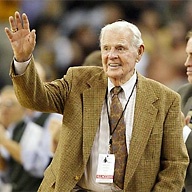
Coach Pete Newell

In Memory of Pete Newell

Beloved Hall of Fame coach, who was one of the game’s greatest teachers.

He will be thoroughly missed. However, his legacy and contributions to the game will live on forever.

“Coaching lasts only for a game, but teaching lasts for a lifetime” -Pete Newell

Quick Tip: Teaching & Learning

Be sure to teach players to listen. Demand and get eye contact of all players prior to speaking. It is imperative that any time a coach talks everyone listens (including assistant coaches). Also, make sure that the entire coaching staff is well coordinated and uses the same offensive and defensive terminology. Do not over coach and keep instructions simple. Talk to players’ level. Whenever possible use short descriptive terms. Clarify rather than confuse. Tell players what you are going to teach them, teach them, and tell them what you taught them.

Coaching Tips: Developing a Defensive Stopper.

A vital but often overlook position on a team is a defensive “Stopper.” Having an outstanding defensive player is essential to any championship hopes. Like shooters, stoppers aren’t born and just don’t happen. They must be development and nourished. Successful defensive Stoppers are a result of having solid on and off ball defensive fundamentals along with a strong attitude and relentless determination. They are highly challenged and motivated when it comes to stopping and frustrating the opponent’s leading scorer. They thrive on the responsibility and opportunity of denying a good shooter a last second shot opportunity. However, this attitude and self‐confidence must be created, fostered and supported by the coaching staff throughout the season. Since a Defensive Stopper’s role is primarily that of a defensive specialist, any offensive output is a bonus. Their job is to stop not score.

Successfully Attacking the Out Number Situations

Coaches, on all levels, should not make the mistake of assuming and taking for granted that players are skilled in attacking out numbered situations. In fact, there are very few coaches that actually take the time to teach or reinforce the fundamentals and principles required to successfully attack and score on out number situations. Failure to take advantage and capitalize on these situations will not only make the difference in winning or losing close games, it will also cancel any great defensive effort that created the out numbered situation in the first place. T learn more – Premium Members Click Here

Player Tips: Taking an Offensive Charge
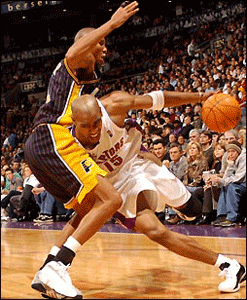
Taking a Charge

Taking an offensive charge is a really big play (RBP) in basketball. It not only takes away a potential basket and creates an offensive turnover but it also assesses the offensive player with an additional penalty of a personal foul. When taking a charge, it is important to try to establish good defensive position by squaring up before the ball handler can get into a shooting motion, preferably outside the three second area. In the case when a blocking foul is called, the ball handler will not receive any free throws (unless in the bonus).

In taking a charge it is very important to eliminate injuries. Players should be taught to absorb contact by executing a shoulder roll. If, the defender remains rigid and does not give on contact, injuries to one or both players are likely to occur. To perform a shoulder roll, on contact, players must first lower their center of gravity by sitting down. Then, roll over using the back of their shoulder, while leaning their head to one side and tucking their chin into their neck. In taking an offensive charge, players should be able to roll over backwards and bounce right back up on their feet using a shoulder roll with either shoulder. Caution: In taking a charge, players should always tuck in their chin and never roll on their neck or head.

By knowing how to properly take a charge, it not only prevents injuries, but, more importantly, players are more likely to take charges during the game.

Basketball Tips & Strategies – November 2008

Quick Tip: Teaching & Learning

Use positive reinforcement and point out successful performances rather than negative ones. Find reasons to praise and encourage rather than condemn. Use constructive criticism when appropriate, but never yell. Have you ever heard of a successful teacher that yells at their students?

Coaching Tips: Why the need for early offense?

The main reason for early offense, accompanied by flow action, is to force the defense to react rather than act! This simply put is to advance the ball quickly into the front court areas and attack before the defense is able to become organized into a disruptive force. As a defensive specialists over the many years of coaching, we have found that the most difficult teams to defend were the ones with offenses that pushed the ball into the front court area in the time span of 3 to 5 seconds. This early offense push creates quick medium jump shots, or penetration lay‐ups, or kick out passes for scores to occur before the defense had a chance to set up and disrupt any organized set play.

We have also found that when teams walked the ball up the court or call out plays, they were much easier to defend because the defense is able to get its players back into positions near the basket were they could execute pressure denials, traps to disrupt the offensive flow and to force rushed shots as time on the clock became a factor. To learn more – Click Here

Coaching Tips: The Importance of Defensive Stops

Defensive Stops are the determining factor of any game. A Defensive Stop is a possession in which the opposing team does not score. Defensive Stops occur as result of offensive turnovers and defensive rebounds. Defensive Stops don’t just happen. They are a product of solid defensive play.

  • Defensive Stops are a key element to all offensive runs. It doesn’t do much good to score, if you don’t keep your opponent from scoring. 14 to 2 and 10 to 0 blitzes are a result of combining defensive stops and scoring.
  • Defensive Stops allow you to play through adversity. Defensive Stops during a game buy you critical time when your offense is performing badly and not scoring. If you should experience a four or five minute scoring drought, Defensive Stops will keep you in the game and minimize the hemorrhaging. Instead of falling behind by double digits, you may only lose 2 or 4 points.
  • Defensive Stops neutralize and erase offensive mistakes. Offensive turnovers or bad shots, no matter how severe, can be simply “erased” or cancelled out just by hustling back on defense and making a defensive stop. The only turnovers that hurt are the ones that the opponent scores after.
  • Defensive Stops are vital after bad calls and offensive charging fouls. A bad call by an official, no matter how bad, can be simply “erased” or cancelled out just by turning up the defensive intensity and making a defensive stop on the ensuing possession. During a game a charge/block foul can be a 50/50 call. Anytime an offensive charge is called, it can be “erased” or neutralized with a defensive stop.
  • Defensive Stops are a must after allowing offensive rebounds. Increasing the defensive intensity and determination and making a defensive stop is crucial after giving up an opponent rebound. Like turnovers, the only opponent offensive rebounds that hurt are the ones that they score after.
  • Defensive Stops are also crucial in catching up at the end of a game. All the scoring in the world will do you little good if you don’t keep the other team from scoring.
  • Defensive Stops are also crucial protecting a hard earned lead at the end of a game. End of game leads can evaporate quickly without defensive stops. The best way to protect the lead is by making defensive stops.

Player Tips: Motor Learning & Conditioning

Basketball skills require active learning. The best way to learn basketball is to practice BASKETBALL. However, to be effective, basketball skills and techniques must be learned and practiced at game speed. Pay attention to detail. Precise execution and footwork are vital. Repetition is a must for motor learning. Motor learning also requires visualization and mental practice.

Motor learning is dependent on physical conditioning. Superior conditioning does not just happen nor is it acquired quickly. It is the result of a well planned and executed program of exercise, rest, and diet. Rest and diet is just as important as exercise. Training is exacting and the responsibility is heavy. What is done off the court is as important as what is done on it. To be successful, each player as well as the team collectively, must be possessed with the desire and determination to develop superior physical condition. Throughout the course of the season the team will be pushed and trained hard. However, it is going to be up to each individual to see that their maximum physical condition is achieved and maintained. Anything less is a violation of a trust. To learn more – Premium Members Click Here

Basketball Tips & Strategies – October 2008

Quick Tip: Teaching & Learning

Whenever possible introduce and demonstrate a skill or drill one day, and then refine it in the ensuing practices. Do not attempt to introduce and refine at the same time. Use positive reinforcement and point out successful performances rather than negative ones.

Motivation is the single most important factor in learning and perfecting basketball skills.

Motivation can be either intrinsic (a self‐curiosity or desire to know) or extrinsic (a definite or must need to know). In basketball, self or intrinsic motivation is the most effective and long lasting. Motivation is definitely enhanced when:

  • the coaching staff possesses a contagious excitement and commitment for the game.
  • the physical and social environments are conducive for learning.
  • the coaching staff encourages and fosters the desire to want to learn and achieve on the part of ALL of the players.
  • the players are surrounded by good people, and poor behavior and distractions are not ignored or tolerated.
  • every player on the team is given definite roles and responsibilities that are incorporated into a total team effort.
  • when it is FUN!

Defense: The Key to Building a Solid Offense

When practicing and refining offense in a half court scrimmage (5‐on‐5) situation, have the defense switch to offense only after making five or six defensive stops (defensive rebounds and turnovers). In requiring 4 or 5 defensive stops to go to offense, it will encourage and motivate the defense to play harder. As a result, by practicing against tough defense, it will definitely help the offense better prepare for actual games.

Player Tips: Hustle and Desire is What Puts Points on the Board

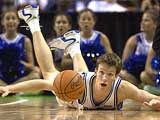
Loose Ball

Many players are under the misconception that they have to be a great shooter or shoot a lot in order to score. Still others are constantly being pressured and influenced into shooting more during a game by parents and/or so called “advisors” and personal trainers. However, in most cases, this selfish advice is given out without regard to a total team effort or to the outcome of the game. In addition, players spend countless hours working on their shooting form and individual moves. However, players should realize that to become a proficient and consistent scorer it only requires hustle, aggressiveness and determination.  To learn more – Click Here