

Subscribe To The Newsletter Now

Subscribe To The HoopTactics Newsletter

Recently @ HoopTactics


Inside HoopTactics

Coaching Liabilities

The Art of Teaching Basketball

What you will discover or recall:

Legal Responsibilities

Liability Laws

12 Ways to protect yourself against lawsuits

Before You Step Onto the Court
Gavel

As a coach, doing what you love to do is awesome and rewarding. However, it can really come back and haunt you if you do not adhere to your legal responsibilities. With the alarming increase in the number of sports lawsuits in recent years, coaches on ALL levels of the game, paid or volunteer, must be acutely aware of the legal ramifications and responsibilities that accompany coaching. These personal liabilities cannot be ignored or avoided. Criminal charges and civic lawsuits, no matter how frivolous and unjustified, are very serious matters that can be devastating and costly, even when they are won or dismissed.

Liability laws have been enacted to protect athletes and to provide for a safe and healthy environment. Legal liability is established through negligent or intentional acts that harm a third party either through omission (not performing an act that is expected to be performed by a prudent person) or by commission (performing an intentional act that results in harm).

Examples of coaches’ personal liability can include: failure to stay within job description, faulty equipment or usage, insufficient supervision, inadequate instruction, failure to act prudently during a medical emergency, failure to report harassment (bullying), hazing or sexual misconduct, failure to supervise volunteers, and improper transportation.

12 Ways to Protect Yourself Against Legal Liabilities

By addressing the following 12 coaching obligations and responsibilities, it will not only help protect you from lawsuits and legal challenges, but it will also insure your players of a wholesome participation and safe environment.

1. Have Personal Liability Insurance

Coaching Liability Insurance

Personal liability can and does result in civil lawsuits, criminal charges, exposed personal assets, loss of careers and reputation damage. Therefore, coaches must have appropriate insurance that covers both public liability and personal accidents. Do NOT go on the court without it. The risks are too great!

Check with your  school/organization or insurance agent to see if they provide personal liability coverage for coaching. If possible, join the coaches’ or teachers’ association. These associations not only provide liability insurance, they also provide legal representation. Make sure that all volunteer coaches are aware of their need for liability insurance.

You will also need personal liability insurance that covers basketball camps, off season (summer) coaching, open gyms and any personal training since schools  require proof of liability insurance for non-school facility usage.

2. Stay within the Job Description following school/district policies and Federal laws.

As a coach, you are acting as an agent of your employer, as long as you stay within the course and scope of your designated and assigned duties. Acting outside of a job description will expose you to personal liability. Do not assume duties, make sure that you have a written contract and/or job description. Also, make sure that your entire coaching staff, paid and volunteer, are aware of their duties and personal liabilities.

3. Warn Participants of Risks

Players must be warned of the risks in playing basketball. Provide a written document warning parents and players of the inherent risks unique to basketball. Obtain a signed acknowledgment of the risk warning document from parent and athlete prior to participation. Be sure to alert and warn players of any changes in equipment, rules, techniques or strategy. Keep a written record of time, place, subject and method of these changes.

4. Require Proof of Physical Exams, Medical Insurance and Treatment Consent

Require proof of physical exams prior to participation. Court decisions have held that coaches have the duty to be aware of all players’ physical fitness, medical conditions, and skill level. Also, require evidence of medical insurance.

Health care providers cannot lawfully render treatment to a patient without consent. When a minor is involved, consent must be obtained from a parent or legal guardian. Having a “consent form” on file not only expedites medical care, but also provides some protection against a parent’s claim that emergency care was not authorized. Consent forms should list any allergies to medications along with specifying who to notify in the event of a medical emergency.

For Printable Emergency Phone Number Form – Click Here

5. Provide Proper Supervision
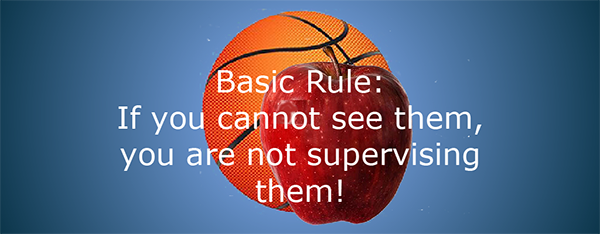
Supervision

Provide proper supervision of players at all times. This includes waiting time prior to practice. As a coach you must also reasonably foresee potential dangers along with watching out for and prohibiting players to practice or play with injuries. Be particularly alert and cautious of players exhibiting any concussion symptoms.

6. Provide Safe Equipment & Facilities

Prior to any practice, game or open gym, make sure the facility is safe. Learn to be cognizant of potential dangers and hazards around the court area at all times. Double check to see that all standards are stowed out of the way, balls remained picked up, water is not on the floor, etc.

Make routine equipment inspections. List and post rules & warnings for equipment usage especially in weight rooms.  Have all equipment installed and repaired by qualified personnel only. Make sure that a first aid kit and supplies including ice or cold packs are available for practices as well as games.

7. Provide Proper Instruction

Coaches must follow the accepted practices for teaching specific basketball skills and techniques. Certain drills and other methods that are standard for basketball instruction should be followed. It is especially important that coaches focus on the more hazardous areas of basketball training, such as proper techniques for taking a charge or diving for loose balls. Coaches must also keep a record of daily practice plans documenting all training activities by time, place, subject and method.

For Printable Daily Practice Form – Click Here

Coaches should constantly update their coaching knowledge and expertise by attending classes, seminars, clinics and through online resources such as HoopTactics. If coaching certification is required, keep it up to date.

8. Follow prudent and approved protocols during an emergency

Medical Emergencies

Coaches are legally responsible for the safety of their players. Unfortunately basketball injuries do occur. Each year, more than 1.6 million basketball-related injuries are treated in hospitals, doctors’ offices, clinics, ambulatory surgery centers and hospital emergency rooms. Therefore, all coaches must be certified in basic first aid and in CPR.

Prior to every practice or game, make sure that you have access to first aid facilities and a means by which to contact emergency services. A first aid kit and supplies including ice or cold packs should also be available at all times. Once an athlete has suffered an severe injury, clearance to return to play must be provided by a doctor in writing. Do not play hurt or injured players.

9. Report Suspected Abuse Immediately

It is the coach’s responsibility, and required by law, to protect players against all forms of abuse. Coaches must be able to recognize indicators that may signify abuse and take appropriate action if concerned.

  • Neglect (inadequate food)
  • Emotional abuse (threats, taunts)
  • Sexual abuse (misconduct, pornography)
  • Physical abuse (trauma or bruising)
Reporting

In addition, coaches have an ethical and legal responsibility to educate their athletes about drug & supplement use and abuse along with providing general nutritional advice. Give players advice and guidance only when appropriate, and never offer any advice beyond your level of qualification and training. Player Confidentiality: Never discuss a player with anyone except parents or school administrators or authorized legal authorities.

10. Follow Transportation Rules

Buses are the safest mode of transportation. If school vans are used make sure that they are not overloaded (maximum capacity of ten) and that drivers are properly licensed and insured. Require players to always return with the team. Never allow a player to return with anyone except a parent. Require a written release with the parent’s signature, if a player is released to their parents rather than traveling back with the team.

If transportation is not provided, let parents know in writing that they will be responsible for transportation. It is highly recommended that coaches do not use their personal vehicles for transporting players to away venues. If you do use your own vehicle, make sure that you are properly insured. Never transport students alone in your car!

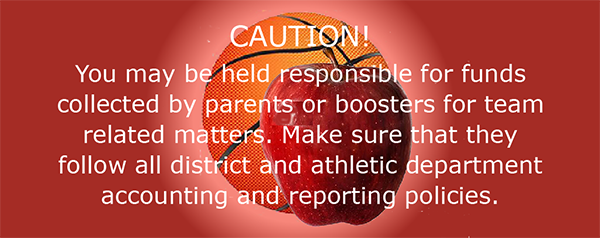
11. Maintain Strict Accountability When Handling Fees and Money

Be extremely cautious when collecting fees and monies. Whenever possible, ask for payments to be made with checks, money orders or credit cards. For any cash payments issue receipts and keep possession of your receipt book for 5 years. Always have a witness when counting cash. Do not store cash. Deposit it immediately using the proper channels and obtain a receipt.

Only purchase team items that have prior administration approval and signed requisition. Use school/team funds, credit cards or purchase orders for team expenditures only. Never use them for personal items. If you receive advance funds, be sure to save and turn in all receipts for record keeping.

Do not ever open a personal basketball bank account or deal in petty cash unless you are running your own basketball camp, tournament or personal training and have a business license.
12. Keep Written Records

Keeping written records is a must. Being right is not enough. Coaches and their designees have to prove it. Be sure to keep a file of the following records:

  • Proof of certification and First Aid/CPR training.
  • Player Physical Exams
  • Signed Warning of Risks Document
  • Eligibility Information
  • Written Practice Plans
  • Written Emergency Action Plan
  • Copies of all Injury and Accident Forms
    Parent/Guardian Consent forms
  • Written doctor’s return to play clearances
  • Alternate transportation permission slips
  • All Financial Collections & Transactions.

It is highly recommended that you keep files for at least five to seven years since many lawsuits do not occur until years after the fact.

Five Stars

_____________________

Coming Next:

Major Medical Emergencies

_____________________

Art of Teaching Basketball Series
#1Coaching, Life Skills, Keys to SuccessTap Here to View
#2Legal LiabilitiesTap Here to View
#3Major Medical EmergenciesTap Here to View
#4Motivation & LearningTap Here to View
#5Different Learning StylesTap Here to View
#6Motor Skill LearningTap Here to View
#7Game of HabitsTap Here to View
#8Changing Bad Habits8/18/2020
#9Goal Setting & Season Review8/25/2020

_____________________

Coaching, Life Skills, & Keys to Success

The Art of Teaching Basketball

What you will discover or recall:

Coaching Today

Teaching of Life Skills

Keys to Successful Coaching

Coaching Today

In recent years, winning has become the primary focus in sports. This is even true on the collegiate and high school levels where the emphasis should be on education and learning. Coaches and programs are being evaluated by the number of games won rather than their program model and teaching abilities. Unfortunately, along with this increased importance being placed on winning, there has been a significant slippage in coaches’ teaching skills and abilities.

During the “Off” season, organized full court games and tournaments have replaced skill building. These are mostly unregulated and lucrative endeavors with no required coaches’ training or certification. Participation in these programs require exorbitant financial burdens. This year around competition also leads to player burn out and injuries.

With the addition of women’s sports, the demand for facility usage has resulted in reduced court time for adequate instruction and practice. In the past, coaches had more time for detailed explanations on the “How’s” of skills and techniques along with “When‘s” and “Why’s.” They also had the luxury of working with players before and after practices.

Teaching Lasts Forever

Teaching of Life Skills

In the past basketball was mainly a school activity. Athletics were originally adopted by schools not to teach shooting, passing, and dribbling, etc. but rather life skills such as teamwork, dependability, reliability, hard work, playing through adversity, physical conditioning, etc. Coaches were full time certified teachers with athletics being extracurricular activities. Teaching and physical education degrees required four years of training and an additional year for certification. They were trained in physiology of exercise, human anatomy, kinesiology, biomechanics & motor learning, prevention & care of Injuries, along with educational classes, such as the laws of learning, teaching methods, public speaking, psychology, media & technology, and student teaching.

Today anyone can coach. Currently, many school districts are now entrusting their basketball programs to off campus coaches, most of which are untrained. On the youth level, programs are desperate for trained coaches. Being a coach carries awesome power and responsibility. Before you step onto the court, be sure that you understand the ramifications of the responsibilities and liabilities that go along with coaching.

Like players, coaches never stop learning. To be successful, coaches must be self-motivated and rely entirely on themselves when it comes to developing and improving their coaching skills and techniques. Coaching, like fine wine, takes time and effort. It does not come over night. Coaches must have patience since it takes hours, days and years to become a very proficient coach. However, the satisfaction in helping their players become their best they are capable, “On and Off” the court is priceless.

Coaching Demeanor

Players influenced by what coaches do not say

A coach’s appearance and demeanor sets the tone for a conducive, learning environment. Therefore, it is important that all coaches dress appropriately for practice, be fully aware of the importance of positive body language, and earn the respect of all your players by being reliable, consistent and fair.

 A coach must be well organized and prepared along with being early to all games and practices. All practices should be well planned and executed. Yet, be flexible and ready to improvise. Sometimes even the best of well laid out plans can go awry or get disrupted.

As a coach you must have patience. Players, on all levels of the game are going to miss shots, make crucial turnovers, and commit needless fouls. They need the freedom to make mistakes. It’s the coach’s job to help players learn from those mistakes. That takes time and patience.

Communication

It’s not enough to know your subject, you must also be aware of your player audience. Coaches must be good at explaining things. Terminology is the only thing in the game of basketball that changes over time. Since players receive instruction from a variety of sources, it is very important that the entire coaching staff use the same offensive and defensive terms.

Communicate by keeping it simple. Talk to your players’ level. Clarify rather than confuse. Go beyond just the HOW’s, and teach the WHEN’s & WHY’s of various basketball skills and techniques. Tell them what you are going to teach them, then teach them, and finally, tell them what you taught them.

Be sure to teach your players to listen. It is imperative that any time a coach talks everyone listens (including assistant coaches). Demand and get eye contact of all players prior to speaking. Use positive reinforcement and point out successful performances rather than negative ones.

Use constructive criticism when appropriate, but never yell. Have you ever heard of a teacher yelling at their students? Be a role model and never use profanity. Educated people can express themselves very clearly without the use of profanity.

Fostering a Team Atmosphere

No "I" in word team

On every level of basketball, one of the most important aspects of coaching is creating and fostering a total team atmosphere and commitment. It is the difference between success and failure. Insure your players that they are going to play in a team atmosphere. Inform them that you are not going to tolerate anyone on the team that keeps others from learning, you from coaching, or any other misbehavior. Great teams are a result of their best players being the hardest workers. No one steps on the floor without a full hustle attitude. Insist on a team effort at all times.

Persistence

Human Relations We & Me

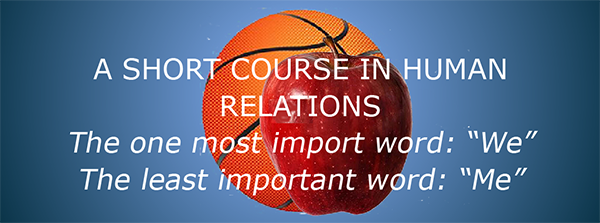
Changing a “Me” to a “We” attitude is a real challenge in coaching, and is of the utmost importance to success. There is an old adage that is often times quoted: “Great teams play hard, play smart and play together.” However, there is one other very important ingredient that is missing and that is “persistence.”

Persistence is what enables players and teams to reach their full potential and goals. It is what separates the great ones from the mediocre ones. Most teams can play hard, play smart, and together for short periods of time. However, to be successful, they must be able to sustain this high level of effort over the course of the entire season which is no easy task.

Demand “Best Efforts” at All Times

Habits do not change in a game. Never tolerate or ignore a player’s laid-back or apathetic attitude and efforts. All great players have one thing in common, they have great work ethics and will not be outworked by anyone. They pay attention to detail. Too much attention and recognition is paid to records and accomplishments, and not enough to the long, hard, hours, days, and years great players put into developing and refining their skills and techniques that make them so successful. In tolerating or ignoring a lack of effort and selfishness, coaches are not only cheating the team, but just as importantly, they are cheating the player and depriving them of any future opportunity to play on a higher level of the game.

Team Leadership

Every team needs at least one leader – a coach on the floor. One that plays with intelligence and poise. They sacrifice and surrender “me” to “we.” This unselfish play makes their teammates better. Leaders play in the future constantly anticipating ahead of the current action. As a result, the game is actually played in slow motion to them. In thinking ahead, their heads are always in the game, which allows them to play through adversity. They rarely get upset or loose their poise.

On the other hand, players playing in the present, or worst yet, playing in the past, such as arguing about a bad call or being upset about a teammates turnover, the game becomes more difficult and actually speeds up dramatically as they lag behind and attempt to catch up with the action.

Coach prior to, not during a game

Establish Significant Player Roles

Guarantee players that they will receive equal opportunities, but not equal playing time. Develop and establish significant roles and assignments for every player on the squad such as 6th Person, Defensive Stopper, Designated Inbounder, etc. Championships are never achieved without the unselfish play of the complementors on the team. These supporting roles, which are vital to a total team effort, must be constantly acknowledged and reinforced by the entire coaching staff throughout the season.

To learn more about vital player roles – Click Here

Real Competitors are Vital to a Team Effort

Real competitors are those special players that come to play every time they step on the court. They are a team’s hardest workers constantly battling and competing. They are not the type that scream at their teammates or officials or kick trash cans after the game. Instead, they dive for loose balls, take charges, fight for rebounds, etc. They just plain enjoy playing and never give up. Competitors are those players that players love to play with not against, spectators love to watch, and coaches love to coach. You cannot win without them.

To learn more about “Real Competitors” – Click Here

Have Fun

The real success in coaching comes with teaching and assisting players to become the best they are capable of becoming “On” and “Off” the court. Too many players are having bad experiences with coaches. Please make sure that the time that ALL of your players spend with you is a very rewarding and positive experience.

Five Stars

_____________________

Coming Next:

Legal Liabilities

_____________________

Art of Teaching Basketball Series
#1Coaching, Life Skills, Keys to SuccessTap Here to View
#2Legal LiabilitiesTap Here to View
#3Major Medical EmergenciesTap Here to View
#4MotivationTap Here to View
#5Player Learning StylesTap Here to View
#6Motor Skill LearningTap Here to View
#7Game of HabitsTap Here to View
#8Changing Bad HabitsTap Here to View
#9Goal Setting & Season Review8/25/2020

_____________________

March 4, 2020

Nightmares to Avoid
End of Game/Season Failures

Wining Close Games & Championships

To win a major championship, you probably will have to win a least two games at the buzzer!

15 Nightmares to Avoid That Will Upset Your Championship Dreams & Haunt You the Rest of Your Life.

1. Not protecting a hard earned lead

 When ahead late in the game the game clock becomes your ally. However, you must use it wisely. Keep it running and do not stop it (unless in very serious trouble). Coaches may elect to spread the court on offense to take time off the clock and cut down on the number of opponent’s offensive possessions. However, in doing so, be sure to continue to make basket cuts and attack the basket. Holding the ball for the sake of trying to run time off the clock will allow the defense to get more aggressive and disruptive. You must attack the basket. If the opponent tries to trap or double team, assume a 2-1-2 alignment and move the ball.

Learn More: Spread Offenses – Click Here

2. Watching the ball and not boxing out on a last shot

On last shot situations, more games are won on putbacks than on made shots. Therefore, on last shot situations, it is imperative that all defenders aggressively box out and prevent any offensive rebound instead of watching the flight of the ball to see if it is going to be made or not.

Learn more: Defensive Rebounding – Click Here

3. Giving up an offensive rebound on a missed free throw

Defensively, teams should work hard to never give up an offensive rebound off a missed free throw situation during a game. Many of championships are lost because of a failure to box out on free throws. Players should be well drilled in boxing out on all free throw situations. Players must also communicate to make sure that the shooter is boxed out. Pinch or double team against a really good offensive rebounder. Be determined to rebound the ball.

To Learn More About Blocking Out on Free Throws – Click Here

4. Allowing precious time to run off the clock before fouling

Hopefully, you are well prepared and in control of the game so that you will not need to resort to clock management. However, if you ever fall behind late in the game don’t give up! By using time outs and fouls, the last few minutes of a game can be an eternity. At this point in the game, the clock is your worst enemy, not the opponents, so every second counts. Therefore, do not let precious time run off the clock before fouling. If you need to foul, foul right away.

To Learn More About When to foul – Click Here

5. Not substituting for key players in must foul situations

When fouling to the stop the clock at the end of the game, during a timeout or free throw or defensive out of bounds situation, substitute players into the game that can afford to foul instead of losing their best players because of disqualification. Also, key players in foul trouble are reluctant to foul, allowing precious time to run off the game clock.  Once a foul has been committed, stopping the clock, players in foul trouble can be reinserted back into the game.

To Learn More About Making Sound Substitutions – Click Here

6. Not teaching and practicing how to foul

Most coaches assume players know how to foul. However, in reality, when a coach tell the players to foul, they will simply go out and just push or grab an opponent resulting in an intentional foul. Since the opponent gets to shoot free throws and retains ball possession, this is disastrous.

CAUTION: There is no room in the game of basketball for hard fouls (even in the NBA) especially on lay ups when shooters are most vulnerable to injury. Play hard but play fair. Basketball carries more than enough injury risk without a player intentionally or unintentionally injuring another player when fouling.

To Learn more about Knowing How to Foul – Click Here

7. Fouling a shooter

Eliminate the three point play. Giving up a three point play by fouling a player in the act of shooting is a RBP (Really Big Play). Instead of fouling a shooter and giving up a three point play, it is better to just concede the shot and let them score. All you have to do is to score on the next possession to “erase” or cancel it. However, if you foul the shooter and give up a three point play, you will then have to not only score on your next possession, but also come up with a defensive stop and score a second time to erase or cancel it.

8. Not saving timeouts

Save your timeouts. You will need at least two at the end of a closely fought game. Force the opponent to use their time outs especially early in the game. Early in the game, use substitutes to make changes and adjustments rather than taking a valuable time out. Play through adversity. Do not ever call a timeout in reaction or frustration to bad call or play. It will only waste one of your valuable time outs! Having time outs at the end of the game will definitely increase your chances of winning.

9. Not knowing the time out situation

Coming out of time outs, make sure every player must knows the number of time outs remaining along with the team foul situation. This is extremely important at the end of a close game. Games and national titles have been lost by players taking a timeout after a team has used their last timeout.

To Learn More About Using Your Timeouts Wisely – Click Here

10. Not knowing and taking advantage of the team foul situation

All too often games are lost on last second shots because a players are unaware that they had a foul(s) to give. After timeouts all players should be aware of the team foul situation and if they have any fouls to give. Keeping an opponent out of the bonus free throw situation is a real advantage.

11. Not avoiding the opponent’s intentional foul

Do not allow the opponent to foul in order to stop the clock. Move the ball and run as much precious time off the clock as possible  before the opponent can foul. Also, be sure to have your best free throw shooters in the game.

12. Not prepared for intentionally missing a free throw

Chances are good that an end of game situation will be encountered that requires intentionally missing of a free throw. Therefore, teams must be prepared for it. Intentionally missing a free throw must be taught and practiced. Players must recognize and know what their assignments are on an “intentionally” missed free throw situation. Shooters must not only practice the intentional miss, they also need to be aware of the rule that the ball must hit the rim on the attempt.

13. Not prepared for last shot situations

End of game situations really become paramount when a single shot can make the difference of winning and losing along with determining a team’s playoff hopes and fate. Therefore, to be successful, teams must be prepare for last shot situations. A last shot situation is not just a simple matter of drawing up a play. There are numerous last shot situations to address dependent on court location and time on the clock. Be sure to get the ball into the hands of your best player, and let them hit the open shot or pass to an open teammate. Keep the play simple and execute. The more complex the action, the greater chance that a breakdown will occur.

CAUTION: Don’t ever expect players to execute anything they have not practiced. The chances of drawing up a last shot play during a timeout and having it be successful is very minimal.

14. Taking the last shot too soon

Taking the last shot too soon, even if it is made, provides the opponent with an opportunity to tie or win the game. When holding for the last shot in a game, players should be in position with 10 seconds and initate the play with 8 seconds remaining. This will allow enough time to take the shot and go to the offensive boards for a second effort. If the opponent should rebound, they will not have enough time to advanced the ball down the court for a shot.

To Learn More about Last Shot Strategies – Click Here

15. Failure to inbound the ball

Good inbounds passers are vital, and a team will not win a championship without one. Many championships have been lost because teams were not able to inbound ball at end of game. It is not easy to inbound the ball under pressure. In making an inbounds pass, the passer is facing a five against four defensive advantage and only has five (5) seconds in which to locate a receiver and make a successful inbounds pass. In addition, to this numerical disadvantage, by rule the inbounder cannot move, except after a made shot. This provides the defense with the opportunity to jam or smother the passer very effectively with an active defender on ball. Also, on baseline out of bound situations, the backboard comes into play and becomes a real obstacle with which the inbounds passer has to contend.

Learn More About Inbounding the Ball Under Pressure – Click Here

Five Stars

End of Game/Season Failures

Don’t let the results of a single game spoil a season of accomplishments.

A tough, season ending lost, where a single bad play or bad call made the difference of winning or losing, can be a very harrowing and devastating experience. Although a lost of an important game is certainly disappointing and frustrating, it should not be catastrophic.

Comforting and Consoling Players

Devasting Lost

If not appropriately addressed, end of game failures can result in severe traumatic, lifelong emotion injuries. Therefore, it is imperative that coaches understand the importance of comforting, consoling, and restoring a player’s confidence making sure that the player realizes that failure can be a good learning experience for things to come, not the end of the world.

A great example of a coach’s recognition and appropriate response to a potentially devastating situation occurred in the North Carolina/Georgetown NCAA Championship game in 1982. In the final seconds of the game, Georgetown lost a golden opportunity to win the game and NCAA championship, when Georgetown player, Fred Brown, mistakenly passed the ball to James Worthy of North Carolina. Immediately at the conclusion of the game, Georgetown’s coach, John Thompson, went out onto the court put his arms around Fred and comforted and consoled him.

This is what coaching is all about!

It is all about the players not the coach or the coach’s record. As long as players give their best effort, they will be the real winners regardless of the score. In every post-season tournament and play-offs, there is only one happy team.

February 4, 2020

Inbounding the Ball Under Pressure

Vital Importance, Under Pressure, Techniques & Principles, Receiving, Rules, Knowledge Quiz

Many of big games and championships have been lost because teams were not able to inbound ball at end of game. It is not easy to inbound ball, especially at the end of a game when the outcome depends on it. Players on all levels, including the professional ranks, need to know and practice the fundamental skills and techniques required in making a successful inbound pass.

Do not take inbounding the ball for granted

Most coaches and players take making an inbounds pass for granted, and rely on individual player skill to get the job done. However, in making an inbounds pass, the passer is facing a five against four defensive advantage and only has five (5) seconds in which to locate a receiver and make a successful inbounds pass. In addition, to this numerical disadvantage, by rule the inbounder cannot move, except after a made shot. This provides the defense with the opportunity to jam or smother the passer very effectively with an active defender on ball. Also, on baseline and endline out of bound situations, the backboard comes into play and becomes a real obstacle in which that the inbounds passer has to contend.

Good inbounders are vital, and a team will not win a championship without one.

Inbounding the Ball

 Good inbound passers are hard to find. They must be developed & nourished. In additional to the physical skills involved, good inbound passers must posssess a strong commitment to team play since they are taken for granted and very rarely acknowledge for the efforts.

Note: Guy Lewis, who led the University of Houston to five final fours, thought that inbounding the ball was so important that he employed a designated inbounder. Every time Houston was awarded the ball out of bounds, the designated inbounder would enter the game and then leave on the next dead ball.

Techniques and Principles

  1. Inbounder must wait for teammates to be aligned and ready before stepping out of bounds.
  2. Call out of bounds plays prior to stepping out of bounds and receiving the ball from the official. Establish eye contact, and echo the call.
  3. See the floor prior to obtaining the ball. Circle to the official (or ball after a made basket) viewing entire court. Never step out of bounds to inbound the ball with back to the court. This is especially true after an opponent’s successful layup on a breakaway.
  4. Anticipate, read and attack any defensive overplays and errors. If defense switches on a screen look for the screener rolling to be open.
  5. Use sharp, crisp passes. No careless, one-handed or soft bounce passes.
  6. Avoid inbounding the ball into a corner (trap zone) unless an open shot is immediately available.
  7. Pass the ball through, not over, the defender pressuring the inbounds pass. If the defender’s hands are up. Fake high and pass under their arm pits. If the defender’s hands are down, fake down and pass the ball close to their ear.
  8. Be sure to step inbounds after inbounding the ball. Create a lead for return pass, establish offensive rebounding position or maintain defensive balance.
  9. AUTOMATIC: Whenever unguarded, execute a “Give & Go” cut. Inbound the ball and receive the ball back on a basket cut.
  10. AUTOMATIC: When the defender guarding the out of bounds pass turns their back to the passer,  the inbounds passer can pass to themselves by throwing the ball off the opponent, stepping inbounds, and retrieving it. This can catch the defense completely by surprise and create an easy shot.

CAUTION: When in trouble throw ball out of bounds off an opponent’s leg or take the five (5) second inbounds violation rather than throw the ball away. When the ball is turned over on the inbounds pass, it immediately creates a five-on-four offensive advantage. However, by taking the five (5) second count, it will allow a team to get set on defense and have better than 60% chance of making a defensive stop.

Executing Long Passes

To be successful, the basic technique of throwing and leading receivers with long baseball passes must be taught and practiced regularly.

Inbounding the Ball Full Court

  1. When inbounding the ball, make as deep as an inbounds pass as the defense will allow. This will cut down the time and distance needed to advance the basketball and attack the defense.
  2. Whenever possible, inbound the ball to a player in motion.
  3. When taking the ball out of bounds after a made basket or free throw, take the ball out on one side of the backboard to avoid striking it on long passes.
  4. Never throw a pass directly to a receiver moving away. Since the receiver will be looking back at the ball, the defender can easily establish defensive position resulting in leading the receiver into offensive foul or traveling violation.
  5. On long passes, always lead the receiver to the “Elbow” eliminating the need of dribbling which allows defenders to catch up. If the pass is thrown too far out in front of the receiver, when it hits the floor, because of the back spin, it will bounce straight up allowing the receiver to catch up and gain possession rather than skipping out of bounds.
  6. Employ an “Over the Top” baseball pass or a hook pass. A high arching pass will not only allow the defense to recover, but it also may hit an obstruction hanging down from the ceiling such as the scoreboard or speaker.

Proven Full Court Out of Bounds Plays: Click Here

Successfully Receiving an Inbounds Pass

Inbounding the ball requires timing and execution on the part of both the passer and receiver. Timing is crucial. Creating a lead is of little value, if it is too early or too late.

Five basic techniques for getting open to receive an inbounds pass: Click Here

Coaching Tip: Press Break

Basketball is a game of habits. When scrimmaging full court in practice, when taking the ball out of bounds after a made basket or free throw the offensive team should execute their press break at all times whether the defense is pressing or not. This will result in the team being prepared and conditioned for presses and eliminate ever getting surprise by an opponent press.

All Players Must Know the Rules

Do not take rule knowledge for granted. A player’s lack of rule knowledge cannot only result in a loss of ball possession, but can also cost you a game.

  1. On a throw-in the ball must leave the inbounders hands within five seconds from the time the throw-in starts.
  2. For a timeout to be granted during the throw-in, it must be requested before the five second count elapses. Make sure all players know how many time outs they have left in the game.
  3. Except after a made shot, the inbounder is allowed one step in either direction from the designated throw-in spot.
  4. After a made shot, the inbounder can run along the baseline prior to making an inbounds pass.
  5. On the throw-in after a made basket, you do not lose right to run baseline because of an infraction by defense. If the ball is kicked by a defender, the inbounds passer can still run the baseline on subsequent throw-in.
  6. The inbounder cannot touch the ball until it has been touched by another player.
  7. If the defender plays with their back to inbounder, the inbounder can toss the ball off the defender’s back as long as, they must step inbounds prior to picking up the ball and shooting.
  8. Cannot not change the inbounder once an official has designated player for throw-in.
  9. From the front court, an inbounder can safely pass the ball into the back court without an over and back violation being called.
  10. Inbounder cannot throw ball over the backboard or directly into the basket.  Note: Prior to rule change, teams with a tall player could simply lob the ball over the basket. Coaches would use their creative ingenuity, including hanging chicken wire down from the ceiling behind the basket, to stop out of bounds lob plays.
  11. After a made basket, if ungarded, the inbounder can pass to a teammate stepping out of bounds on the baseline and receive a pass back after stepping inbounds.
  12. If the defender reaches over the out of bounds vertical plane and touches the ball while in the hands of the inbounder or is in the air behind the vertical plane, it is a technical foul.
  13. When the inbounds pass goes directly out of bounds, it comes back to the original throw-in spot rather than where it goes out of bounds.
  14. When a timeout is called immediately following a made basket, on the subsequent throw-in the inbounder can still move along the baseline.

Test Your Players’ Out of Bounds Rule Knowledge

HoopTactics’ Self-Quiz (Printable) – Click Here

Give this self -test to your players. Don’t assume that they know the rules. Use the results as a team evaluation. Go over any question(s) missed by multiple players making sure that all players understand the rule. In taking a few minutes to test your players’ rule knowledge, it may save and even win a game or two.

CAUTION: Do not ever expect your players to execute anything during a game that you have not covered in practice.